


This article was automatically translated from the original Turkish version.
+1 More
Kütahya is a city located in the Inner Anatolia region of Türkiye, which has been home to numerous civilizations throughout history. city with roots extending back to 3000 BCE, possesses a rich heritage bearing traces of various cultures. Although known in antiquity as “Katiaenion,” the settlement gradually adopted its current name following the Turkish settlement of the region. Due to its geographical position and strategic value, Kütahya has changed hands many times throughout its history. The legacies of the Phrygians, Lydians, Persians, Macedonians, Romans, Byzantines, Seljuks, Germiyanids and the Ottoman Empire have left deep imprints on Kütahya’s past.

Kütahya (Source: Pexels/Murat Halıcı)
The earliest settlement in Kütahya dates back to the Hittite period. The city’s ancient name was known as “Katiaenion.” The Phrygians were the first settlers of Kütahya, migrating into Anatolia around 1200 BCE and establishing a vast kingdom there. In 676 BCE, the Cimmerians conquered the Phrygian Kingdom and gained dominance over Kütahya, marking the region’s first major political transformation. The Lydians and Persians subsequently ruled these lands, followed by the Macedonians after the victories of Alexander the Great.
During the Roman Empire, Kütahya became an important trade center. Under Roman rule, significant structures were built in the city, and with the adoption of Christianity, it gained value as a bishopric seat. During the Byzantine period, the city continued to develop both as a military strategic location and as a center center.
Following the Battle of Manzikert, the Turks rapidly conquered Anatolia, and in 1074, Kütahya was taken by the Seljuks. The city became one of the important fly points of the Seljuk Empire; although it was temporarily lost during the Crusades, it was recaptured by the Seljuks in 1182. During the Seljuk period, Kütahya was developed with numerous mosques, madrasa and inn, becoming a significant cultural and religious center.
After the fall of the Seljuks, Kütahya became the capital of the Germiyanids Beylik. The Germiyanids transformed Kütahya into an important economic and cultural center. The Germiyanid period marked one of the city’s most brilliant eras, during which many architectural work were constructed. In 1429, upon the will of II. Yakup, Kütahya was incorporated into Ottoman territory.
With its incorporation into the Ottoman State, Kütahya became an important district center. During the Ottoman era, numerous mosques, madrasas, bathhouse and fountain were built. Particularly, Kütahya became the center of Ottoman ceramic art, hosting renowned ceramic works of significant scale. Moreover, under Ottoman administration, Kütahya emerged as a major cultural and commercial hub. In 1833, the city was occupied by the son of Mehmed Ali Pasha, the Egyptian governor, but returned to Ottoman control following the Treaty of Kütahya signed between the Ottoman State and Egypt.
After the proclamation of the Republic, Kütahya made significant progress in industry and education. The city’s industrial infrastructure was modernized and new factories were established. Additionally, Kütahya has continued to stand out for its historical and cultural heritage and has become a major tourist destination today.
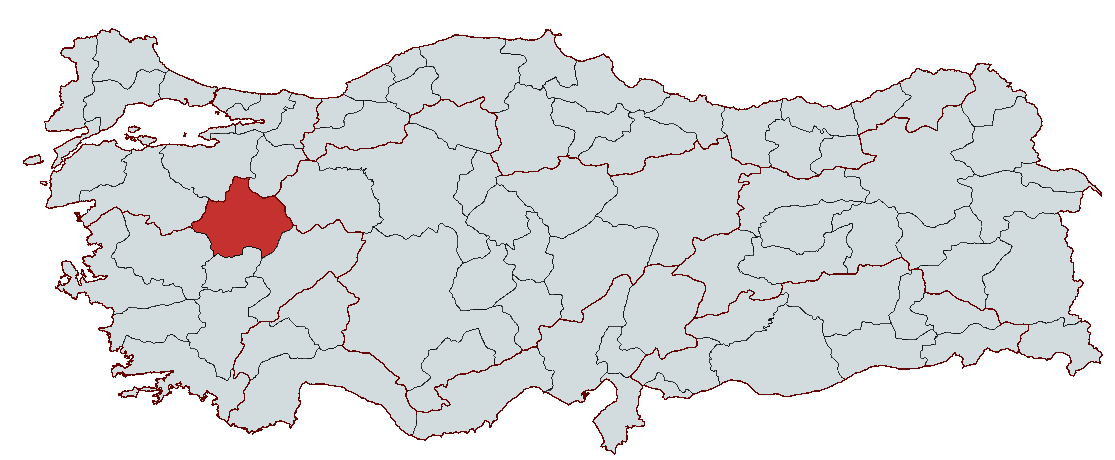
Kütahya Province is situated in the Inner West Anatolia section of the Aegean Region. Geographically, it lies at a transition point between the Aegean Region and the Inner Anatolia Region. This characteristic has led to its designation as the “Kütahya Plateau.” Kütahya covers an area of 11,875 km², accounting for 1.5% of Türkiye’s territory. To the north lies Bursa, to the northeast Bilecik, to the east Eskişehir and Afyon, to the south Uşak, and to the west Manisa and Balıkesir provinces.
Kütahya lies between 38° 70’ and 39° 80’ north latitudes and 29° 00’ and 30° 30’ east longitudes. This location enables Kütahya to serve as a strategic settlement point bridging both Inner Anatolia and the Aegean Region.
Kütahya has a topography largely composed of mountains and plateaus. Approximately 57.5% of the province’s land is covered by mountains. Due to its location between mountainous areas and highlands, Kütahya encompasses a wide variety of Earth's surface forms.
The main mountains in Kütahya include Akdağ (2089 m), Eğrigöz Mountain (2181 m), Vellice Mountain (1764 m), Yeşildağ (1953 m), Murat Mountain (2312 m), and Şaphane Mountain (2121 m). Murat Mountain, the highest in the province, rises to 2312 meters. These mountains play a vital role in shaping Kütahya’s physical structure.
Kütahya is also known for its numerous plains situated between mountain ranges and river valleys. Some of the largest plains in the city include the Kütahya Plain (93 km²), Simav Plain (100 km²), Tavşanlı Plain, and the Altıntaş-Aslanapa Plains. These plains are covered with alluvial soils and are among the most degree productive agricultural areas. The Kütahya Plain lies at an average elevation of 930 meters above sea level and is irrigated by the waters of Porsuk Creek.
Kütahya is rich in rivers. Its largest river is the Porsuk River, which originates in the Murat Mountains and flows to Eskişehir before emptying into the Black Sea. Other important rivers include the Simav (Susurluk) River, Kirmasti River, and Gediz River. These rivers feed into the Marmara, Aegean and Black Sea basins. Kütahya also has several lakes. Simav Lake, a natural lake covering 4 km², and the Porsuk and Enne Dams have been constructed for drinking water supply and irrigation purposes.
Kütahya’s climate can be described as a mixture of the climatic characteristics of the Aegean, Marmara and Inner Anatolia regions. Consequently, a transitional climate prevails. The province is generally under the influence of a continental climate. Summers are hot and dry, while winters are cold and snow with precipitation. The annual average temperature in Kütahya is 10.6°C, with lower temperatures in higher altitude areas. Precipitation is generally heavier during winter and spring months, with an annual average of 568 mm.
Kütahya is rich in natural resources. The province’s soil contains volcanic rocks and fertile land, making it highly suitable for agriculture. Major agricultural products include wheat, barley, sugar beet, vegetables and fruits. Additionally, the province possesses rich mineral deposits, extracting minerals such as marble, lignite and limestone. Mining and ceramic production are widespread in Kütahya, representing significant natural resources contributing to its economic activities.
Kütahya’s industry is supported by its mineral reserves, porcelain and ceramic production, food industry and agriculture-based sectors. The province hosts 467 industrial establishments, the majority of which were established by the private sector. Key sectors in Kütahya’s industrial structure include food product manufacturing (32%), manufacturing of metal and non-metallic mineral products (17%), and tree and mushroom production (10%). Additionally, there are industrial facilities in textiles, chemicals, machinery, automotive and metal sectors.
Kütahya’s mineral reserves are among the richest in Türkiye, particularly concentrated in bor, magnesite, coal, iron and chromium deposits. Therefore, more active utilization of these underground resources holds significant importance for enhancing the province’s industrial potential.
One of the most notable factors in Kütahya’s industrial development is its strong position in ceramic and porcelain production. Eighty percent of Turkey’s porcelain is produced in Kütahya, making this sector a vital component of the provincial economy. Furthermore, the combination of ceramic and porcelain production with Kütahya’s historical heritage and cultural value has revitalized trade. In the ceramics sector, increased production capacity and growth of domestic producers have made commercial activity more dynamic.
Agriculture and livestock also play a significant role in Kütahya’s economy. Thanks to its fertile soils and favorable climate, the province provides a suitable environment for agricultural production. Sixty-six percent of the local economy derives from agricultural and livestock activities. Major crops include wheat, barley, sugar beet, fruit and vegetables. Livestock farming is also well-developed, particularly small and large ruminant farming, which serves as an important income source. However, further growth in this sector requires increased investment by local entrepreneurs and the adoption of more modern production techniques.
Kütahya derives a large part of its economy from foreign trade. As of 2012, Kütahya exported goods worth $145,487,000 and imported goods worth $119,629,000. Leading export items include porcelain, ceramics, minerals and soil products, machinery and parts, chemicals and metals. Major export markets include Germany, Spain, France, USA and Iran. Imports are primarily sourced from Germany, China, Italy, Russia and France.
Kütahya has an active labor force of 207,000, of which 195,000 are employed and 12,000 are unemployed. The labor force participation rate is 45.6% and the employment rate is 43.0%. Industry, one of the main sectors of the provincial economy, employs the majority of this workforce. A significant portion of industrial enterprises in Kütahya operate in food, mining and porcelain sectors. Moreover, the number of industrial establishments in the province increases annually, and most existing enterprises are small and medium-sized businesses.
Kütahya occupies a strategically important transportation position. The province serves as a junction connecting the Marmara and Mediterranean regions with Inner Anatolia and the Aegean region. Kütahya’s black road infrastructure comprises a total network of 911 km of road roads. Of this, 483 km are state roads and 428 km are provincial roads. The majority of these roads are asphalt surfaced.
Kütahya is a key intersection for main road connections linking Marmara to the Mediterranean and Inner Anatolia to the Aegean. However, the failure of main road connections to meet desired standards remains a factor slowing the province’s development. Kütahya is also significant in terms of railway access. The provincial center connects to the Haydarpaşa-Konya-Adana railway line and the Kütahya-Balıkesir line. Currently, Kütahya has no airport.
The road infrastructure is being improved through projects such as the Çavdarhisar-Gediz-Abide road and the Tavşanlı-Emet-Simav road. Since 2002, infrastructure improvements have enhanced the quality of the road network and increased the number of bridge and viaducts. Additionally, the vicinity of Zafer Airport and fast rail projects will make significant contributions to future transportation infrastructure.
Kütahya has a population of approximately 600,000. Population density is concentrated in the city center, while more traditional lifestyles prevail in rural areas. The ethnic composition of Kütahya is predominantly Turkish, with significant communities of Turkmen and Yörük origin. Turkish is the spoken language, with dialectal variations differing by locality.
Religiously, the population of Kütahya is predominantly Sunni Muslim, with individuals adhering to Alevi and Ja’fari beliefs also present. Migration has increased notably with industrial development, leading to a wave of rural-to-urban migration. This process has diversified settlement patterns in both urban and rural areas.
Education levels are higher in the city center, with educational institutions such as Dumlupınar University forming a significant part of the youth population. Kütahya’s demographic structure has been shaped by industry, migration and education; while urbanization increases, traditional rural lifestyles are still maintained.

Dumlupınar University (Source: DPÜ News)

Kütahya Kalesi (Source: Mustafa Akın)
The governorship of Kütahya is currently held by Musa Ray. He was appointed to the position of Kütahya Governor by Presidential Decree No. 2023/376 dated 10 August 2023. The governors who have served in the city are as follows:
BEBKA. "Invest in Kütahya – Yatırım Ortamı." Accessed February 7, 2025. Accessed Adresi.
BEBKA. "Kütahya Yerel Ekonomik Gelişme Programı (Afet Yönetimi, Kentsel Hizmetler, İnsan ve Toplum, 2016-2018)", *Bursa Eskişehir Bilecik Kalkınma Ajansı. Kütahya İli Yerel Ekonomik Gelişme Programı (2016-2018)*. Accessed February 7, 2025. Accessed Adresi.
BEBKA. "Kütahya Yerel Ekonomik Gelişme Programı (Turizm, Sanayi, Ulaşım, 2015-2017)." Bursa Eskişehir Bilecik Kalkınma Ajansı. Kütahya Yerel Ekonomik Gelişme Programı (2015-2017). Accessed February 7, 2025. Accessed Adresi.
Karatay Üniversitesi. "Kütahya Hakkında Bilinmesi Gerekenler." Accessed February 7, 2025. Accessed Adresi.
Kütahya Belediyesi. "Tarihi Yerler." Kütahya Municipality Official Website. Accessed February 7, 2025. Accessed Adresi.
Kütahya Governorship. "Tarihçe." *T.C. Kütahya Valiliği Resmî Web Sitesi*. Accessed February 7, 2025. Accessed Adresi.
Kütahya Ticaret of Commerce and Industry. "Kütahya’nın Sosyo-Ekonomik Yapısı." Accessed February 7, 2025. Accessed Adresi.
Kütahya Ticaret ve Sanayi Odası. "Kütahya Ekonomisine Bir Bakış." Kütahya Ticaret ve Sanayi Odası Resmî Web Sitesi. Accessed February 7, 2025.
Kütahya Valisi. "Kütahya Governor Musa Işın." *T.C. Kütahya Valiliği Resmî Web Sitesi*. Accessed February 7, 2025. Accessed Adresi.
Ministry of Culture and Tourism of the Republic of Türkiye. "Kütahya’nın Adı." *Kültür Portalı*. Accessed February 7, 2025. Accessed Adresi.
Ministry of Transport and Infrastructure of the Republic of Turkey. "Ulaşımda ve Erişimde 2002/2023 – Kütahya." Accessed February 7, 2025. Accessed Adresi.
T.C. Ministry of Culture and Tourism. "Kütahya’nın Tarihi." Kütahya İl Kültür veTurizm Müdürlüğü. Accessed February 7, 2025. Accessed Adresi.
Tripod. "Kütahya Ekonomisi." Tripod Web Sitesi. Accessed February 7, 2025. Accessed Adresi.
Tripod. "Kütahya'nın Tarihçesi." Tripod Web Sitesi. Accessed February 7, 2025. Accessed Adresi.
Tripod. "Kütahya’nın Konumu." Tripod Web Sitesi. Accessed February 7, 2025. Accessed Adresi.

History
Ancient Period and Early Civilizations (3000 BCE – 6th Century BCE)
Roman and Byzantine Periods (133 BCE – 395 CE)
Seljuk Period and Turkish Rule (1071 – 1300)
Germiyanids Beylik (1300 – 1429)
Ottoman Period (1429 – 1922)
Republican Era and Present Day (1923 – Today)
Geographical Structure
Location and Boundaries
Landforms
Mountains
Plains
Rivers and Lakes
Climate
Natural Resources
Economic Structure
Industry and Production Structure
Agriculture and Livestock
Exports and Imports
Employment and Labor Force
Infrastructure and Transportation
Demographic Structure
Historical Structures
Districts
Local Administration