


This article was automatically translated from the original Turkish version.
+1 More
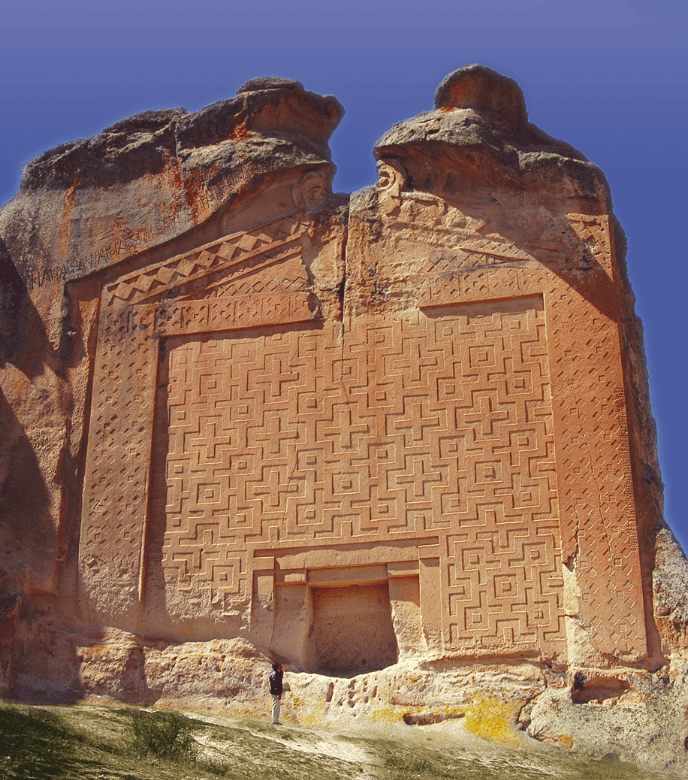
Yazılıkaya
Location | Eskişehir | ||||||||
|---|---|---|---|---|---|---|---|---|---|
The Yazılıkaya Valley is part of the region known as Mountainous Phrygia, located within the boundaries of Eskişehir Province, important. The Yazılıkaya Platform, selected by the Phrygians as a religious center, lies within the valley and is enriched with rock monuments. This region is situated west of Yazılıkaya Village, which belongs to the Inn district of Eskişehir. Monumental rock structures and altars demonstrating the Phrygians’ devotion to the Mother Goddess Matar Kubileya are densely concentrated in this area.
The Yazılıkaya Valley is 75 km from Eskişehir city center, 39 km from Çifteler and 30 km from Seyitgazi. Access to the valley is possible via asphalt roads from all these centers. The Yazılıkaya plateau, located at the southern end of the valley west of Yazılıkaya Village, measures 650 meters in length and 320 meters in width. It rises 60 to 70 meters above the valley floor.
The first investigations concerning the Yazılıkaya Valley and the City of Midas were initiated in 1800 by William Martin Leake and his team. The first researcher to designate Yazılıkaya as the “City of Midas” was W. Ramsay. Between 1937 and 1939, Albert Gabriel, director of the French Institute of Archaeology in Istanbul, and Dutch archaeologist C. H. Emilie Haspels conducted the first systematic excavations at Yazılıkaya.
The findings from these excavations indicate that the City of Midas was equipped with rock-cut religious structures and was regarded by the Phrygians as a sacred center. Evidence of initial settlements dating back to 3000 BCE has been discovered, with the earliest Phrygian occupation dated to the final quarter of the 8th century BCE. After the collapse of the Phrygian Kingdom, the City of Midas was not abandoned; its rock-cut structures continued to be used with modifications and additions during the Hellenistic, Roman and Byzantine periods.
In the Yazılıkaya Valley, numerous monumental and small scale religious building demonstrate the Phrygians’ devotion to the Mother Goddess Matar Kubileya. These include:
One of the most important monuments in the valley is known as the Midas Monument. Inscriptions in the Phrygian language are carved on the monument. One inscription, located on the upper left side of the monument, extends over a 11-meter area and contains the name “King Midas”. Another inscription on the right side frame of the monument contains the word “Father”, carrying a distinctive meaning. Completed with niches and altars, this monument is one of the most significant symbols of Phrygian religious belief.
The Yazılıkaya Valley and the City of Midas hold great historical significance due to their unique rock monuments and religious structures surviving from the Phrygian era to the present day. The site has been nominated for inclusion on the UNESCO World Heritage List of Cultural and Natural Heritage and is recognized as an important cultural heritage area that must be preserved and transmitted to future generations.
Culture Portal. "Midas Anıtı." Accessed February 13, 2025. https://www.kulturportali.gov.tr/turkiye/eskisehir/gezilecekyer/midas-aniti.
Eskişehir İl Kültür ve Turizm Müdürlüğü. "Yazılıkaya Vadisi Dağlık Frigya." Accessed February 13, 2025. https://eskisehir.ktb.gov.tr/TR-336885/yazilikaya-vadisi-daglik-frigya.html.
Turkish Museums. "Eskişehir Midas Yazılıkaya Örenyeri." Accessed February 13, 2025. https://www.turkishmuseums.com/museum/detail/2044-eskisehir-midas-yazilikaya-orenyeri/2044/1.
Turkish Museums. "Midas Yazılıkaya Örenyeri." Accessed February 13, 2025. https://turkishmuseums.com/Uploads/M%C3%BCze/Dosya/063be9e7-563b-4530-94c2-a54dd141c05a.pdf.

Yazılıkaya
Location | Eskişehir | ||||||||
|---|---|---|---|---|---|---|---|---|---|
No Discussion Added Yet
Start discussion for "Yazılıkaya Valley (Mountainous Phrygia)" article
Historical and Archaeological Investigations
Architectural Structures
The Midas Monument