




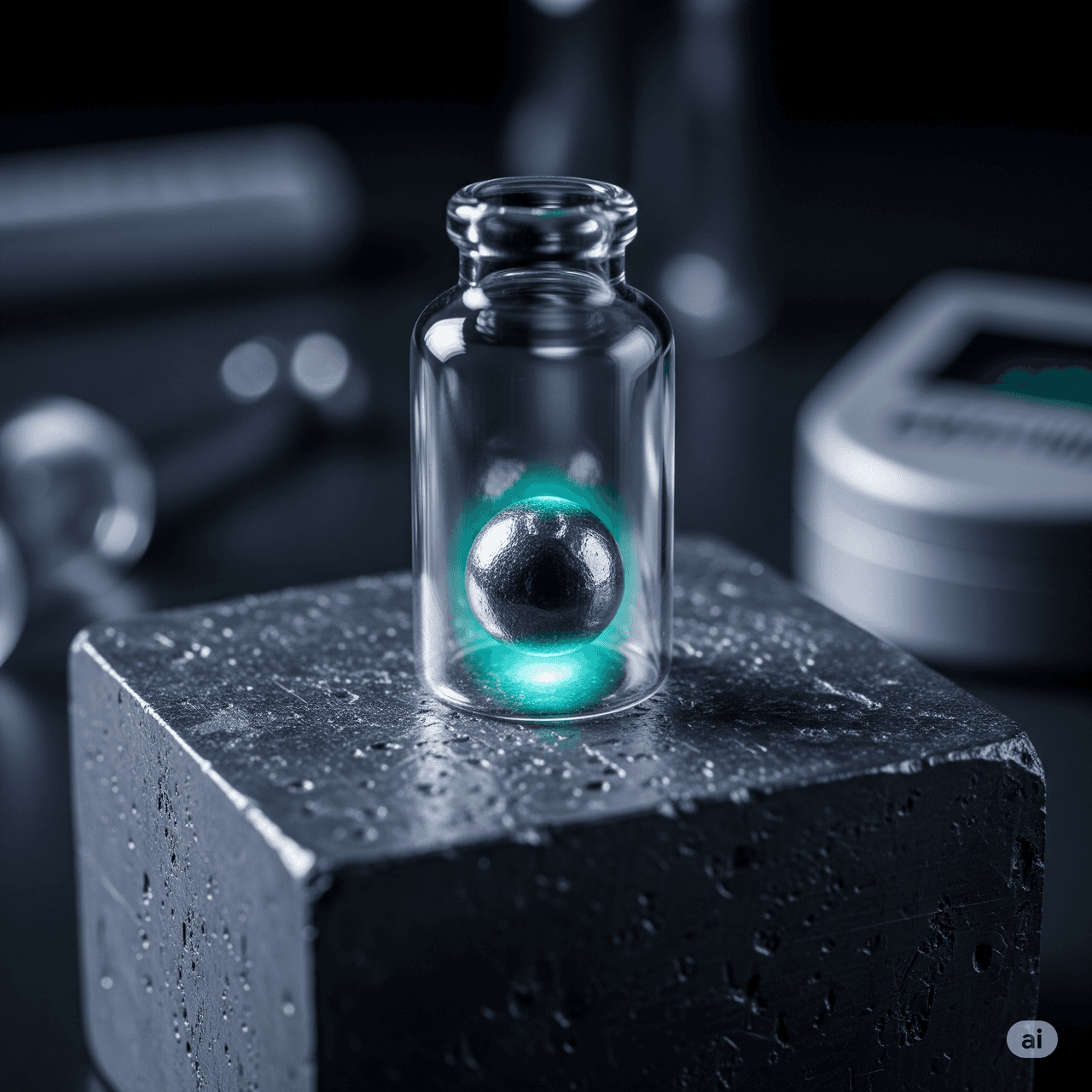
Polonium Element
Polonium is a rare and radioactive element with the symbol Po and atomic number 84. It exists as a solid at room temperature and has a silvery-metallic appearance. Due to its radioactive properties, it occurs in nature only in trace amounts and is processed under specialized laboratory conditions.

(Generated by Artificial Intelligence.)
History
Polonium was discovered in 1898 by the renowned scientist Marie Curie. She named it after her country of birth, Poland. Its discovery marked a significant milestone in research on radioactivity and generated considerable interest in the scientific community.
Physical Properties
Polonium is a brittle, dense metal with a silvery luster. It is solid at room temperature and possesses radioactive properties that can harm health through direct contact or inhalation. It is sensitive to temperature and pressure, requiring careful handling.
Chemical Properties
Chemically, polonium exhibits behavior similar to tellurium and selenium. Its compounds are both toxic and radioactive. Reactions involving polonium must be conducted with strict precautions in a laboratory environment. Some compounds are used in minute quantities for scientific experiments.
Applications
The applications of polonium are very limited. Small amounts are used as static electricity eliminators in spacecraft or in nuclear research. Medical and industrial uses are extremely rare and always conducted under strict regulatory control.
Natural Occurrence
Polonium occurs in trace amounts in uranium and thorium ores. Obtaining pure polonium is difficult, and it is mostly produced in laboratory settings. Its rarity in nature increases both its value and its hazard potential.
Scientific Significance and Future Perspectives
Polonium holds importance among radioactive elements for scientific research. It is used in minute quantities in nuclear physics and materials science. In the future, with controlled and safe handling methods, polonium may be more effectively and safely utilized in scientific studies.