


This article was automatically translated from the original Turkish version.
+1 More
Tellurium (Te)
Periodic Table | 5 | ||||||||
|---|---|---|---|---|---|---|---|---|---|
Chemical Symbol | Te | ||||||||
Atomic Number | 52 | ||||||||
Group | 16 | ||||||||
Atomic Weight | (127.60) g/mol | ||||||||
Electron Configuration | [Kr] 4d¹⁰5s²5p⁴ | ||||||||
Appearance | gray powder (amorphous) metallic-looking solid (crystalline) Silvery white | ||||||||
Density | 6.232 g/cm³ | ||||||||
Melting Point | 449.51 °C | ||||||||
Boiling Point | 988 °C | ||||||||
Atomic Radius | ~206 pm | ||||||||
Electronegativity | 2.1 | ||||||||
Electron Affinity | 190.161 kj/mol | ||||||||
Important Isotopes | ¹²⁰Te, ¹²²Te, ¹²³Te, ¹²⁴Te, ¹²⁵Te, ¹²⁶Te, ¹²⁸Te, ¹³⁰Te (natural) | ||||||||
Year of Discovery(ies) | 1783 | ||||||||
Discoverer(s) | Franz-Joseph Müller von Reichenstein | ||||||||
Tellurium is a metalloid element with atomic number 52, located in group 16 (chalcogens) of the periodic table. It was discovered in 1783 by Franz-Joseph Müller von Reichenstein and derives its name from the Latin word "Tellus," meaning "Earth." It typically occurs as a brittle, gray solid and is used in various metallurgical and electronic applications.
Tellurium (Te) is one of the elements in the fifth period and group 6A (or group 16) of the periodic table. It exhibits chemical similarities to selenium and sulfur. Classified as a metalloid, it possesses certain properties of both metals and nonmetals. Its electron configuration is [Kr] 4d¹⁰5s²5p⁴. Its crystalline structure consists of atoms forming spiral chains. At room temperature, it exists as a solid with a density of approximately 6.232 g/cm³.
Tellurium was discovered in 1783 by Franz-Joseph Müller von Reichenstein, who was working as a mining inspector in the Habsburg Monarchy (within modern-day Romania). While examining gold ores from Transylvania, he noticed the presence of an unknown metal alongside gold. He referred to this substance as "metallum problematicum" (problematic metal) or "aurum paradoxum" (paradoxical gold). Although Müller could not fully characterize the new material, he suspected it was a new element. In 1798, the German chemist Martin Heinrich Klaproth confirmed Müller’s findings, isolated the element, and named it "tellurium."

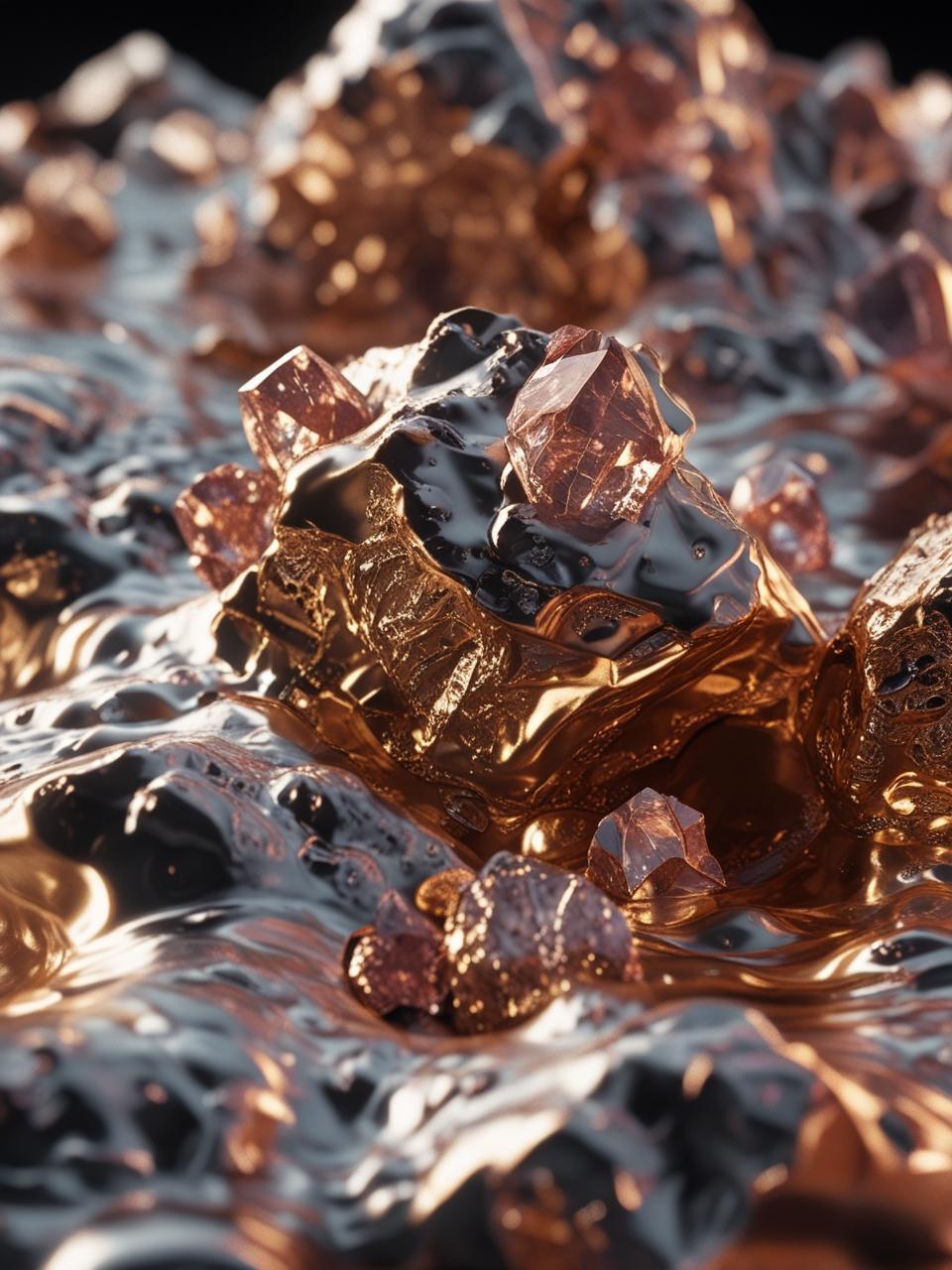
Tellurium (Generated by Artificial Intelligence.)
The name "tellurium" was coined by Martin Heinrich Klaproth in 1798, derived from the Latin word "Tellus," meaning "Earth." This naming was intended to parallel selenium, an element previously discovered and named after the Greek word "selene," meaning "Moon."
Tellurium is a rare element in the Earth's crust, with an estimated abundance of about 0.001 parts per million. It occurs very rarely in its free (metallic) form but is commonly found in telluride minerals combined with metals such as gold, silver, copper, lead, and bismuth. The most well-known telluride minerals include calaverite (AuTe₂), sylvanite ((Ag,Au)Te₂), petzite (Ag₃AuTe₂), and tellurite (TeO₂). The majority of commercially required tellurium is obtained as a byproduct during the electrolytic refining of copper. These anode slimes can contain up to approximately 8% tellurium along with other metals.
Crystalline tellurium is a brittle, metallic-looking solid with a silvery-white luster. Amorphous tellurium typically appears as a gray powder. Its melting point is 449.51 °C and its boiling point is 988 °C. The atomic radius is approximately 206 pm and its electronegativity is 2.1. Its electron affinity is reported as 190.161 kJ/mol. Tellurium is a semiconductor and exhibits photoconductivity—its electrical conductivity increases upon exposure to light. Chemically, it is reactive; it readily reacts with halogens. When burned in air, it produces a greenish-blue flame and forms tellurium dioxide (TeO₂). It dissolves in oxidizing acids such as sulfuric acid but not in reducing acids like hydrochloric acid. In its compounds, tellurium commonly exhibits oxidation states of -2, +2, +4, and +6.
Naturally occurring tellurium has eight stable or very long-lived isotopes: ¹²⁰Te, ¹²²Te, ¹²³Te (radioactive, very long half-life), ¹²⁴Te, ¹²⁵Te, ¹²⁶Te, ¹²⁸Te (radioactive, the longest-lived known isotope), and ¹³⁰Te (radioactive, very long half-life). ¹³⁰Te is noted as an important isotope. In addition, numerous artificial radioactive isotopes are known.
Tellurium has various industrial applications:
Tellurium has no known biological role. Tellurium and its compounds, particularly soluble forms, are highly toxic and may have teratogenic effects (disrupting embryonic development). Exposure to tellurium, even in small amounts, can lead to the formation of dimethyl telluride in the body, resulting in a distinctive, garlic-like odor in breath and sweat ("tellurium breath"). Appropriate safety measures—including adequate ventilation, protective clothing, gloves, and eye protection—must be taken when handling tellurium to prevent exposure.
National Center for Biotechnology Information. "Tellurium." *PubChem Compound Database CID 6327182.* Accessed May 31, 2025. https://pubchem.ncbi.nlm.nih.gov/compound/6327182
TÜBİTAK Bilim Genç. "Tellür." Bilim Genç. Accessed May 31, 2025. https://bilimgenc.tubitak.gov.tr/periyodik-tablo/tellur

Tellurium (Te)
Periodic Table | 5 | ||||||||
|---|---|---|---|---|---|---|---|---|---|
Chemical Symbol | Te | ||||||||
Atomic Number | 52 | ||||||||
Group | 16 | ||||||||
Atomic Weight | (127.60) g/mol | ||||||||
Electron Configuration | [Kr] 4d¹⁰5s²5p⁴ | ||||||||
Appearance | gray powder (amorphous) metallic-looking solid (crystalline) Silvery white | ||||||||
Density | 6.232 g/cm³ | ||||||||
Melting Point | 449.51 °C | ||||||||
Boiling Point | 988 °C | ||||||||
Atomic Radius | ~206 pm | ||||||||
Electronegativity | 2.1 | ||||||||
Electron Affinity | 190.161 kj/mol | ||||||||
Important Isotopes | ¹²⁰Te, ¹²²Te, ¹²³Te, ¹²⁴Te, ¹²⁵Te, ¹²⁶Te, ¹²⁸Te, ¹³⁰Te (natural) | ||||||||
Year of Discovery(ies) | 1783 | ||||||||
Discoverer(s) | Franz-Joseph Müller von Reichenstein | ||||||||
Classification and Basic Properties
Discovery
Etimology
Natural Occurrence
Physical and Chemical Properties
Isotopes
Applications
Biological Role and Effects