


This article was automatically translated from the original Turkish version.
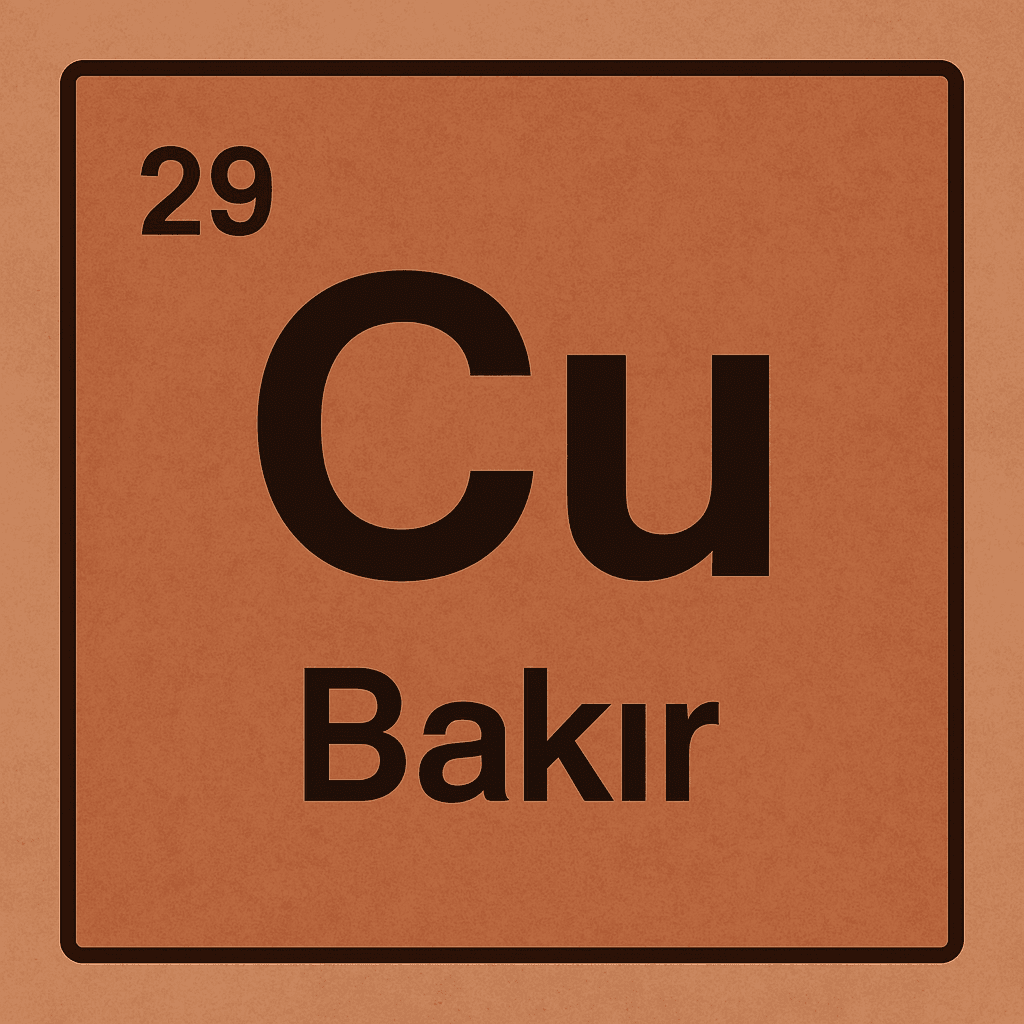
Generated with artificial intelligence.
Copper (Cu)
Group / Period / Block | 11 / 4 / d-block | ||||||||
|---|---|---|---|---|---|---|---|---|---|
Atomic Mass | 63.546 g/mol | ||||||||
Crystal Structure | Face-centered cubic (FCC) | ||||||||
Melting Point | 1084.62 °C | ||||||||
Boiling Point | 2562 °C | ||||||||
Density | 8.96 g/cm³ | ||||||||
Electronegativity (Pauling) | 1.90 | ||||||||
Isotopes | Cu-65 (31%) Cu-63 (69%) | ||||||||
Copper is an element located at atomic number 29 in the periodic table and belongs to the group of transition metals. Throughout history, copper has played a significant role in both technological and cultural developments due to its high electrical and thermal conductivity, ease of workability, and chemical stability. This metal is found in nature both in its native form and as a component of various minerals and also serves essential functions in biological systems. Its industrial applications span numerous sectors including energy, construction, transportation, and healthcare.
The discovery of copper dates back to prehistoric times. Archaeological evidence indicates that native copper was being worked in the Middle East as early as 8000 BCE. By the 5000s BCE, techniques for extracting copper from ores had developed. This process is regarded as the beginning of metallurgy in human history. The early discovery of copper is linked to its ability to occur naturally in pure form and its workability at relatively low temperatures.
Copper is located in group 11 and period 4 of the periodic table. Classified as a transition metal, it has an atomic number of 29 and the symbol Cu. Its electron configuration is [Ar] 3d¹⁰ 4s¹. Its standard atomic mass is 63.546 g/mol. It has a face-centered cubic (FCC) crystal structure, which enhances its capacity to conduct electricity. These fundamental properties determine copper’s physical and chemical behavior.
Copper is a reddish metallic lustrous metal that is malleable and ductile. Its melting point is 1084.62 °C and its boiling point is 2562 °C. With a density of 8.96 g/cm³, copper is preferred especially in electrical wiring due to its high electrical and thermal conductivity. Chemically, it forms compounds in +1 (cuprous) and +2 (cupric) oxidation states. The Cu²⁺ ion appears blue in aqueous solutions and tends to form complex compounds. When exposed to oxygen, a protective oxide layer forms on its surface, preventing further oxidation.
The electronegativity of copper is 1.90 on the Pauling scale. Its reactivity is moderate. It slowly reacts with oxygen in air to form copper(II) oxide (CuO) on its surface. It dissolves in acids to produce soluble salts. Its reaction with nitric acid is exothermic and releases brown NO₂ gas. These characteristics enable controlled use of copper in both laboratory and industrial processes.
Natural copper consists of two stable isotopes: Cu-63 and Cu-65. Cu-63 accounts for approximately 69% of natural copper, while Cu-65 makes up about 31%. Both isotopes possess nuclear spin and are used in various spectroscopic analyses. Radioactive isotopes are evaluated only in limited applications for medical and scientific research.
Copper occurs in nature both in its native form and as a component of minerals. The most common copper minerals include chalcopyrite (CuFeS₂), chalcocite (Cu₂S), malachite (Cu₂CO₃(OH)₂), and azurite (Cu₃(CO₃)₂(OH)₂). Copper is extracted from these minerals using pyrometallurgical (high-temperature smelting) and hydrometallurgical (aqueous solution separation) methods. The evaluation of natural reserves depends on the mineralogical composition of the ore and its economic processability.
Copper is required in trace amounts by living organisms. In plants, it is a component of the protein plastocyanin and plays a role in photosynthesis. In humans and animals, it is involved in iron metabolism, nervous system development, connective tissue synthesis, and antioxidant defense mechanisms. Copper deficiency can lead to anemia, immune system disorders, and neurological problems, while excess copper can cause toxic effects that impair liver and kidney function. Therefore, maintaining balanced copper levels in biological systems is essential.
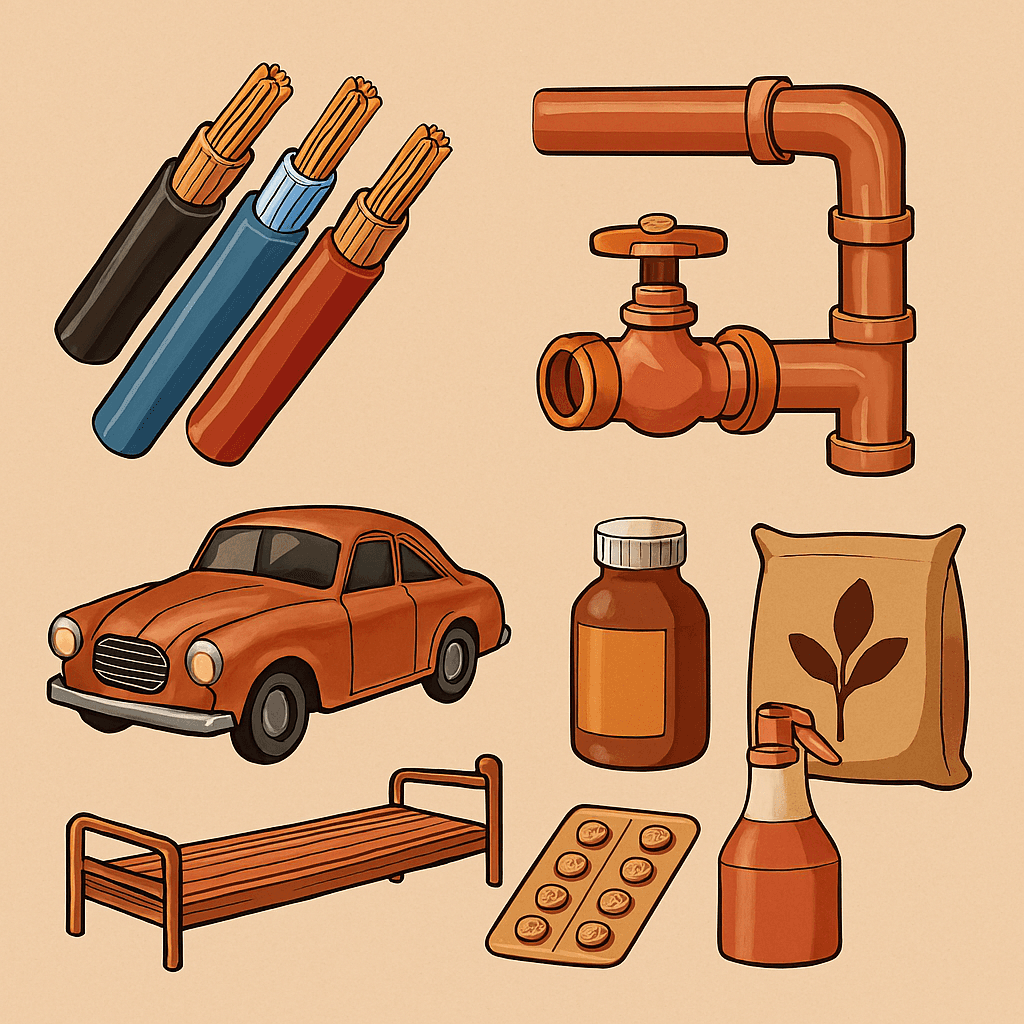
Applications of Copper Element (generated by artificial intelligence.)
The industrial use of copper is extensive. In the electrical and electronics industry, it is used in cables, circuit components, and motor windings. In construction, it is employed in pipes, roofing materials, and decorative elements. In transportation, it is used in the production of automotive and aerospace parts. In agriculture, it serves as a component in fungicides and pesticides, and in healthcare, it is used in antibacterial surfaces and medical alloys. Additionally, it acts as a primary component in the production of alloys such as brass and bronze.
Türkiye possesses reserves that can be considered rich in copper. Notable copper deposits are located in the Black Sea region, particularly in Küre, Murgul, and Artvin. The ores in these areas are primarily composed of chalcopyrite and chalcocite. Annual copper ore production in Türkiye is approximately four million tons. According to data from the Ministry of Energy and Natural Resources, this production largely supplies domestic industry with raw materials and reduces dependence on imports. The economic value of copper is increasing due to its export potential and its use in strategic sectors. Therefore, the sustainable exploitation of copper reserves in Türkiye is of critical importance for mining policy.
Bolat, İlyas, and Ömer Kara. “Bitki Besin Elementleri: Kaynakları, İşlevleri, Eksik ve Fazlalıkları.” *Bartın Orman Fakültesi Dergisi* 24, no. 2 (2022): 345–360. Accessed August 16, 2025. https://dergipark.org.tr/tr/download/article-file/307430
National Center for Biotechnology Information. “Copper.” PubChem Compound Summary. Accessed August 16, 2025. https://pubchem.ncbi.nlm.nih.gov/compound/copper
Sönmez, Sahriye, Mustafa Kaplan, N. Kemal Sönmez, and Harun Kaya. “Topraktan Yapılan Bakır Uygulamalarının Toprak pH’sı ve Bitki Besin Maddesi İçerikleri Üzerine Etkisi.” *Akdeniz Üniversitesi Ziraat Fakültesi Dergisi* 19, no. 1 (2006): 151–158. Accessed August 16, 2025. https://dergipark.org.tr/tr/download/article-file/18172
T.C. Ministry of Energy and Natural Resources. "Bakır." *Bilgi Merkezi – Tabii Kaynaklar*. Accessed August 16, 2025. https://www.enerji.gov.tr/bilgimerkezi-tabiikaynaklar-bakir
TÜBİTAK Bilim Genç. “Bakır.” *Periyodik Tablo*. Accessed August 16, 2025. https://bilimgenc.tubitak.gov.tr/periyodik-tablo/bakir

Generated with artificial intelligence.
Copper (Cu)
Group / Period / Block | 11 / 4 / d-block | ||||||||
|---|---|---|---|---|---|---|---|---|---|
Atomic Mass | 63.546 g/mol | ||||||||
Crystal Structure | Face-centered cubic (FCC) | ||||||||
Melting Point | 1084.62 °C | ||||||||
Boiling Point | 2562 °C | ||||||||
Density | 8.96 g/cm³ | ||||||||
Electronegativity (Pauling) | 1.90 | ||||||||
Isotopes | Cu-65 (31%) Cu-63 (69%) | ||||||||
Discovery
Classification and Fundamental Properties
Physical and Chemical Properties
Electronegativity and Reactivity
Isotopes
Occurrence in Nature and Compounds
Biological Role and Importance to Living Organisms
Applications
Copper Reserves and Economic Importance in Türkiye