


This article was automatically translated from the original Turkish version.
+1 More
Selenium (Se)
Periodic Table | 4 | ||||||||
|---|---|---|---|---|---|---|---|---|---|
Chemical Symbol | Se | ||||||||
Atomic Number | 34 | ||||||||
Group | 16 (Chalcogens) | ||||||||
Atomic Weight | (78.971) g/mol | ||||||||
Electron Configuration | [Ar] 3d¹⁰4s²4p⁴ | ||||||||
Appearance | red powder (red form) Gray-metallic solid | ||||||||
Density (Estimated) | 4.809 g/cm³ (gray form) | ||||||||
Melting Point | 220.8 °C (gray form) | ||||||||
Boiling Point (Estimated) | 685 °C | ||||||||
Melting Point (Estimated) | ~190 pm | ||||||||
Electronegativity | 2.55 | ||||||||
Electron Affinity | 194.965 kJ/mol | ||||||||
Important Isotopes | ⁸²Se (natural) ⁷⁸Se ⁷⁷Se ⁷⁶Se ⁷⁴Se | ||||||||
Year of Discovery(ies) | 1817 | ||||||||
Discoverer(s) | Johan Gottlieb Gahn Jöns Jacob Berzelius | ||||||||
Selenium is a nonmetal element with atomic number 34, located in group 16 (chalcogens) of the periodic table. It was discovered in 1817 by Jöns Jacob Berzelius and named after the Greek word "Selene," meaning "Moon." Selenium can exist in various allotropes and is particularly known for its roles in electronics, glass manufacturing, and biological systems.
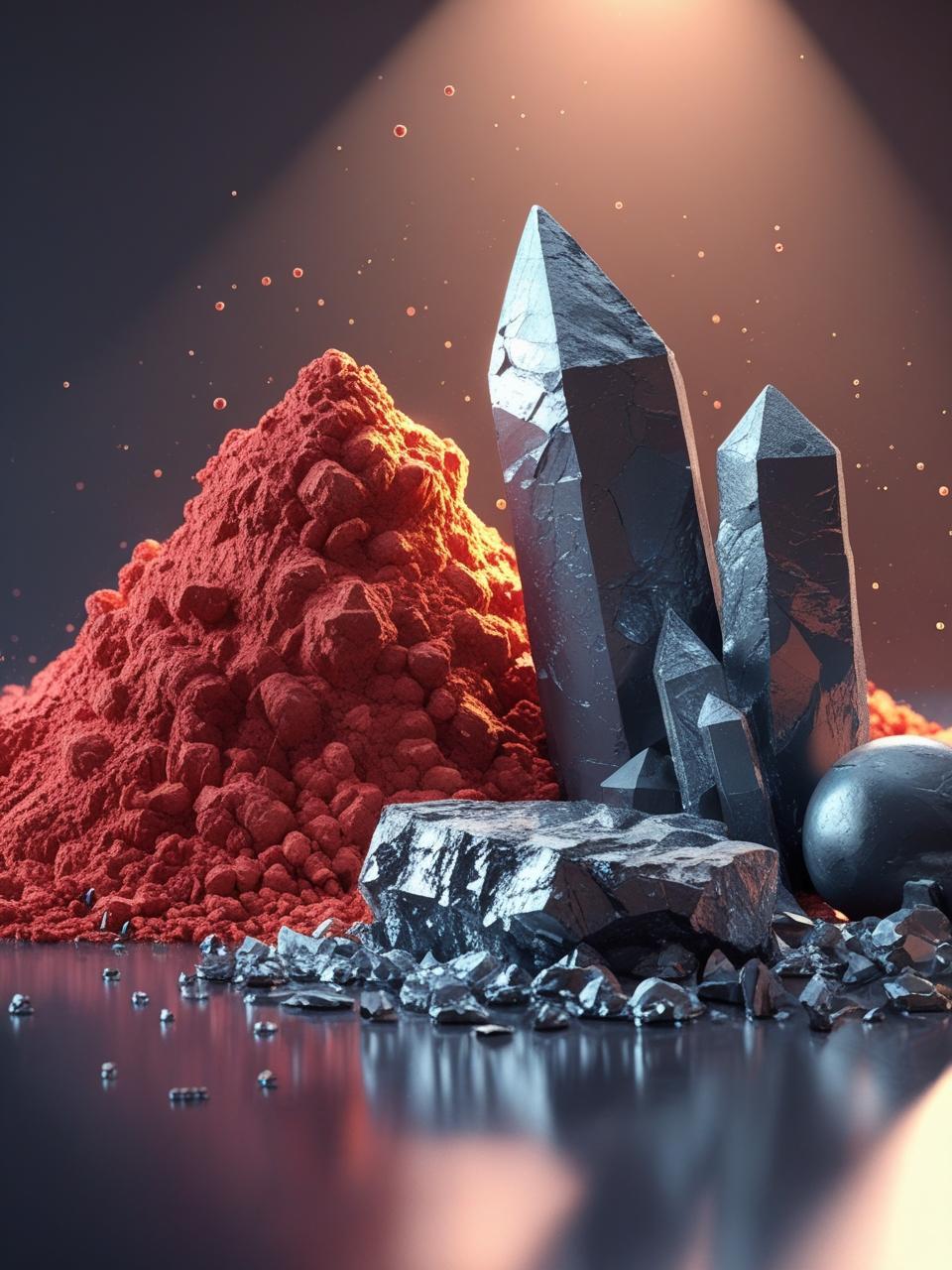
Selenium (Se) is one of the elements in the fourth period and group 6A (or group 16) of the periodic table. Its chemical properties resemble those of sulfur and tellurium. It is a nonmetal, but some of its forms exhibit semiconducting properties. Its electron configuration is [Ar] 3d¹⁰4s²4p⁴. Selenium occurs in several allotropes; the most common are red amorphous selenium (powder) and gray crystalline (metallic appearance) selenium. It is solid at room temperature. The density of gray selenium is approximately 4.809 g/cm³.
Selenium was discovered in 1817 by Swedish chemists Jöns Jacob Berzelius and Johan Gottlieb Gahn while examining a red precipitate that had accumulated in the lead chambers of a sulfuric acid factory in Gripsholm, Sweden. Initially, the precipitate was thought to contain tellurium, which Berzelius had previously identified in pyrite ore used for sulfuric acid production at the same facility. However, more detailed analysis revealed to Berzelius that this was a new element resembling tellurium.

Red Amorphous Selenium Powder and Gray Metallic Crystalline Selenium (Generated by Artificial Intelligence.)
Jöns Jacob Berzelius named the newly discovered element "selenium," inspired by the Greek word "Selene" (Σελήνη), meaning "Moon." This naming created a parallel with tellurium, whose name derives from the Latin "Tellus" meaning "Earth," reflecting their chemical similarities.
Selenium is a relatively rare element in the Earth's crust. It is rarely found in its free state and typically occurs in trace amounts associated with sulfide minerals. It can be found as selenites or selenides within sulfide deposits of copper, lead, silver, and nickel. Important selenium minerals include clausthalite (PbSe) and berzelianite (Cu₂Se). Commercially, most selenium is obtained as a byproduct during the electrolytic refining of copper, lead, and nickel, where it is recovered from anode slimes.
The most stable form of selenium, gray (metallic) selenium, has a silvery luster, is brittle, and exhibits semiconducting properties. Its electrical conductivity increases when exposed to light (photoconductivity), and it can directly convert light energy into electricity (photovoltaic effect). Red selenium may exist in amorphous or monoclinic crystalline forms and acts as an insulator. The melting point (for gray selenium) is 220.8 °C and the boiling point is 685 °C. The atomic radius is approximately 190 pm and the electronegativity is 2.55. Its electron affinity is reported as 194.965 kJ/mol. Selenium readily reacts with halogens and oxygen. When burned in air, it produces blue flames and selenium dioxide (SeO₂), emitting a characteristic odor reminiscent of rotten horseradish. It dissolves in acids. In its compounds, selenium commonly exhibits oxidation states of -2, +2, +4, and +6.
Selenium has six naturally occurring stable or very long-lived isotopes: ⁷⁴Se, ⁷⁶Se, ⁷⁷Se, ⁷⁸Se, ⁸⁰Se, and ⁸²Se (radioactive with a very long half-life). The isotope ⁸⁰Se is highlighted in the source as significant. Many artificial radioactive isotopes are also known. ⁸⁰Se is the most abundant naturally occurring isotope of selenium, making up approximately 49.6%.
Selenium has various applications due to its unique physical and chemical properties:
Selenium is an essential trace element for many living organisms, including humans. It is a structural component of various enzymes, particularly the antioxidant enzyme glutathione peroxidase, which protects cells from oxidative damage. It is estimated that the human body contains approximately 14 milligrams of selenium, with more than a million selenium atoms present in each cell.
Selenium deficiency can lead to various health problems, such as Keshan disease, a cardiomyopathy. However, the range between the amount required for health and the amount that becomes toxic is narrow. Excessive intake of selenium is hazardous and can cause a condition known as selenosis. Symptoms include hair loss, nail abnormalities, skin lesions, neurological disturbances, and a distinctive garlic-like odor on the breath. High-level exposure may increase cancer risk and adversely affect embryonic or fetal development.
National Center for Biotechnology Information. "Selenium." *PubChem Compound Database CID 6326970.* Accessed May 31, 2025. https://pubchem.ncbi.nlm.nih.gov/compound/6326970
TÜBİTAK Bilim Genç. "Selenyum." *Bilim Genç*. Accessed May 31, 2025. https://bilimgenc.tubitak.gov.tr/periyodik-tablo/selenyum

Selenium (Se)
Periodic Table | 4 | ||||||||
|---|---|---|---|---|---|---|---|---|---|
Chemical Symbol | Se | ||||||||
Atomic Number | 34 | ||||||||
Group | 16 (Chalcogens) | ||||||||
Atomic Weight | (78.971) g/mol | ||||||||
Electron Configuration | [Ar] 3d¹⁰4s²4p⁴ | ||||||||
Appearance | red powder (red form) Gray-metallic solid | ||||||||
Density (Estimated) | 4.809 g/cm³ (gray form) | ||||||||
Melting Point | 220.8 °C (gray form) | ||||||||
Boiling Point (Estimated) | 685 °C | ||||||||
Melting Point (Estimated) | ~190 pm | ||||||||
Electronegativity | 2.55 | ||||||||
Electron Affinity | 194.965 kJ/mol | ||||||||
Important Isotopes | ⁸²Se (natural) ⁷⁸Se ⁷⁷Se ⁷⁶Se ⁷⁴Se | ||||||||
Year of Discovery(ies) | 1817 | ||||||||
Discoverer(s) | Johan Gottlieb Gahn Jöns Jacob Berzelius | ||||||||
Classification and Basic Properties
Discovery
Etimology
Natural Occurrence
Physical and Chemical Properties
Isotopes
Applications
Biological Importance and Effects