



Şanlıurfa Archaeology Museum
History and Establishment
The idea of a museum in Şanlıurfa emerged in 1948. At that time, artifacts were stored in a depot at Atatürk Primary School. In 1956, these artifacts were moved to a designated space at Şehit Nusret Primary School. However, as this space proved insufficient, construction of a new museum building began in 1965 in the city center, at the Şehitlik site.
The first museum, opened in 1969, was inadequate for the region’s thousands of years of history and artifacts. Therefore, in 2015, a modern and vastly larger museum with a covered area of 29,000 square meters was built. Today’s Şanlıurfa Archaeology Museum is among the largest archaeological museums in both Türkiye and the world.

(Türkiye Culture Portal)
What Can You See?
The museum features exactly 14 large exhibition halls and 33 reconstruction areas. Additionally, a special area called “Arkeopark” displays replicas of ancient structures. Here, visitors can view prehistoric dwellings and learn how archaeologists work through an excavation training area.

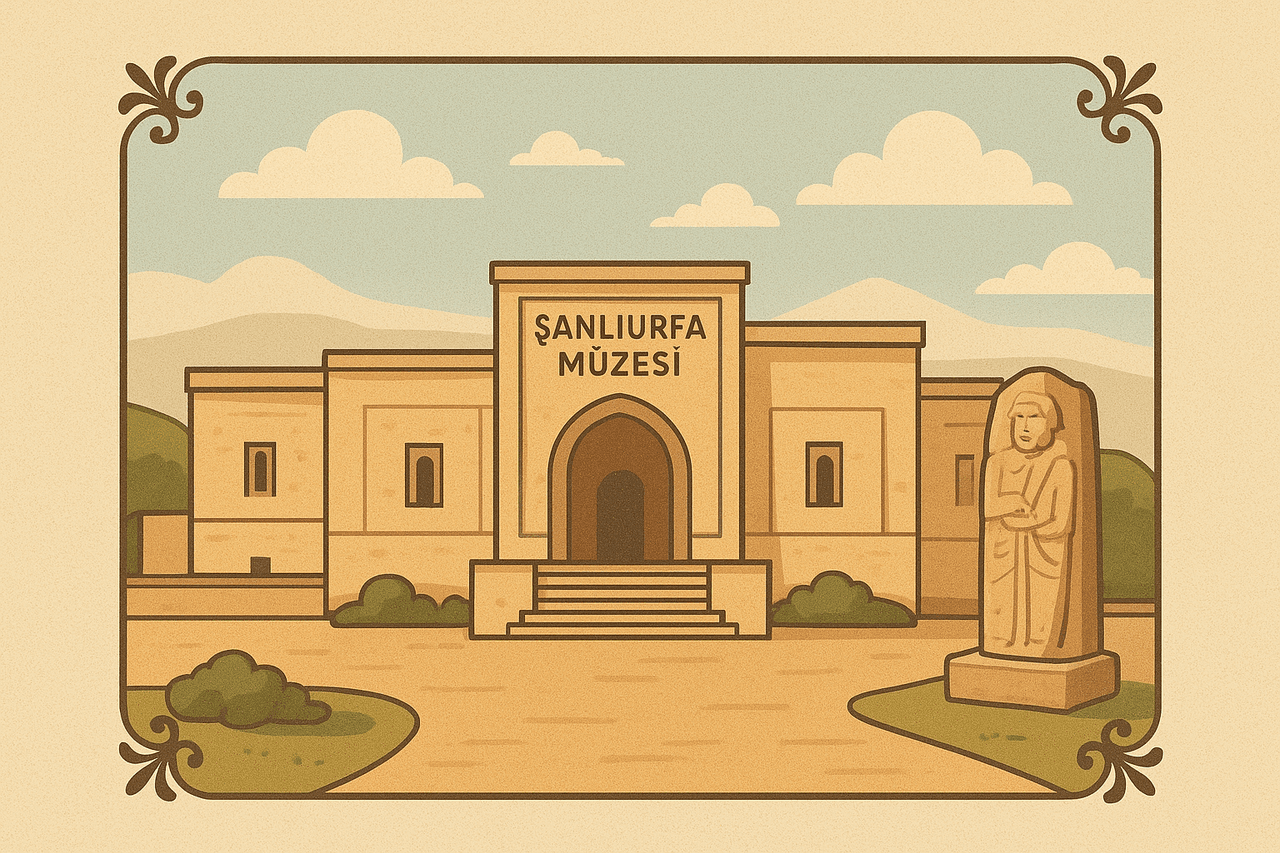
(Generated by artificial intelligence)
The museum halls are arranged chronologically:
- Palaeolithic Period Hall: Stone Age artifacts
- Neolithic Period Hall: Stone statues from Göbeklitepe and its surroundings
- Chalcolithic Period Hall: Artifacts from the Copper Age
- Bronze Age Hall
- Iron Age Hall
- Hellenistic–Roman–Byzantine Period Hall
- Islamic Period Hall
- Reconstruction of the Time of Prophet Ibrahim
- Coin Section: Ancient coins

(Generated by artificial intelligence)
Most Famous Artifacts
Balıklıgöl Statue: The world’s oldest known life-sized human sculpture. Made of limestone, it stands 180 cm tall. The eye sockets contain black obsidian stones. Dated to the 9500 BCE period. The hands are joined in front and the body is decorated with simple lines.

Göbeklitepe Totem Pole: This stone pillar dates to 8700–8200 BCE and features carvings of predatory animals and human figures on its upper section. Alongside them are snake reliefs shaped like the letter “S”. The stone was carved from a single piece.
Serpent Head: Dated to between 8500 and 7900 BCE. It is a large fragment of a human head with a serpent relief extending toward the face.
Eye Idols: Used in ancient times as protective or auspicious objects. They were left as votive offerings in temples or carried like amulets.
Stone Bowl Fragment: It depicts human figures dancing. This is one of the earliest known representations of dance.
Mythology and Art
Relief of Eros and Psyche
Depicts a love story from ancient Greek mythology. Eros falls in love with Psyche but remains invisible to her. Driven by curiosity, Psyche sees Eros while he sleeps, but accidentally spills oil from a lamp onto his shoulder. They are separated as a result, but eventually reunite.
Goddess of Victory Nike
Symbolizes victory as a winged goddess. In Greek mythology she is known as “Nike”, and in Roman mythology as “Victoria”. She is depicted in statues wearing delicate, flowing garments.
Time Travel
The Neolithic Age began approximately 12,000 years ago. During this period, humans first began farming, building homes, and domesticating animals. The region around Şanlıurfa was one of the most important centers of this era. Göbeklitepe is recognized as the world’s oldest temple.