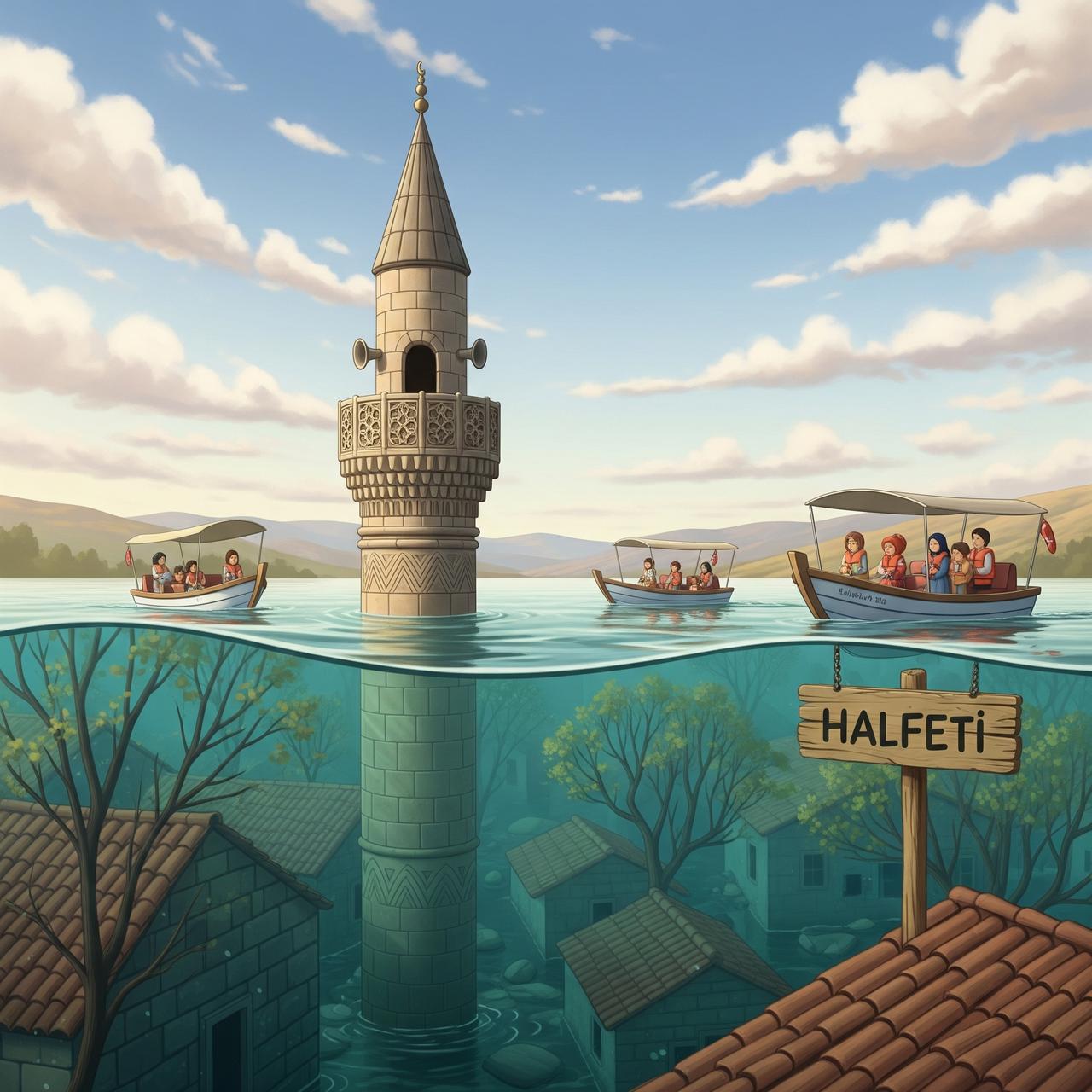




The Submerged City: Halfeti
Halfeti
Have you ever heard of a town built along the banks of the Euphrates River, part of which lies submerged underwater? That town is Halfeti. With its stone houses, black roses that grow nowhere else, and a minaret rising from the water, Halfeti feels like a land from a fairy tale. Let us explore this fascinating town together.
Halfeti is a place whose life changed with the construction of the Birecik Dam on the Euphrates River. The dam was built to generate electricity and provide water for farmland, but it also caused part of the town to be submerged. Residents moved to a nearby newly established settlement, taking their belongings and memories with them. Today, there are two Halfetis: one is “Old Halfeti” by the water’s edge, and the other is “New Halfeti,” where people have rebuilt their lives.
The Submerged Town
When you visit Old Halfeti, one of the most striking sights is a stone minaret standing in the middle of the water. This is the minaret of the former Savaşan Village Mosque, now submerged. The streets once walked by townspeople and the sites of their homes are now part of the Euphrates River. Visitors who tour the sunken town by boat encounter a scene that is both melancholic and awe-inspiring.
While traveling by boat, you can see the rooftops of submerged houses and the treetops rising above the water. This image shows how nature and human-made structures can intertwine. In this sense, Halfeti is both a living landscape and an open-air museum.
Time Travel
The land of Halfeti has sheltered human settlements since ancient times. Around 3,000 years ago, great civilizations such as the Assyrians lived in this region. Near Halfeti, Rumkale is a large fortress perched on a high hill overlooking the Euphrates River. This fortress served as an important center for many kingdoms and empires throughout history.
Inside and around the fortress, you can find churches, monasteries, and cisterns—water storage structures—from various historical periods. Seeing these ruins is like stepping into a time machine and traveling back to those days. Over centuries, people from different cultures have left their traces here.
The Homeland of the Black Rose
One of the things that makes Halfeti unique in the world is the black rose, which grows nowhere else. This rose is called “Karagül.” In reality, it is a very deep red, but when in bud, it appears pitch black. Its color is believed to come from the soil of Halfeti and the waters of the Euphrates River.
When planted elsewhere, the Karagül gradually loses its intense black hue and fades to a lighter shade. For this reason, the Karagül has become a symbol of Halfeti. For the local people, this flower represents both a source of livelihood and a symbol of their longing for the homes they lost.