



UNICEF
UNICEF is a United Nations agency established on 12 December 1946 by a resolution of the United Nations General Assembly. Initially known as the International Children’s Emergency Fund (ICEF), its purpose was to provide emergency assistance to children suffering under the heavy burdens of war, destruction, poverty and mass displacement following the Second World War.
In 1953, UNICEF became a permanent agency within the UN; as part of this change, the words “International” and “Emergency” were removed from its official name, although the acronym UNICEF was retained.
UNICEF’s fundamental mission is to work for every child’s survival, development and realization of their potential. Since its founding, it has committed to providing equal, non-discriminatory assistance to all children, regardless of where they live.
Universal Mission and Core Principles
UNICEF was established as a global organization focused on aid and advocacy for children. Its mission extends beyond emergency humanitarian assistance to include creating systemic change in long-term, sustainable areas such as development, protection, education, health and nutrition.
This mission is grounded in the principles of children’s rights, equality, non-discrimination and the belief in “fair opportunities for every child.” UNICEF defends and supports children without regard to political, religious, ethnic or geographic differences.
A particularly emphasized principle is “the best interests of the child” — meaning that political interests, economic benefits or adult needs must never take precedence over children’s fundamental rights. The phrase “There are no enemy children,” one of UNICEF’s historic slogans, encapsulates this universal perspective.
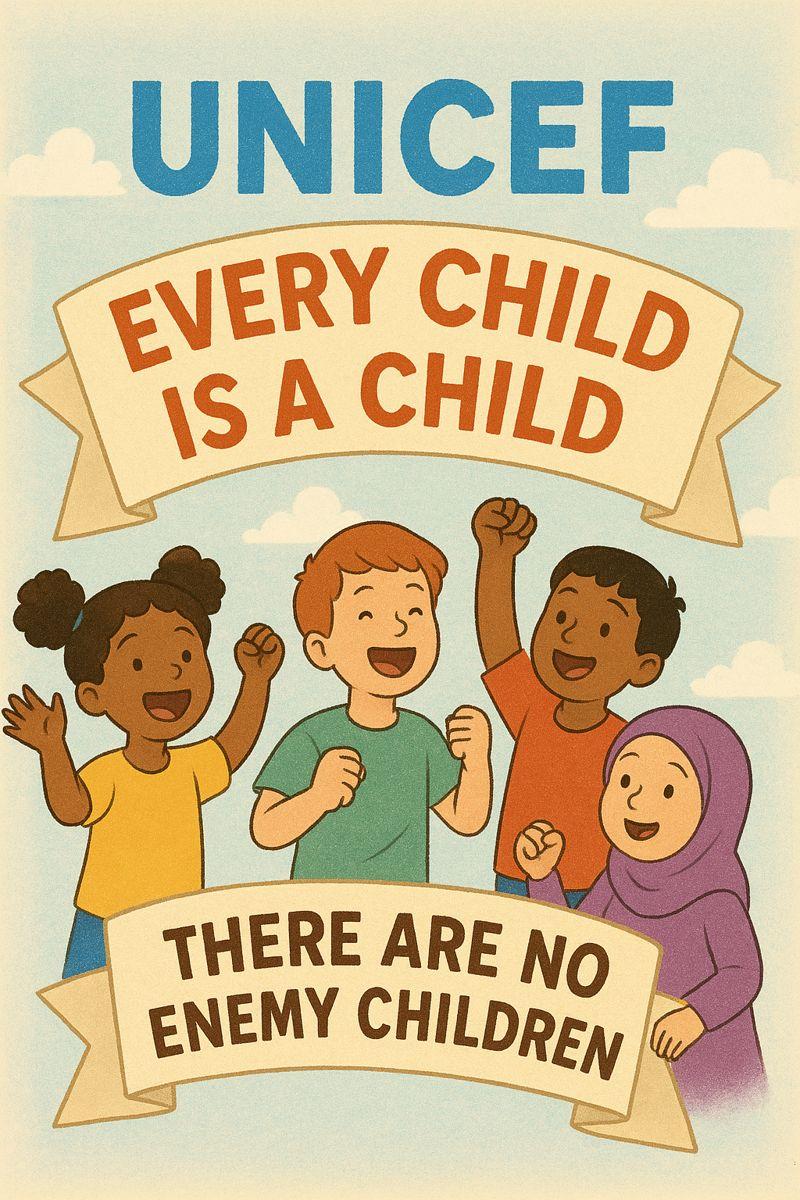
UNICEF’s Universal Mission and Core Principles. (Generated by artificial intelligence.)
UNICEF’s Global Evolution and Core Areas of Work
In its early years, UNICEF implemented humanitarian programs in war-affected regions, primarily in post-war Europe, focusing on nutrition, vaccination, health care and water sanitation. From the 1950s onward, while maintaining its humanitarian approach, UNICEF expanded its scope to include child health, education and early childhood development.
From the 1960s, UNICEF evolved from a mere aid fund into a development and advocacy organization, designing global programs in education, health, children’s rights, protection and nutrition.
In the 1970s, UNICEF’s collaboration with civil society partners helped bring children’s rights to the global agenda, paving the way for the adoption of the Convention on the Rights of the Child in 1989.
In 1965, UNICEF was awarded the Nobel Peace Prize for its contributions to “international brotherhood, peace and humanitarian work for children.” This recognition reflected the international acknowledgment that “children’s well-being is the foundation of peace.”
Today, UNICEF operates in more than 190 countries. At the global level, it conducts extensive work across a broad spectrum of areas including child health, nutrition, water and sanitation, education, protection, emergency humanitarian response, adolescent support and the defense of children’s rights.
UNICEF and Türkiye: UNICEF Türkiye National Committee and Programs
The UNICEF Türkiye National Committee functions as UNICEF’s representative in Türkiye, working since 1951 to advocate for, protect and promote children’s rights.
UNICEF’s key focus areas in Türkiye include education, child protection, social policy, early childhood development, adolescent and youth participation, nutrition, health, and the integration of refugee and migrant children.
In this context, “inclusive and child-centered education” initiatives have gained prominence in recent years. UNICEF, in collaboration with public institutions and civil society partners, implements programs aimed at ensuring that children with disabilities, refugee children, and those from economically disadvantaged, migrant or marginalized families have equal opportunities in school.
For example, inclusive early childhood education projects for children with disabilities encompass multiple components including diagnosis, family support, teacher capacity building and the development of creative learning materials.
Additionally, UNICEF Türkiye expands access to education for refugee children learning Turkish as a second language through language support programs, out-of-school learning assistance, transportation aid and material contributions.

UNICEF Türkiye activities. (Generated by artificial intelligence.)
Child-Centered Principle, Inclusion and Rights-Based Approach
UNICEF’s activities are based on the principles of “child-centeredness” and the “rights-based approach.” This approach aims to ensure equal respect, rights and opportunities for every child, regardless of their place of residence, physical or mental condition, ethnic origin, economic status or gender.
In Türkiye, the concept of inclusive education encompasses all children with disabilities, refugees, those living in poverty, migrants or those facing disadvantage. This reflects the principle of “adapting the system to the child,” rather than “adapting the child to the system.”
Multi-dimensional components such as teacher training, counseling, psychosocial support, pedagogical materials, language assistance and family guidance make this inclusive approach possible. UNICEF addresses not only academic achievement but also children’s emotional, psychological and social needs.
Why It Matters: UNICEF’s Impact and Value
- UNICEF has ensured the survival and development of millions of children who faced deprivation and destruction after the war.
- The organization has played a pivotal role in the international recognition of children’s rights and the development of the Convention on the Rights of the Child.
- UNICEF’s work extends beyond individual aid; it aims to generate systemic change, equity, inclusion and peace.
- In Türkiye, UNICEF’s programs have strengthened disadvantaged children’s access to education, health care and protection.