




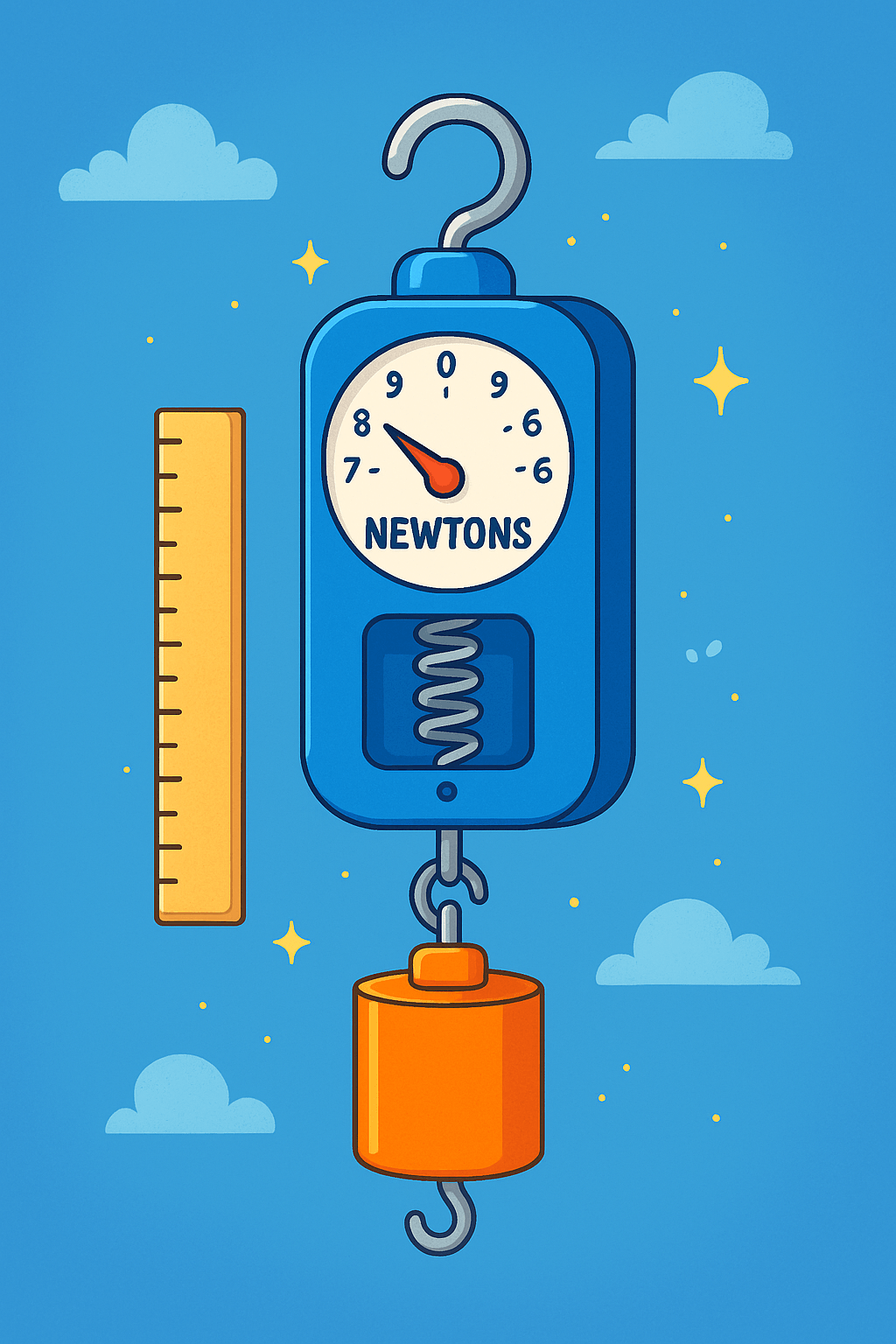
What is a Dynamometer?
The Scientific Way to Measure Force
Have you ever wondered how much force is applied to an object? For example, is it possible to find out how much strength you exert when pulling a spring or how much force you apply when lifting a box? Yes! This is precisely where a physical measuring instrument called the dynamometer comes into play.

(Generated by Artificial Intelligence.)
What Is a Dynamometer?
Dynamometer is an instrument that measures the magnitude of applied force. Since the unit of force is the newton (N), measurements taken with a dynamometer are typically expressed in newtons.
Does the name newton sound familiar? This unit is named after the renowned scientist Isaac Newton, who discovered gravity.
How Does a Dynamometer Work?
Many dynamometers contain a spring. The spring stretches or deforms under the influence of the applied force. The greater the force applied, the more the spring extends.
This extension is measured using a scale on the dynamometer, allowing us to easily determine how many newtons of force are being applied.
Example: A 1 kg object on Earth exerts approximately 10 N of force. This is read as 10 N on the dynamometer.

(Generated by Artificial Intelligence.)
Where Is It Used?
Dynamometers are used not only in schools but also in many scientific and technical fields:
In physics laboratories for experiments.
In vehicle engine testing.
In measuring athletes’ performance.
In adjusting the gripping force of robots.
In engineering projects.
Thus, the dynamometer is a small but very important tool!