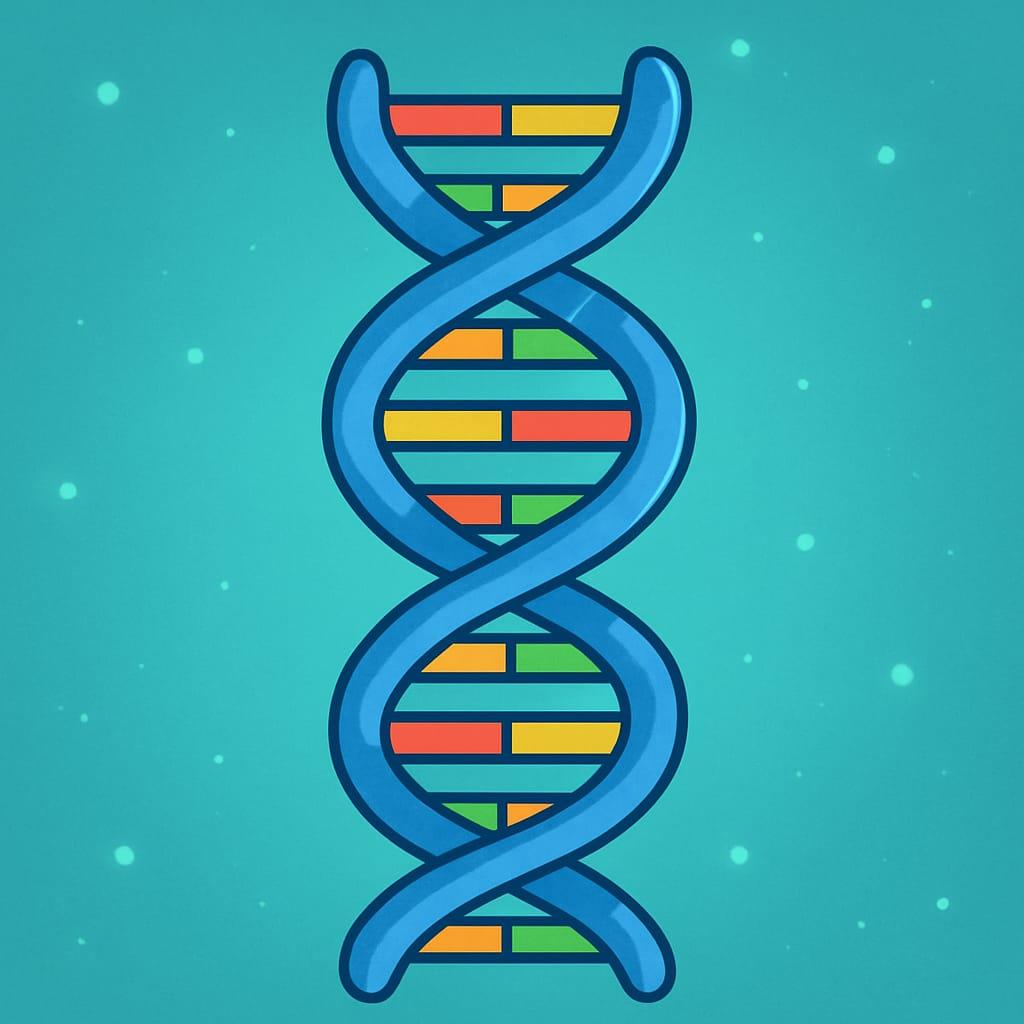




What is DNA?
DNA (Deoxyribonucleic Acid) is the molecule that carries the genetic information determining the structure and characteristics of living organisms. It is found in the nucleus of our cells and functions like a “manual” that dictates how our body operates.

(Generated by Artificial Intelligence.)
The Discovery of DNA
The double helix structure of DNA was discovered in 1953 by James Watson and Francis Crick. This discovery marked a pivotal turning point in the development of genetics.
The Structure of the DNA Molecule
DNA consists of two long strands twisted together to form a double helix. This structure resembles a ladder; the sides are made of sugar and phosphate groups while the rungs are composed of nitrogenous bases.
Nucleotides and Nitrogenous Bases
The building block of DNA is the nucleotide. Nucleotides consist of three parts: a sugar, a phosphate group, and a nitrogenous base. There are four types of nitrogenous bases:
- Adenine (A)
- Thymine (T)
- Guanine (G)
- Cytosine (C)
- Adenine always pairs with thymine and guanine always pairs with cytosine.

(Generated by Artificial Intelligence.)
The Functions of DNA
DNA instructs cells which proteins to produce. Proteins are essential for forming nearly all structures in the body, from muscles to enzymes. Traits such as eye color, hair shape, and height are encoded in DNA.
DNA and Protein Synthesis
The information in DNA is first transferred to RNA. RNA then uses this information to produce proteins. This process is called gene expression.

(Generated by Artificial Intelligence.)
Cell Division and DNA Replication
Before a cell divides, it copies its DNA so that the new cell receives the same genetic information. Occasionally, errors may occur during DNA replication; these are called mutations.
DNA and Biological Diversity
The sequence of bases in DNA differs between species. This variation enables the distinction between different organisms. Although human and chimpanzee DNA is 98 percent similar, the small remaining differences account for distinct traits.
The Importance of DNA in Daily Life
DNA knowledge is applied in medicine, agriculture, animal husbandry, and forensic science. DNA is used in diagnosing diseases, developing new plant varieties, and identifying criminals.

(Generated by Artificial Intelligence.)