



What Is Superrotation?
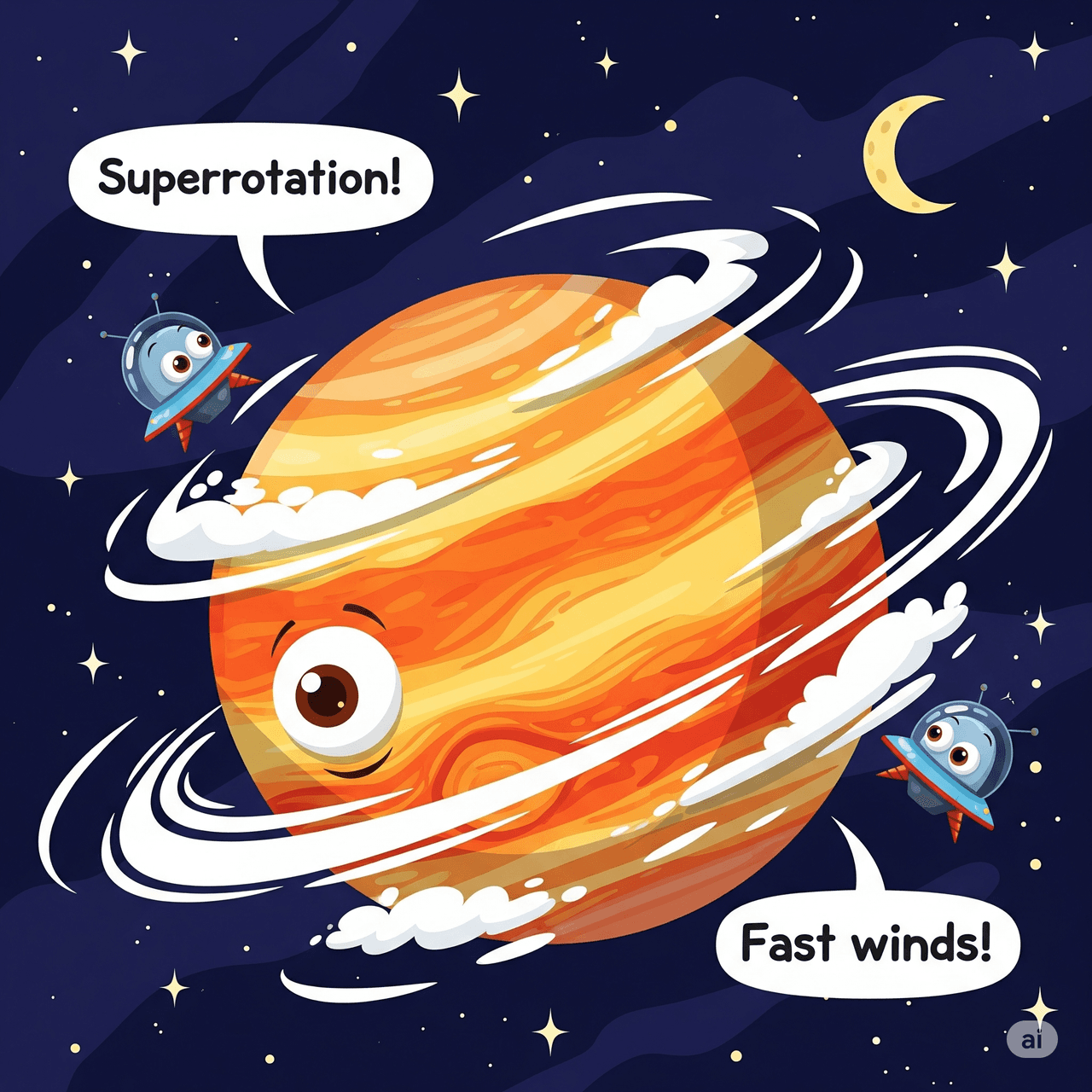
Superrotation is the phenomenon in which a planet’s atmosphere rotates faster than the planet itself. In other words, the atmosphere moves more rapidly than the surface. This effect is particularly pronounced on planets such as Venus and Titan.

(Generated by Artificial Intelligence.)
How Does It Occur?
This phenomenon occurs due to large waves and fluctuations in the atmosphere. Particularly, the transport of angular momentum toward the equator generates this strong rotational motion. Additionally, Rossby waves formed in the atmosphere by heat rising from below facilitate the transfer of momentum toward the equator, thereby supporting superrotation.
On Which Planets Is It Observed?
Superrotation is notably observed on planets or moons such as Venus, Jupiter, Saturn and Titan. For example, on Venus the atmosphere rotates approximately 60 times faster than the planet’s surface. Such intense superrotation is not observed on Earth, although similar wind patterns may occur at certain high altitudes.
Characteristics of Superrotation
Thanks to superrotation, winds blow at very high speeds. For instance, in Earth’s upper atmosphere winds can sometimes reach speeds exceeding 400 kilometers per hour. These rapid winds influence weather patterns.
Why Is It Important?
Superrotation plays a crucial role in understanding a planet’s climate and atmospheric dynamics. It helps scientists comprehend how planetary atmospheres transport energy and momentum, and even provides insights into the possible weather conditions on certain exoplanets.
How Do Scientists Study Superrotation?
Scientists use computer models, satellites and atmospheric observation systems to study superrotation. Researchers such as Richard and Vallis have worked to understand how atmospheric waves influence this phenomenon. Their studies are essential for deciphering the atmospheric systems of different planets.