




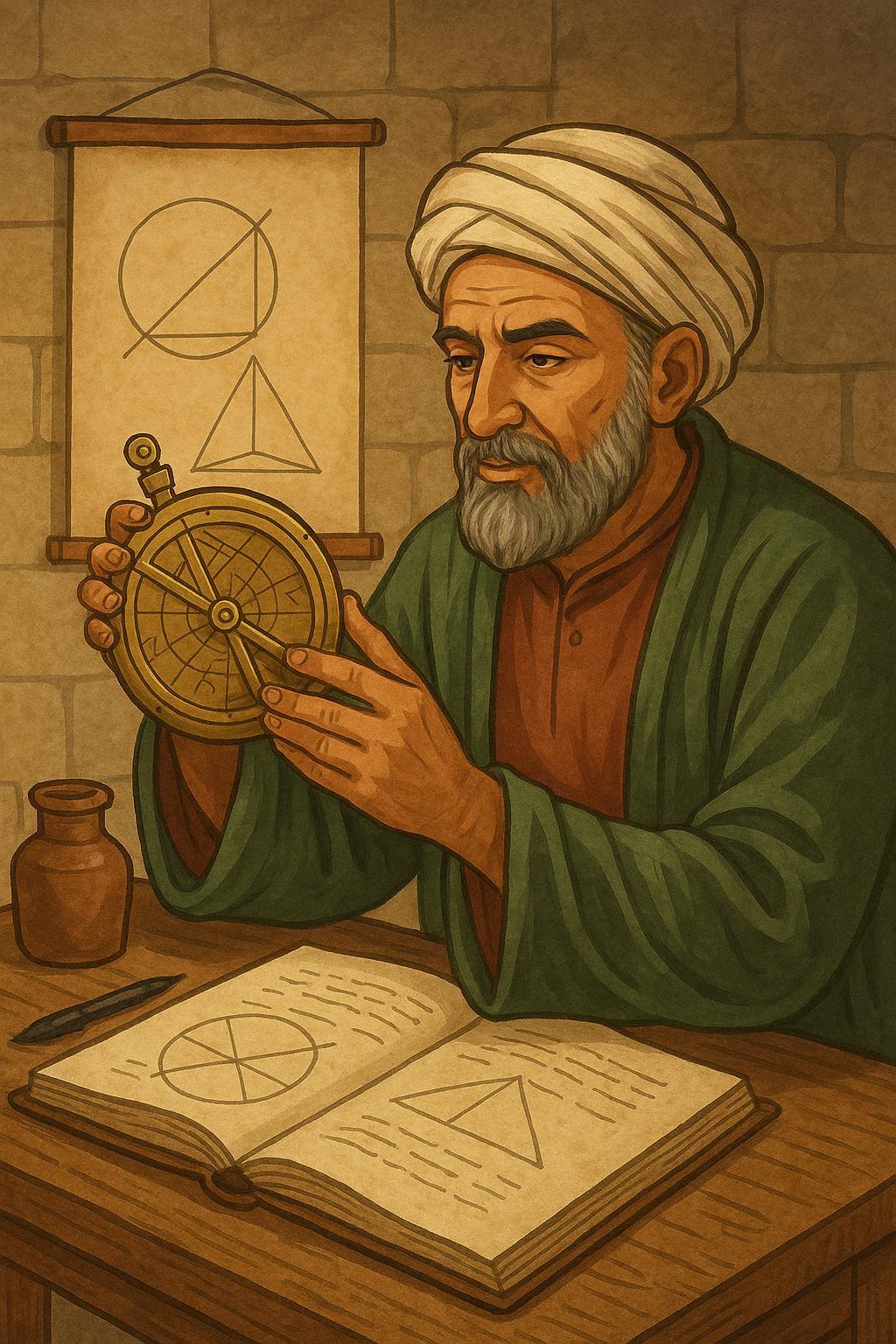
Who is Ibn al-Haytham?
Ibn al-Haytham, a renowned Muslim scientist, was born in 865 in the city of Basra, in present-day Iraq. His full name is Abu Ali al-Hasan ibn al-Hasan ibn al-Haytham. From an early age, he showed great interest in books and science. He studied topics such as light, the eye, vision, and optics, and is known for his groundbreaking work in these fields.
🏡 Early Life and Education
Ibn al-Haytham was a curious child with a strong passion for learning. His family encouraged him to read and pursue knowledge. He began his education in Basra and later moved to Baghdad, where he studied at the finest schools of his time. He decided at a young age to become a scientist, particularly developing his knowledge by reading the works of ancient Greek scholars.
🔬 Contributions to Science
Ibn al-Haytham investigated how the eye sees and how light behaves. He refuted the ancient belief that light emanates from the eyes. Instead, he proved that light enters the eye from external objects and that vision occurs in this manner. He demonstrated this using a device called the camera obscura. This work is considered the foundation of modern cameras.
He also explained the laws of reflection and refraction of light through experiments. For the first time, he laid the foundations of the scientific method by systematically conducting experiments. For this reason, he is regarded as one of the pioneers of modern science.
📚 Works
- Kitab al-Manazir (Book of Optics)
- Risala fi al-Makan (Treatise on Place)
- Sharh Kitab Uqlidis (Commentaries on Euclid’s Elements)
- Zij (Astronomical Tables)
These works were studied for centuries in both Europe and the Islamic world.

(Generated by artificial intelligence.)
🧠 Fields of Study
- Optics (light and vision)
- Physics
🌍 Impact on the Scientific World
Ibn al-Haytham influenced numerous scientists not only during his own time but also in subsequent centuries. In Europe, he was known as Alhazen. His ideas played a crucial role in the development of the observational and experimental approach in science. The foundations of many inventions, including cameras, telescopes, and microscopes, are based on his work.
Even today, his experiments are still taught in schools. For this reason, he is often called the “father of modern optics.”
References
- TÜBİTAK Bilim Genç. "Who is Ibn al-Haytham?" https://bilimgenc.tubitak.gov.tr/makale/ibn-heysem-kimdir
- Gutas, Dimitri. Greek Thought, Arabic Culture. Routledge, 1998.
- Saliba, George. Islamic Science and the Making of the European Renaissance. MIT Press, 2007.