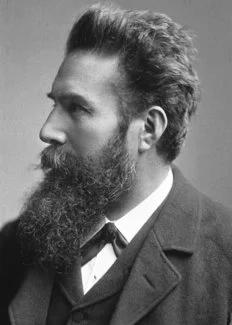




Wilhelm Röntgen
Wilhelm Conrad Röntgen was born on 27 March 1845 in Lennep, a small town in Germany. As a child, he was not considered particularly brilliant in his studies, but he had a deep love for nature. One of his favorite activities was building small inventions on his own. At home, he constantly assembled devices from wire fragments and wooden boxes, creating toy-like machines. Perhaps the curiosity he displayed in those days would one day lead to one of the greatest discoveries in the history of science.
Student Adventures
Röntgen’s student life was somewhat adventurous. He was unjustly expelled from school because it was believed he had drawn a caricature of a teacher—though he was innocent. Despite this injustice, he did not give up. He first considered studying engineering, then turned to physics.
His passion for physics led him to Switzerland, where he studied at the Zurich Polytechnic and eventually earned his doctorate. His professors described him as an extremely patient, meticulous, and curious student. Through his own hard work, he overcame difficulties and succeeded in becoming a scientist.

(Generated by artificial intelligence.)
Scientific Work
Röntgen’s early research focused on the properties of gases, heat conduction in crystals, and electromagnetism. But what made him famous was something entirely different: seeing the invisible.
One day, while conducting experiments with cathode rays in his laboratory, he noticed mysterious glowing lights in a corner of the room. These rays were so extraordinary that they could pass through thick objects. To his astonishment, Röntgen realized that these rays made human bones visible. Since their nature was unknown, he named them X-rays (X meaning “unknown”).

(Generated by artificial intelligence.)
The First X-ray Image
To test these mysterious rays, Röntgen placed his wife’s hand in front of them and took a photograph. The resulting image was astonishing: her bones and the ring on her finger were clearly visible.
This was the first X-ray image in history. The foundation of all modern X-ray machines used in hospitals today was laid on that day. From then on, doctors gained the ability to see broken bones, lungs, and internal organs. One of the most important tools in modern medicine, which has saved countless lives, was born.

(Generated by artificial intelligence.)
Awards and Fame
This great discovery caused excitement around the world. Doctors, scientists, and even newspapers spoke of his invention. In 1901, Röntgen received the first Nobel Prize in Physics. This award was a testament to how valuable his discovery was to humanity.
X-rays began to be used not only in medicine but also in materials science, security systems, and even space research. Thus, Röntgen’s discovery illuminated the path not only for doctors but for many fields of science.
Everyday Life
Despite all his fame and honors, Röntgen remained a very humble person. He never exaggerated his reputation and, although he could have earned vast sums of money, he never patented his discovery. His only goal was to ensure that his invention benefited humanity.
He loved exploring nature during holidays. He climbed mountains, went on long walks, and observed the beauty around him. He made most of his own equipment and enjoyed working alone in his laboratory. He never wanted an assistant because he preferred to conduct experiments with his own hands.