
This article was automatically translated from the original Turkish version.
+2 More
1926 Baku Turkological Congress (First Turkological Congress) was an international gathering held in Baku, the capital of Azerbaijan, from February 26 to March 6 1926, where the linguistic, historical, literary, and cultural issues of the Turkic world were addressed on a scientific platform. The congress, convened with the aim of promoting cultural integration and modernization among Turkic peoples living within Soviet Union’s borders, is particularly notable for its efforts toward achieving script unity and establishing a common written language among Turkic communities.
This congress, which holds a significant place in the history of Turkology, was organized with the support of Moscow within the borders of the Soviet Union, yet its outcomes influenced the entire Turkic world.

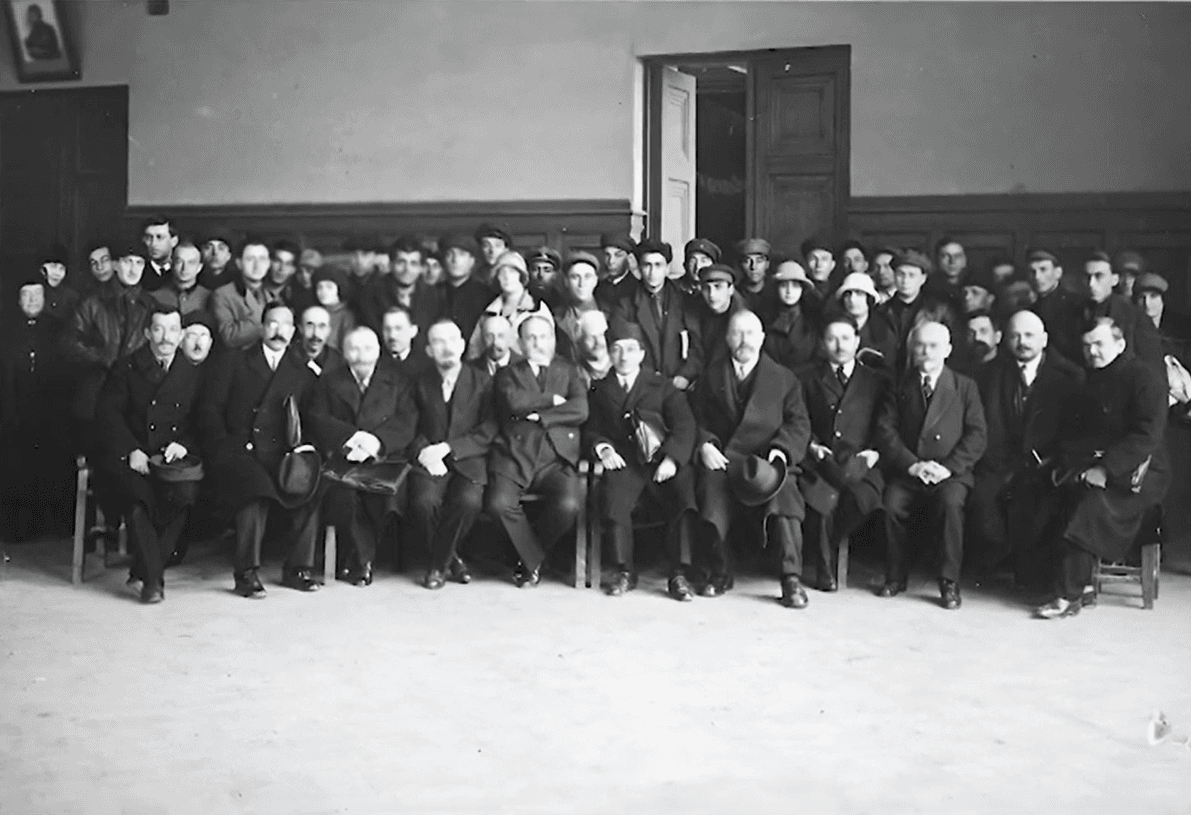
Some of the Delegates Attending the Baku Turkological Congress, Including M. Fuad Köprülü (TRT Avaz)
1926 Baku Turkology Congress (First Baku Turkological Congress) is recognized as a turning point in the cultural and political history of Turkic peoples. The national awakening and enlightenment process, which began in the early 20th century under the influence of the Ceditçilik movement, found institutional expression through this congress. Although held within the borders of the Soviet Union, this congress is regarded as one of the foundational elements of cultural and political rapprochement among Turkic peoples, especially regarding linguistic convergence.
The initiative for convening the congress was strongly influenced by the educational reforms and the idea of "linguistic unity" launched by Ismail Bey Gasprinski. The intellectual legacy of pioneers of Turkism such as Hüseyinzade Ali Bey also provided the conceptual foundation for the congress.

Hüseyinzade Ali Bey (TRT Avaz)
The Soviet authorities initially supported the congress to strengthen their influence over Turkic peoples and to institutionalize Soviet Turkology. The primary objectives of the congress were to unify scattered Turkological studies, resolve the script issue, and reframe the cultural ties among Turkic peoples on a scientific basis.

The Ismailiye Palace Where the Congress Was Held (Today the Azerbaijan National Academy of Sciences) (Photo: Duygu Şahinler)
A large number of scholars from various republics of the Soviet Union, Europe, and Türkiye participated in the congress. Republic of Türkiye attached great importance to the event and, under special instructions from Mustafa Kemal Atatürk, sent a delegation headed by Fuad Köprülü.
A total of 131 delegates attended the congress, 93 of whom were Turkic, from various regions of the Soviet Union, Türkiye, and Europe. Among the participants were leading scholars of the era.
From Azerbaijan: 6
From Nakhchivan: 1
From Georgia: 1
From Armenia: 1
From Ajaria: 1
From Turkestan: 4
From Crimea: 3
From Tatarstan: 6
From Bashkortostan: 3
From Kazakhstan: 3
From Uzbekistan: 6
From Turkmenistan: 4
From Kyrgyzstan: 2
From the Oyrot Region: 1
From Yakutia: 3
From the Kalmyk Region: 1
From Chuvashia: 2
From Eastern Turkestan: 1
From Abkhazia: 1
From Khakassia: 1
From Karachay: 1
From the North Caucasian Turkmen Region: 1
From the Academy of Sciences: 3
From the Society of Oriental Scholars: 2
From Tashkent University: 1
From Leningrad University: 1
From the North Caucasian Executive Committee of the Council of Nationalities: 2
From the Ufa People’s Education Commissariat: 1
From the Council of Nationalities of the Russian Soviet Federative Socialist Republic: 4
From the Central Executive Committee of the USSR: 1
Two delegates were invited from South Azerbaijan.
In addition, the following individuals were personally invited: 3 from Türkiye, 2 from Azerbaijan, 2 from Armenia, 2 from Crimea, 2 from Tatarstan, 2 from Bashkortostan, 4 from Uzbekistan, 2 from North Caucasus, 1 from Leningrad, 2 from Moscow, 1 from Ukraine, 2 from Dagestan, 2 from Transcaucasia, 2 from Germany, and 1 from Hungary.【1】
Some of the leading scholars who attended the congress include:【2】
Theodor Menzel of the German delegation proposed that the congress be dedicated in honor of Wilhelm Radloff; in response, the Turkish delegates suggested honoring Ismail Bey Gasprinski. Both proposals were accepted, and the congress was dedicated to both figures.【3】
At the congress, 17 sessions were held and 38 papers were presented under headings related to Turkic history, Turkic ethnography, The relatedness of Turkic languages, Turkic languages, orthography, alphabet, literary language and its history, teaching methodology, geography, and culture.【4】
The most heated debate at the congress concerned the change of script. Most participants argued that the Arabic alphabet was unsuitable for representing the phonological structure of Turkic languages. Some groups, such as the Tatarstan delegates, opposed this view. Nevertheless, the idea of adopting a new alphabet based on Latin script gained overwhelming support at the congress.

The First Turkic Alphabet Adapted to the Latin Script After the Congress (TRT Avaz)
At 1926 Baku Turkology Congress, scholars debating terminology grouped into four perspectives: those favoring Arabic-Persian sources, European-Russian sources, Turkic language sources, and a democratic approach. The prevailing view concluded that priority should be given to Turkic dialects in deriving terminology, with recourse to other sources only when insufficient.【5】
During this process, Prof. Dr. Bekir Çobanzade argued for the creation of a rich and common literary language capable of encompassing the mental structures of Turkic peoples and presented a technical roadmap for achieving this. Bekir Çobanzade’s proposals—creating a common communication language, identifying root sources for enriching the vocabulary, and implementing a three-stage educational reform based on a systematic foundation—were not only discussed at Baku Congress but also recognized as among the congress’s most fundamental decisions.【6】
Çobanzade viewed the common language not merely as a romantic ideal but as a technical process to be constructed through education and science. The core principles of his views were as follows:
Çobanzade stated that the vocabulary of the common language should be drawn from three main sources:
Çobanzade proposed a three-stage educational plan for developing the common language:
Although overshadowed by debates on language and alphabet, the congress also featured significant papers on history, literature, ethnography, folklore, and museology. Participants emphasized the need to collect orally transmitted cultural products, epics, and ethnographic data using scientific methods. However, these proposals did not gain the same prominence as those on language and script. Additionally, discussions took place on the scientific methodologies to be used in Turkological research.
Atatürk placed great importance on Türkiye’s relationship with the Turkic world and advocated for maintaining spiritual bridges on issues such as language and history.【7】 The Republic of Türkiye attached great importance to the congress and sent a delegation under the instructions of Mustafa Kemal Atatürk. The Turkish delegation closely followed the debates on script reform, and this process helped lay the groundwork for the Alphabet Reform that would take place in Türkiye in 1928.
The most concrete and far-reaching outcome of the congress was the decision to adopt the Latin alphabet. Azerbaijan’s experience since 1922 in implementing the Latin script served as a model. After intense debates, it was decided that, due to the Arabic alphabet’s inadequacy in representing Turkic phonology, all Turkic peoples should transition to the Latin alphabet. This decision was a strategic step aimed at strengthening cultural ties among Turkic states and communities.
Another recommendation adopted in the final report was the establishment of Turkological centers in various locations. These centers would collect and microfilm all sources and manuscripts related to Turkology. Furthermore, all centers would maintain communication with each other and support Turkic scholars.【8】
As a result of the first congress in Baku, it was decided that the second congress would be held in Samarkand two years later.【9】
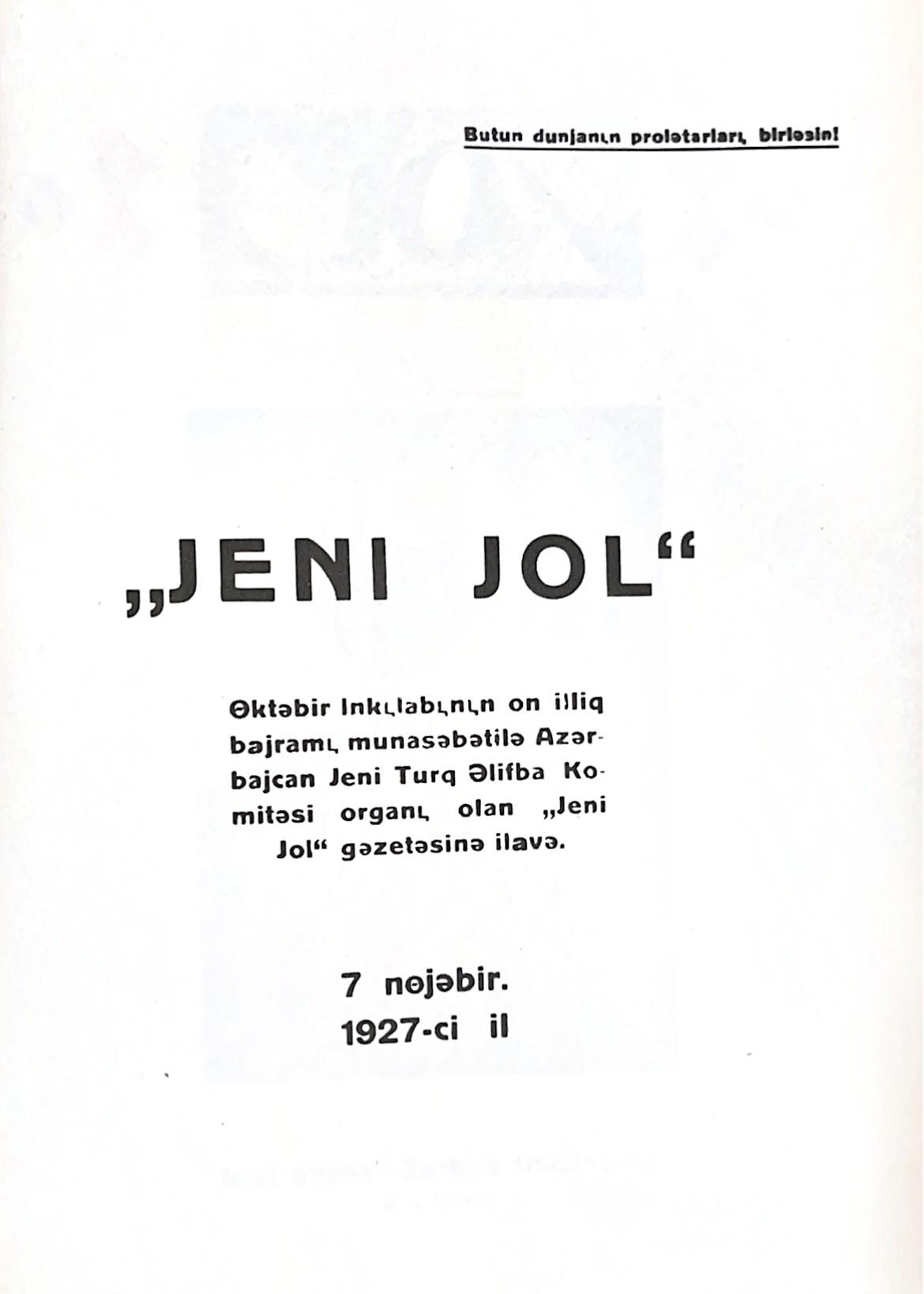
The First Publication in Azerbaijan Using the Latin Alphabet: Yeni Yol Newspaper (Nerimanoğlu et al., p.485)
The congress served as a rare “platform for reconciliation” for global Turkological circles. Until then, Western and Eastern (Soviet/Russian and Turkish) Turkological communities had developed in isolation; the Baku congress provided them with an opportunity to meet. This gathering created an environment for mutual recognition of different scholarly schools and the discussion of scientific methodologies.
The congress is regarded as a “turning point” for the peoples of Turkistan (Central Asian Turkic communities). The decisions made, especially regarding the transition to the Latin alphabet, directly affected their cultural destiny and position within the Soviet system. The congress was one of the critical historical events determining the direction of modernization in the Turkistan region.
Although it was decided at Baku Turkology Congress that the second congress would be held in Samarkand two years later, this decision was never implemented. Orthography conferences were held in Akmescit in 1927, Samarkand in 1928, and Almaty in 1930, during which issues of orthography in Crimean Tatar, Uzbek, and Kazakh Turkic were discussed. Topics related to the transition to the Latin alphabet, as decided in 1926, were also addressed.

Applause for the Adoption of the New Alphabet at the Turkological Congress (from Yeni Yol Newspaper, Nerimanoğlu, p.494)
Work halted in the Soviet Union due to political repression known as “Repressiya.” In 1932, these efforts continued in Ankara with the Turkish Language Congress.
The process of script and cultural unity initiated by the 1926 Baku Congress suffered a definitive rupture with the 1936 Ashgabat Turkmenology Congress, which reversed all previously adopted policies. Despite the 1926 decision to adopt the Latin alphabet, this congress mandated that all Turkic communities within the Soviet Union switch to the Cyrillic alphabet. Other topics discussed included writing rules, translation of Marxist-Leninist classics, and their dissemination.【10】
After a 50-year gap, Soviet Turkology congresses were held in Almaty in 1976, Tashkent in 1980, and Ashgabat in 1988 during the dissolution of the Soviet Union. These meetings focused on Soviet-era Turkological research.
The decision to adopt the Latin alphabet at Baku directly influenced debates and reform processes in the Republic of Türkiye. The adoption of Latin script by Azerbaijan and other Turkic communities facilitated support for the Alphabet Reform in Türkiye among Turkish nationalist intellectuals and organizations such as the Turkish Hearth.
The congress became a site of apparent cooperation between the Soviet Union and the Republic of Türkiye, but behind the scenes, it was a field of “secret competition.” The Soviet regime sought to strengthen its influence over Turkic peoples within its borders and to keep them under the umbrella of “Soviet Turkology” rather than Türkiye’s cultural sphere. Türkiye, on the other hand, participated in the congress to strengthen the cultural foundations of its newly established republic and preserve spiritual ties with Turkic peoples abroad. This transformed the congress from a purely scientific meeting into a stage for strategic maneuvers by the two states.【11】
Following the Baku Congress, the process of ending Turkological cooperation between Türkiye and Russia began. Russia began eliminating and arresting Turkic intellectuals and Turkologists who supported the Latin alphabet transition at the congress. After Türkiye’s adoption of the Latin alphabet in 1928, by the 1930s the decision to transition Turkic communities under Soviet rule to the Latin alphabet was entirely abandoned.【12】

Organizing Committee of the Turkological Congress (from Yeni Yol Newspaper, Nerimanoğlu, p.494)
Although the congress began as a scientific endeavor, it ultimately became a tragedy for its participants. In the mid-1930s, under Stalin’s regime, the Soviet authorities came to view the cultural rapprochement they had initially supported as a threat. By the end of the 1930s, the Repression (Purge) period began.
Many intellectuals who attended the congress—including Bekir Çobanzade, Ahmed Baytursun, Kasım Tınıstanov, Selman Mümtaz, and Hanefi Zeynallı—were executed or exiled in 1937–1938 under accusations of being “Pan-Turkists,” “spies,” and “enemies of the people.” Their works were banned and destroyed. In these cases, mere participation in the congress was treated as a criminal act. The repression became so extreme that even non-Turkic scholars such as Aleksandr Samoylovich and Rudolfovich Zilfeld were executed on the pretext of being “Pan-Turkists.”
In the end, the accusation of Pan-Turkism became the primary justification for political repression and purges against Turkic intellectuals. Academic research on the Turkic language, history, and folklore was equated with opposition to the regime. Not only researchers but also historical epics such as Dede Korkut, Manas, and Alpamysh, and even the characters within these works, became targets of ideological condemnation. Intellectuals who studied or published these works were sentenced to imprisonment, exile, or execution as “anti-system” and “enemies of the people.”【13】
The decision made at the Baku Turkological Congress to adopt a Latin-based common alphabet, though interrupted by political repression and the “Repressiya” period, has been revived nearly a century later. The consensus reached by the Turkic World Common Alphabet Commission on a 34-letter Common Turkic Alphabet that represents the distinct phonemes of Turkic languages is the most concrete manifestation of the seeds planted in 1926.【14】
The 12th Summit of the Organization of Turkic States, held in Gebele, Azerbaijan, marks a historical milestone in which the ideal of a “common written language and alphabet,” first laid out at the 1926 Baku Congress but left incomplete due to historical ruptures, has been realized through the most concrete and institutionalized steps a century later.【15】 This ideal, advocated in 1926, has been implemented through the experimental publication of works such as Abay Kunanbay’s Kara Sözler and Cengiz Aytmatov’s White Ship using the common alphabet, enabling Turkic peoples to read each other’s classics without translation.【16】
1926 Baku Language Congress (TRT Avaz)
The 1926 Baku Turkological Congress was the first comprehensive scientific initiative aimed at achieving script and terminology unity among Turkic-speaking peoples, culminating in the adoption of the Latin-based alphabet. The theoretical framework developed by Bekir Çobanzade and other delegates was interrupted in the 1930s by changing Soviet policies and the purging of intellectuals (Repressiya); the Latin alphabet was replaced by the Cyrillic script and policies of fragmentation. Today, the 34-letter Common Turkic Alphabet project, led by the Turkish Academy of Sciences and related institutions, draws its technical and historical foundations largely from the decisions and methodologies of this congress.
To mark the centenary of the 1926 Baku Congress—a historic turning point for the scientific, cultural, and linguistic unity of the Turkic world—Turkological Congress 2026 aims to establish a lasting foundation for scientific cooperation among Turkic academic institutions.
During the 80th anniversary events of the Azerbaijan National Academy of Sciences, a Memorandum of Understanding was signed between TÜBA and AMEA on the occasion of the 8th General Assembly of UNASTW to implement the congress. TÜBA President Prof. Dr. Muzaffer Şeker emphasized that this collaboration is a valuable partnership strengthening the scientific and cultural solidarity of the Turkic world. As a concrete example of this historical continuity, TDK President Prof. Dr. Osman Mert attended the “From Yesterday to Today: The First Turkological Congress” program held on September 30, 2025, in the same hall where the 1926 congress took place, organized jointly by TDK and AMEA. The congress, opened by Prof. Dr. İsa Habibbeyli, comprehensively addressed the century-long journey of the common alphabet idea and its contemporary relevance.
Prof. Dr. Mert’s assessment titled “The Common Alphabet Issue in the Turkic World from the 1926 Baku First Turkological Congress to the Present” interpreted the 2024 consensus within the Organization of Turkic States on the 34-letter “Common Turkic Alphabet” as a milestone toward realizing the 99-year-old ideal. He also recalled that more than 80 of the 131 delegates who attended the congress were executed by Stalin’s regime between 1937 and 1938, honoring these esteemed figures with gratitude and remembrance.
Turkological Congress 2026, planned by TÜBA and AMEA, will comprehensively reassess the past, present, and future of Turkology on a scientific basis; integrate the legacy of the First Baku Turkological Congress with contemporary scientific understanding to promote joint projects, publications, and exchange programs for young researchers; and bring new dimensions such as digital ecosystems, artificial intelligence, and terminology unity into the discourse on the common alphabet.
[1]
Ahmet Buran. Kurşunlanan Türkoloji. Ankara: Akçağ Yayınları, 2010: 291-292.
[2]
Kâmil Veli Nerimanoğlu, "1926-Bakü Türkoloji Kurultayı Üzerine", 1926 Bakü Türkoloji Kurultayı Tutanaklar (26 Şubat-6 Mart 1926), çev. Prof. Dr. Mustafa Öner, Ankara: TDK, 2008: 3-6; Buran, Kurşunlanan Türkoloji, 293.
[3]
Nerimanoğlu, "1926-Bakü Türkoloji Kurultayı Üzerine", 14.
[4]
Nerimanoğlu, "1926-Bakü Türkoloji Kurultayı Üzerine", 13-14; Theodor Menzel, 1926 Bakü 1. Türkoloji Kongresi, çev. Doç. Dr. Bekir Direkçi, Konya: Palet Yayınları, 2017: 15-16.
[5]
Nerimanoğlu, "1926-Bakü Türkoloji Kurultayı Üzerine", 16.
[6]
Pervin Eyvazov, "I. Bakü Türkoloji Kurultayı'ndaki (1926) Konuşmalarında Bekir Çobanzade'nin Ortak Türkçe Üzerine Görüşleri," Yeni Türkiye, 146 (2025): 48-50.
[7]
Selami Kılıç, “Atatürk’ün Büyük Özlemi Türk Dünyası’nda Kültür Birliği”. Atatürk Dergisi 3, 1 (Şubat 2010): 1.
[8]
Buran, Kurşunlanan Türkoloji, 298.
[9]
Buran, Kurşunlanan Türkoloji, 298.
[10]
Buran, Kurşunlanan Türkoloji, 300.
[11]
Mustafa Oral, "1926 Bakü Türkoloji Kongresi", Türk Dünyası Ansiklopedisi, Atatürk Araştırma Merkezi, https://turkdunyasiansiklopedisi.gov.tr/detay/1594/1926-Bak%C3%BC-T%C3%BCrkoloji-Kongresi
[12]
Buran, Kurşunlanan Türkoloji, 300-301.
[13]
Buran, Kurşunlanan Türkoloji, 301-303.
[14]
Türk Dil Kurumu. "Türk Dünyası Ortak Türk Alfabesinde Uzlaştı." Türk Dil Kurumu. Erişim Tarihi:18.01.2026.
https://tdk.gov.tr/icerik/basindan/turk-dunyasi-ortak-turk-alfabesinde-uzlasti/
[15]
Anadolu Ajansı. "Cumhurbaşkanı Erdoğan: Ortak alfabe hususunda Türkiye olarak ilk adımı atıyoruz." Anadolu Ajansı. Erişim: 18.01.2026.
[16]
Anadolu Ajansı. "Türk Akademisi Başkanı Mustafayev, kitapları ortak Türk alfabesi ile yayınlamaya başladıklarını söyledi." Anadolu Ajansı. Erişim: 18.01.2026.

No Discussion Added Yet
Start discussion for "1926 Baku Turkology Congress" article
Historical Background
Participation in the Congress
Key Agenda Items and Discussed Topics
The Alphabet Issue
The Issue of a Common Language and Terminology
Bekir Çobanzade’s Concept of a Common Language
The “Triple Base” System in Vocabulary
Three-Stage Educational Transition Plan
Folklore and History
The Role of Atatürk and the Turkish Delegation
Decisions Made at the Congress
Decision to Adopt the Latin Alphabet
Decision to Establish Turkological Centers
Decision to Hold a Second Congress
Political and Geopolitical Nature of the Congress
A Platform for Reconciliation Between Eastern and Western Turkology
A Historical Turning Point for the Peoples of Turkistan
Post-Congress Developments and the Tradition of Turkological Congresses
Orthography Conferences (1927–1930)
Turkish Language Congresses (from 1932)
Turkmenology Congress (1936)
Soviet Turkology Congresses (1976–1988)
Post-Congress Developments and Political Repercussions
Alphabet Reform in Türkiye
Impact on Relations Between Türkiye and the Soviet Union
Repression and Purge Period
Legacy of the Baku Turkological Congress Today
100th Anniversary of the Congress