


This article was automatically translated from the original Turkish version.
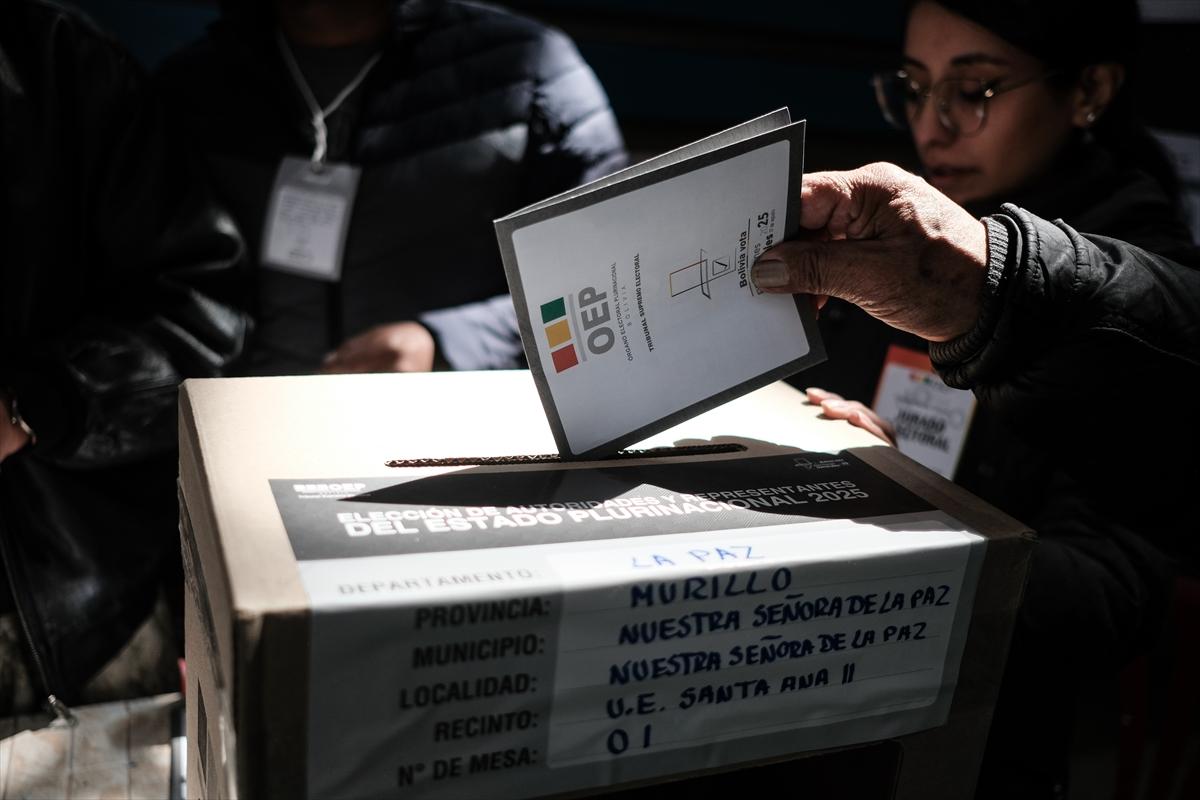
(Source: Anadolu Agency)
2025 Bolivia General Elections
History | 19 October 2025 (2nd round) 17 August 2025 (1st round) | ||||||||
|---|---|---|---|---|---|---|---|---|---|
Election Type | General election (presidency and parliament) | ||||||||
Number of Voters | 7.9 million | ||||||||
Newly Elected Head of State | Rodrigo Paz Pereira | ||||||||
The 2025 Bolivian general elections were held on 17 August 2025 to elect the president and the legislative body. The electoral process, culminating in a second round on 19 October 2025, marked the end of approximately twenty years of rule by the Movement for Socialism party (Movimiento al Socialismo – MAS), which has governed the country since 2006.

Voting for the presidential election in Bolivia, 17 August 2025 – (Anadolu Ajansı)
To be elected president in the first round, a candidate must secure more than 50 percent of the vote or at least 40 percent with a margin of at least ten percentage points over the second-place candidate. As no candidate met these conditions, the election proceeded to a second round, in which Rodrigo Paz Pereira won the presidency on 19 October 2025.
The country had approximately 7.9 million registered voters, and voting was compulsory. Voting began at 08:00 and ended at 16:00. The electoral process was generally peaceful, with no major violations reported beyond isolated incidents. It was decided that the new president would take the oath of office and assume duties on 8 November 2025.

Voting for the presidential election in Bolivia, 17 August 2025 – (Anadolu Ajansı)
Since 2006, the Movement for Socialism party (MAS) has been the dominant force in Bolivian politics. Under the leadership of Evo Morales, MAS won uninterrupted victories in the 2005, 2009, 2014 and 2020 elections. The Morales era was defined by policies such as the nationalization of natural gas revenues, reduction of foreign debt and a significant decline in extreme poverty.
The 2019 elections were marred by allegations of fraud, leading to widespread protests and Morales’s resignation and departure from the country. In the 2020 elections, Luis Arce, a former economy minister and Morales’s ally, won with 52.4 percent of the vote. However, he soon developed political rifts with Morales. Protests against the government intensified in 2023 amid deepening currency and fuel crises, and the split between Arce and Morales became increasingly evident within MAS.
Morales expressed his intention to run in the 2025 elections, but his candidacy was rejected by the Constitutional Court and the Supreme Electoral Tribunal. In 2024, an arrest warrant was issued against him on charges of human trafficking, which he denied, and he urged his supporters to cast invalid votes. In the 2025 elections, MAS received its lowest vote share in its history.

Voting for the presidential election in Bolivia, 17 August 2025 – (Anadolu Ajansı)
The 2025 Bolivian general elections were held on Sunday, 17 August 2025. The voting process was conducted by the Supreme Electoral Tribunal (Tribunal Supremo Electoral – TSE), whose president, Óscar Hassenteufel, declared the day peaceful. Photographs of ballot results were transmitted electronically to a central office, followed by the official count.
The European Union (EU) deployed 120 observers, and representatives from the Organization of American States (OAS) and other institutions monitored the elections. According to observation reports, the elections were generally transparent. Isolated incidents were recorded in some regions; for example, Andronico Rodríguez was attacked with stones in the Entre Ríos district of Cochabamba and voted under police escort. A small explosion occurred in the same area, but no serious damage or casualties were reported.
Eight candidates competed in the 2025 Bolivian general elections. They represented diverse ideological positions, and their campaigns focused primarily on the economic crisis, combating corruption and foreign policy.
Rodrigo Paz Pereira is the candidate of the Christian Democratic Party (Partido Demócrata Cristiano – PDC). A senator from Tarija and the son of former president Jaime Paz Zamora, Paz built his campaign around the slogan “capitalism for everyone.” He pledged to increase resource transfers from the central government to regions, combat corruption, facilitate access to credit, reduce the informal economy through tax incentives and remove import barriers on goods not produced in Bolivia. His running mate was former police captain Edman Lara Montaño, known for exposing corruption within the police force.
Jorge Quiroga is the candidate of the conservative coalition Alianza Libre. He served as interim president from 2001 to 2002 and previously held the position of vice president under Hugo Banzer. His campaign emphasized ending what he called the “20 lost years,” promising cuts in public spending, weakening ties with Venezuela, Cuba and Nicaragua supported by left-wing governments, and implementing radical economic transformations.

Former President Jorge 'Tuto' Quiroga (pictured) at a voting center in La Paz, 17 August 2025 – (Anadolu Ajansı)
Samuel Doria Medina is the candidate of the Unidad (UN) alliance. A businessman from the private sector, Medina led opinion polls for much of the campaign but finished third in the election. After the vote, he announced his support for Rodrigo Paz Pereira in the second round.

Center-right candidate Samuel Doria Medina, a 66-year-old businessman (pictured), at a voting center in La Paz, 17 August 2025 – (Anadolu Ajansı)
Eduardo del Castillo, the MAS candidate and former minister of the interior, is 36 years old. He received the lowest vote share in MAS’s history, securing only 3.16 percent of the vote. This result narrowly surpassed the 3 percent legal threshold required for the party to maintain its official status.
Andrónico Rodríguez, a former ally of Morales and leader of the coca growers’ union, ran as a candidate under a small coalition after leaving MAS. Although initially expected to perform strongly, he finished fourth with 8.22 percent of the vote. During voting, he was attacked with stones and voted under police escort after an explosive device detonated near a polling station in his district.
Manfred Reyes Villa, representing the Súmate movement, finished fifth with 6.62 percent of the vote. Other candidates from smaller parties also participated but received low vote shares.

Bolivian presidential candidate Jorge Quiroga Ramirez’s final rally in La Paz, 14 August 2025 – (Anadolu Ajansı)
According to preliminary results announced by the Supreme Electoral Tribunal, no candidate secured enough votes to win the presidency in the first round, forcing a second round to be held on 19 October 2025.
The rate of invalid and blank votes ranged between 19 and 21.5 percent. As no candidate met the threshold for victory in the first round, the election proceeded to a second round. The runoff will feature Rodrigo Paz Pereira, who received the highest number of votes, and Jorge “Tuto” Quiroga, who came in second.
The second round of voting took place on Sunday, 19 October 2025. The contest between Rodrigo Paz Pereira of the Christian Democratic Party (PDC) and Jorge “Tuto” Quiroga of Alianza Libre formally ended the MAS administration that had held power since 2006. According to results announced by the Supreme Electoral Tribunal (TSE), with 97 percent of polling stations counted, Rodrigo Paz received 54.5 percent of the vote, while Jorge Quiroga received 45.4 percent.
TSE President Óscar Hassenteufel declared the results “irreversible.” Voting began at 08.00 and ended at 16.00 on election day. No major incidents occurred, and the process generally proceeded peacefully. Early projections suggested Quiroga was leading, but as official counts advanced, Rodrigo Paz gained a clear advantage.
After the results were announced, celebrations took place in La Paz and Tarija. Quiroga accepted the outcome and publicly congratulated Paz. The new president’s term will begin with the inauguration ceremony on 8 November 2025.

Rodrigo Paz, winner of the Bolivian presidential election, 20 October 2025 – (Anadolu Ajansı)
At the time of the second round, Bolivia was facing one of its most severe economic crises in the past four decades. Inflation reached 23 to 25 percent, and nationwide long queues formed due to shortages of US dollars and fuel. Natural gas production declined by 46 percent, and energy revenues fell from $6.1 billion in 2013 to $1.6 billion in 2024.
Rodrigo Paz campaigned on a platform of “capitalism for everyone,” pledging support for small and medium-sized enterprises, reduction of the informal economy, and incentives for production. He also proposed a model in which half of central government revenues would be shared with regional administrations. Jorge Quiroga, by contrast, promised spending cuts, privatization of state enterprises, and a financial program backed by the International Monetary Fund.
Both candidates advocated for the normalization of relations with the United States. US Secretary of State Marco Rubio stated before the election that “both candidates seek stronger ties with Washington.” Media reports indicated that Paz had held discussions with US officials prior to the vote regarding a $1.5 billion economic cooperation agreement.
According to the election results, Rodrigo Paz’s PDC won 49 seats in the Chamber of Deputies and 16 seats in the Senate. This outcome compels the government to form a coalition to secure legislative support, as it lacks an outright majority.
After the election, Paz’s running mate Edman Lara Montaño called for “a time of unity and consensus.” Lara’s popularity among the general public, particularly among younger voters, played a significant role in shaping electoral trends. However, trade unions have announced their opposition to any reduction in social assistance programs.
In post-election statements, Rodrigo Paz indicated that his top priorities would be securing fuel supplies and strengthening foreign exchange reserves. It was announced that universal fuel subsidies would be phased out gradually, while targeted support would continue for vulnerable sectors.
Al Jazeera. “Bolivia Elects Centre-Right Rodrigo Paz as President.” Al Jazeera English. Accessed October 20, 2025. https://www.aljazeera.com/news/2025/10/20/bolivia-elects-centre-right-rodrigo-paz-as-president
Al Jazeera. “Bolivia to hold presidential run-off between centrist and right-winger.” Al Jazeera. Accessed August 19, 2025. https://www.aljazeera.com/news/2025/8/18/bolivia-to-hold-presidential-run-off-between-centrist-right-wing-candidates
Anadolu Ajansı. “Bolivya’da Devlet Başkanı Seçimini Rodrigo Paz Kazandı.” Accessed October 20, 2025. https://www.aa.com.tr/tr/dunya/bolivyada-devlet-baskani-secimini-rodrigo-paz-kazandi/3721459#
Anadolu Ajansı. “Bolivya’daki Devlet Başkanı Seçimi, Solun 20 Yıllık İktidarına Son Verdi.” Accessed August 19, 2025. https://www.aa.com.tr/tr/dunya/bolivyadaki-devlet-baskani-secimi-solun-20-yillik-iktidarina-son-verdi/3663328#
Associated Press (AP). “Centrist Rodrigo Paz wins Bolivia’s presidential runoff, topping right-wing rival.” AP News. Accessed October 20, 2025. https://apnews.com/article/bolivia-runoff-election-jorge-quiroga-rodrigo-paz-ef7643d07d8968452cdce784e75a7810
BBC News. “Bolivia set to elect first non-left wing president in two decades.” BBC News. Accessed August 19, 2025. https://www.bbc.com/news/articles/c4gzlp85432o
European Union External Action Service (EEAS). “EU Deploys 120 Observers for Bolivia’s General Elections.” EEAS. Accessed August 19, 2025. https://www.eeas.europa.eu/eom-bolivia-2025/eu-deploys-120-observers-bolivia%E2%80%99s-general-elections_en?s=410499
Reuters. “Bolivia Heads to Runoff after Right-Turn Presidential Vote.” Accessed August 19, 2025. https://www.reuters.com/world/americas/bolivia-heads-runoff-after-right-turn-presidential-vote-2025-08-18/
Reuters. “Centrist Rodrigo Paz wins Bolivian presidency, ending nearly 20 years of leftist rule.” Reuters. Accessed October 20, 2025. https://www.reuters.com/world/americas/bolivia-votes-runoff-election-marking-pro-market-shift-us-embrace-2025-10-19/
Statista. "First round results of the 2025 presidential elections in Bolivia." Statista. Accessed August 19, 2025. https://www.statista.com/statistics/1621391/votes-first-round-presidential-elections-in-bolivia/
The Guardian. “Two decades of leftwing dominance end in Bolivia as rightwingers head to election runoff.” Accessed August 19, 2025. https://www.theguardian.com/world/2025/aug/18/bolivia-presidential-election-preliminary-results

(Source: Anadolu Agency)
2025 Bolivia General Elections
History | 19 October 2025 (2nd round) 17 August 2025 (1st round) | ||||||||
|---|---|---|---|---|---|---|---|---|---|
Election Type | General election (presidency and parliament) | ||||||||
Number of Voters | 7.9 million | ||||||||
Newly Elected Head of State | Rodrigo Paz Pereira | ||||||||
No Discussion Added Yet
Start discussion for "2025 Bolivia General Elections" article
Election System and Overall Participation
Political Background
First Round (17 August 2025)
Election Day and Organization
Candidates and Parties
Rodrigo Paz Pereira
Jorge “Tuto” Quiroga
Samuel Doria Medina
Eduardo del Castillo
Andrónico Rodríguez
Other Candidates
First Round Election Results
Vote Shares (2025 Bolivian General Election – First Round)
Second Round (19 October 2025)
Vote Shares (2025 Bolivian Election – Second Round)
Economic and Political Background
New Era and Parliamentary Composition