

 Recently Added:
This article was automatically translated from the original Turkish version.
The 2026 Shanghai Cooperation Organization (SCO) Summit is a meeting of the Council of Heads of State coinciding with the 25th anniversary of the organization’s founding and taking place in the capital of Kyrgyzstan, Bishkek. Events related to the summit will be held between 30 August and 1 September 2026, with the main Council of Heads of State meeting scheduled for 1 September 2026.
The summit is hosted by Kyrgyzstan, which holds the organization’s 2025–2026 presidency, and will be chaired by Kyrgyz President Sadyr Japarov. The theme of the summit has been set as “25 Years of the SCO: Together for Sustainable Peace, Development and Prosperity” (“The SCO’s 25th Anniversary: Together for Sustainable Peace, Development and Prosperity”).
Shanghai Cooperation Organization (SCO) Summit is being held in 2026 in Bishkek, the capital of Kyrgyzstan. The main meeting of the Council of Heads of State will take place on 1 September 2026. Events under the summit program will begin on 30 August.
Some of the meetings and events associated with the summit will be held at the Ala-Archa State Residence in Bishkek. In addition to SCO member states, senior representatives from observer and partner countries of the organization will also attend the summit.
The summit is expected to be attended by Chinese President Xi Jinping, Russian President Vladimir Putin, Indian Prime Minister Narendra Modi, Pakistani Prime Minister Shehbaz Sharif, and Iranian President Masoud Pezeshkian. It has also been reported that the leaders of Kazakhstan, Uzbekistan, and Belarus, as well as Tajik President Emomali Rahmon, will attend the summit.
Although not an SCO member, Turkish President Recep Tayyip Erdoğan, United Nations Secretary-General António Guterres, and ASEAN Secretary-General Kao Kim Hourn are also expected to attend; the summit will be chaired by Kyrgyz President Sadyr Japarov in his capacity as host.
Xi Jinping arrived in Bishkek on 30 August 2026 (Sunday). His delegation includes his wife Peng Liyuan, Foreign Minister Wang Yi, and Director of the General Office of the Communist Party of China Cai Qi. Iranian President Masoud Pezeshkian arrived in Bishkek on 31 August 2026 (Monday) for a two-day visit, accompanied by Foreign Minister Abbas Araghchi. Pezeshkian is scheduled to deliver a speech at the SCO Summit on the second day of his visit.
A number of bilateral meetings are planned on the margins of the summit. Kremlin Advisor on Foreign Policy Yuri Ushakov has announced that Putin will hold separate bilateral meetings with Pezeshkian and Xi.
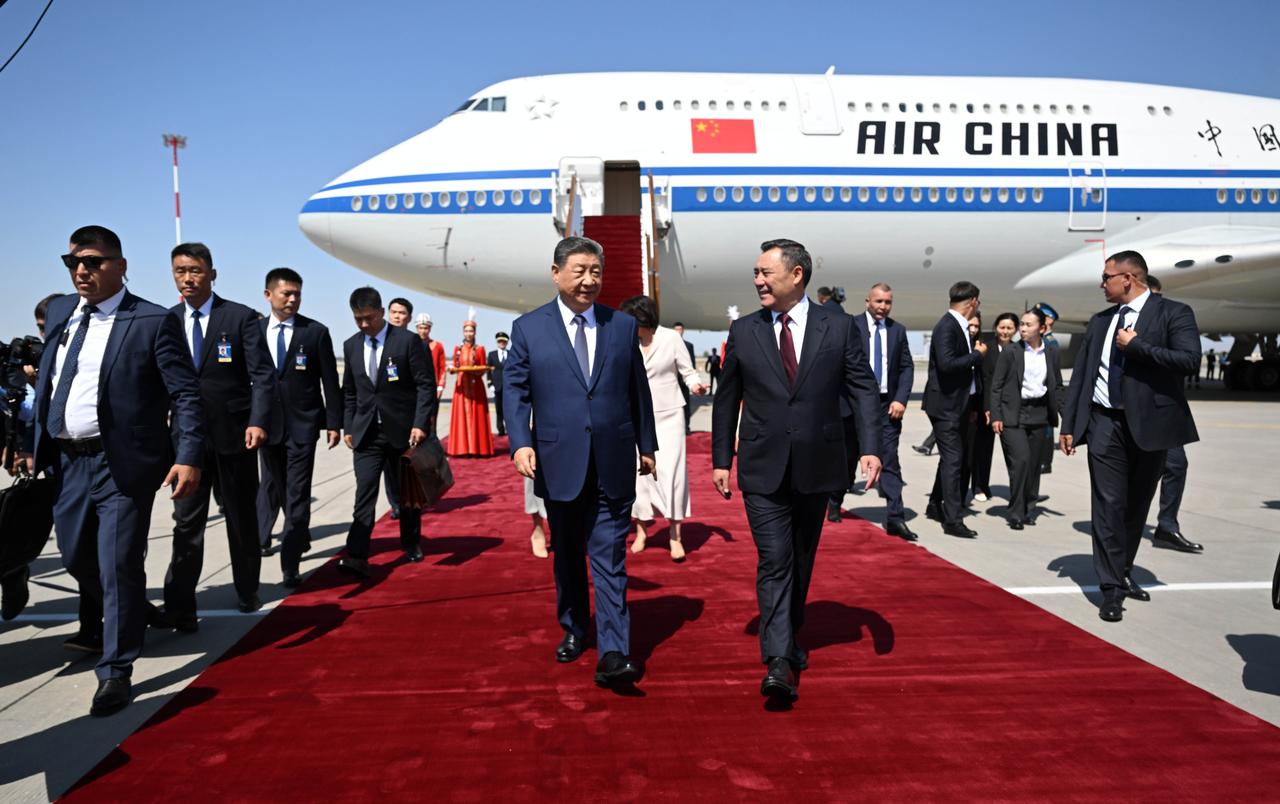
Chinese President Xi Jinping in Kyrgyzstan, 30 August 2026 - (Anadolu Agency)
Putin will hold a total of nine bilateral meetings on the sidelines of the summit: he will meet with Xi Jinping on 31 August, hold talks with Narendra Modi, and meet with Kazakh President Kassym-Jomart Tokayev. On 1 September, he is scheduled to meet with Masoud Pezeshkian and also hold talks with President Erdoğan, with an agenda addressing the situation in Ukraine and the Black Sea region. Ushakov noted that given the tense situation in the Middle East and around Iran, the importance of the meeting with Pezeshkian is self-evident.
Another item on the agenda is a Putin meeting with Armenian Prime Minister Nikol Pashinyan, focusing on Armenia’s orientation toward Europe. Putin is also expected to hold meetings with the leaders of Kyrgyzstan, Tajikistan, and Mongolia on the sidelines of the summit. After their Saturday meetings, Russian and Belarusian heads of state Putin and Alexander Lukashenko are expected to hold an additional informal meeting. Putin is scheduled to meet with journalists following the summit.
Pezeshkian is also expected to hold bilateral meetings with Modi, Sharif, Japarov, and Rahmon. Modi is also expected to hold a bilateral meeting with Japarov; his stop in Bishkek follows the Tashkent leg of his Central Asia tour.
On 25 August, a high-level border talks tour was held in Beijing between China and India, during which both sides agreed to maintain stability along the border and continue efforts toward resolving outstanding issues.
At the summit, leaders are expected to address regional and international security issues, including conflicts in the Middle East and Ukraine, instability in Afghanistan, and India’s relations with China and Pakistan.
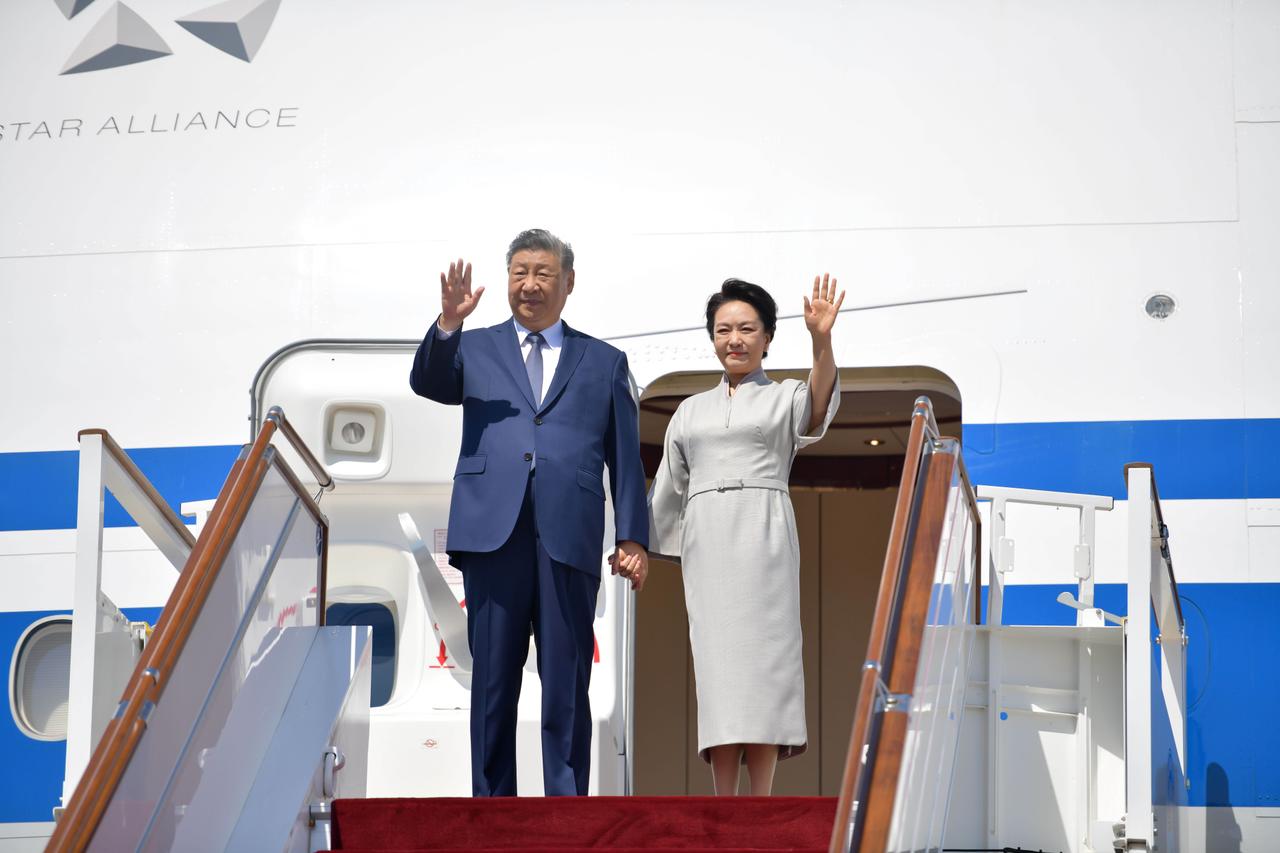
Chinese President Xi Jinping in Kyrgyzstan, 30 August 2026 - (Anadolu Agency)
At the Foreign Ministers’ meeting held in July 2026, concerns were expressed regarding developments in the Middle East and around Iran, and it was reiterated that international disputes must be resolved through political and diplomatic means in accordance with international law norms and the principles of the UN Charter. In March, the organization issued a statement condemning the US-Israeli military action against Iran. The statement emphasized that the use of force is unacceptable and that existing disagreements must be resolved solely through peaceful means, dialogue, mutual respect, and consideration of the legitimate interests of all parties.
Afghanistan remains a long-standing regional priority for the organization due to terrorism, drug trafficking, and transnational security concerns. Under the framework of counter-terrorism cooperation coordinated by the Regional Anti-Terrorist Structure based in Tashkent, the summit is expected to approve the organization’s plans for the coming year, including potential joint exercises.
Economic connectivity is another key theme of the summit. In this context, transportation infrastructure and the proposed SCO Development Bank project are prominent. The 7,200-kilometer International North-South Transport Corridor, linking St. Petersburg to Mumbai in India via Iranian and Persian Gulf ports, is one of the major transport projects of interest to member states.
In 2025, the organization reached an agreement on establishing a network of Silk Road Stations to support international freight transport across Eurasia. Discussions on the SCO Development Bank are ongoing; the fourth round of consultations on the bank’s structure and operational regulations was held in Shenzhen in June 2026, but the bank’s structure remains under negotiation.
According to SCO Secretary-General Nurlan Yermekbayev, the Kyrgyz Presidency has submitted concrete proposals ahead of the summit, including the establishment of the SCO Development Bank, the construction of new transport corridors to enhance connectivity among member states, the strengthening of joint mechanisms for climate and emergency response, and the launch of a SCO Youth Digital Forum.
The ongoing crisis in the Strait of Hormuz, with its continuing impact on global supply chains, energy markets, and financial systems, has elevated economic connectivity as a central issue at the summit, prompting discussions on new trade and transport corridors. During the planned bilateral meeting between Modi and Putin, discussions on the Northern Sea Route, which runs along the Arctic coast, are also expected. It has been reported that Moscow and New Delhi may explore India’s use of this route if Western Asia’s crises continue to disrupt traditional trade paths.
27–28 July 2026 saw the convening of the SCO Member States Media and Analytical Centers Forum at the Ala-Archa State Residence under Kyrgyzstan’s presidency. Approximately 250 representatives from member states, observer states, and dialogue partners, including heads of national news agencies, chief editors, media and analytical center representatives, relevant state institutions, international organization delegates, and SCO Secretariat staff, participated in the forum. The forum’s main theme was “The SCO in a New Era: From Mutual Understanding to Practical Cooperation.”
At the opening ceremony, speeches were delivered by the Head of the Information Policy Service of the Kyrgyz Presidency, Dairbek Orunbekov; Director of Kyrgyzstan’s state news agency Kabar, Mederbek Shermetaliyev; Deputy Director-General of Xinhua News Agency, Shi Yanchun; Chinese Ambassador to Kyrgyzstan, Liu Jiangping; a representative of the SCO Secretariat; and heads of news agencies from member states.
According to a statement issued by the Russian Presidential Administration on 28 August 2026, after the Council of Heads of State meeting, the parties are expected to adopt a final political declaration outlining their common positions, along with a series of documents on various areas of cooperation. The summit is anticipated to conclude with 20 to 25 documents, including the Bishkek Declaration. Following the Council meeting, a meeting under the SCO Plus format will be held, attended by invited leaders of observer and dialogue partner states, heads of international and regional organizations, and guests of the Kyrgyz Presidency. It is expected that this meeting will address the contribution of member states to the creation of a multipolar world order with the United Nations at its center.
The summit is expected to conclude with the adoption of the Bishkek Declaration, commemorating the organization’s 25th anniversary, along with additional documents on the organization’s development and regional and international issues. The summit will also mark the end of Kyrgyzstan’s presidency and the transfer of leadership to Pakistan, which will lead the organization until 2027 and host the 2027 summit.
Although not an SCO member, Turkish President Recep Tayyip Erdoğan departed for Bishkek on 31 August 2026 to attend the summit on behalf of Turkey, which holds dialogue partner status. The special aircraft carrying Erdoğan, his wife Emine Erdoğan, and his delegation departed from Ankara Airport at 09:00. Erdoğan was seen off at the airport by Vice President Cevdet Yılmaz, Presidential Chief of Staff Hakkı Susmaz, Ankara Governor Yakup Canbolat, and other officials. A bilateral meeting between Putin and Erdoğan on the sidelines of the summit is planned to address the Ukraine issue and the situation in the Black Sea region.
The origins of the SCO lie in agreements signed in 1996 and 1997 between Kazakhstan, China, Kyrgyzstan, Russia, and Tajikistan on confidence-building military measures and mutual reductions of armed forces along their borders. Regular meetings among the leaders of these five countries were known as the “Shanghai Five.”
The Dushanbe Declaration of 4 July 2000 decided to transform the Shanghai Five into a multilateral cooperation structure, and in the same year Uzbekistan joined the five countries.
15 June 2001 saw the six heads of state meet in Shanghai and decide to establish the Shanghai Cooperation Organization. The foundational document of the organization, the SCO Charter, was signed at the summit in St. Petersburg on 7 June 2002, entered into force on 19 September 2003, and was registered with the UN Secretariat on 1 February 2013. Today, the organization’s international legal framework consists of over 25 agreements and regulations, including the Convention on Privileges and Immunities and the Agreement on the Regional Anti-Terrorist Structure.
The organization’s fundamental objectives include strengthening mutual trust, friendship, and good-neighborly relations among member states; developing multilateral cooperation to preserve regional peace, security, and stability; taking joint action against new threats and challenges; promoting mutually beneficial cooperation in various fields; and supporting economic growth and socio-cultural development. The organization’s activities are based on the principles of mutual respect for sovereignty and territorial integrity, non-interference in internal affairs, and non-use or threat of force. Collectively, these principles are known internationally as the “Shanghai Spirit.” The SCO is not a military alliance.
Among the organization’s 29 statutory bodies are the Council of Heads of State, the Council of Heads of Government, the Council of Foreign Ministers, and the Council of National Coordinators, along with over 40 working mechanisms. The SCO has two permanent bodies: the Secretariat in Beijing and the Regional Anti-Terrorist Structure (RATS) headquartered in Tashkent; the Secretariat became operational on 15 January 2004, and the RATS Executive Committee on 17 January 2004. The organization’s non-governmental bodies include the SCO Business Council, the SCO Interbank Consortium, the SCO Youth Council, and the SCO Forum. The official languages are Russian and Chinese.
The Long-Term Treaty on Good-Neighborliness, Friendship and Cooperation, signed on 16 August 2007 and joined by India, Pakistan, Iran, and Belarus, has added a new dimension to relations among member states. India and Pakistan were admitted as full members in 2017, followed by Iran in 2023 and Belarus in 2024.
In 2026, the SCO comprises 10 member states: Belarus, India, Iran, Kazakhstan, China, Kyrgyzstan, Pakistan, Russia, Tajikistan, and Uzbekistan; 2 observer states: Afghanistan and Mongolia; and 15 dialogue partner states, including Turkey, Azerbaijan, Armenia, Egypt, Cambodia, Qatar, Kuwait, Laos, Maldives, Myanmar, Nepal, the United Arab Emirates, Saudi Arabia, and Sri Lanka. The organization does not function as a military alliance like NATO or an economic union like the EU, but operates as a consensus-based structure. Turkmenistan is the only Central Asian country not to join the SCO due to its policy of permanent neutrality. The organization’s founding declaration states that the SCO “is not an alliance directed against other states or regions.”【1】
Al Jazeera. "Rusya ve Çin Liderleri Şanghay İşbirliği Örgütü Zirvesinde Buluşacak." Accessed August 31, 2026.https://www.aljazeera.com/news/2026/8/31/russia-china-leaders-to-meet-at-shanghai-cooperation-organisation-summit
Al Jazeera. "Şi, Modi ve Putin ŞİÖ Zirvesi İçin Buluşmaya Hazırlanıyor: Gündemde Neler Var?" Accessed August 31, 2026.https://www.aljazeera.com/news/2026/8/31/xi-modi-and-putin-set-to-meet-for-sco-summit-whats-on-the-agenda
Anadolu Ajansı. "Cumhurbaşkanı Erdoğan Kırgızistan'a Gitti." Accessed August 31, 2026.https://www.aa.com.tr/tr/gundem/cumhurbaskani-erdogan-kirgizistana-gitti/4042144
Anadolu Ajansı. “Çin Devlet Başkanı Şi, ŞİÖ Zirvesi ve Devlet Ziyareti İçin Kırgızistan'a Geldi.” Accessed August 31, 2026.https://www.aa.com.tr/en/asia-pacific/chinas-xi-arrives-in-kyrgyzstan-for-sco-summit-and-state-visit/4041498
Anadolu Ajansı. “İran Cumhurbaşkanı, ŞİÖ Zirvesi İçin Kırgızistan'a Geldi.” Accessed August 31, 2026.https://www.aa.com.tr/en/middle-east/iranian-president-arrives-in-kyrgyzstan-for-sco-summit/4042318
Anadolu Ajansı. “Şi, Modi ve Putin Kırgızistan'da Buluşacak: ŞİÖ Zirvesinde Neler Bekleniyor?” Accessed August 31, 2026.https://www.aa.com.tr/en/eurasia/xi-modi-putin-to-meet-in-kyrgyzstan-what-to-watch-at-sco-summit/4040106
Global Times. "ŞİÖ Zirvesinden Devlet Ziyaretlerine, Şi'nin Gezileri Küresel Türbülans Ortasında Olumlu Mesajlar Getirecek." Accessed August 31, 2026.https://www.globaltimes.cn/page/202608/1369300.shtml
International Business Times Singapore. "ŞİÖ Zirvesi 2026: Kimler Katılıyor, Nerede Düzenleniyor ve Gündemde Neler Var?" Accessed August 31, 2026.https://www.ibtimes.sg/sco-summit-2026-who-attending-where-it-held-what-agenda-93038
Kremlin. "Vladimir Putin, 31 Ağustos-1 Eylül Tarihlerinde ŞİÖ Zirvesi'ne Katılmak Üzere Kırgızistan'ı Ziyaret Edecek." Accessed August 31, 2026.http://en.kremlin.ru/events/president/news/80613
Shanghai Cooperation Organisation. "ŞİÖ Medya ve Analitik Merkezler Zirvesi Bişkek'te Düzenlendi." Accessed August 31, 2026.https://eng.sectsco.org/20260728/2470205.html
Shanghai Cooperation Organisation. “Şanghay İşbirliği Örgütü Hakkında.” Accessed August 31, 2026.https://eng.sectsco.org/20170109/192193.html
TASS. “Kısaca: EEF'de Önemli Konuşma ve ŞİÖ Zirvesinde Bir Dizi Uluslararası Görüşme: Putin'in Programı.” Accessed August 31, 2026.https://tass.com/politics/2179145
[1]
Shanghai Cooperation Organisation. “About Shanghai Cooperation Organisation.” Shanghai Cooperation Organisation. Erişim 31 Ağustos 2026. https://eng.sectsco.org/20170109/192193.html
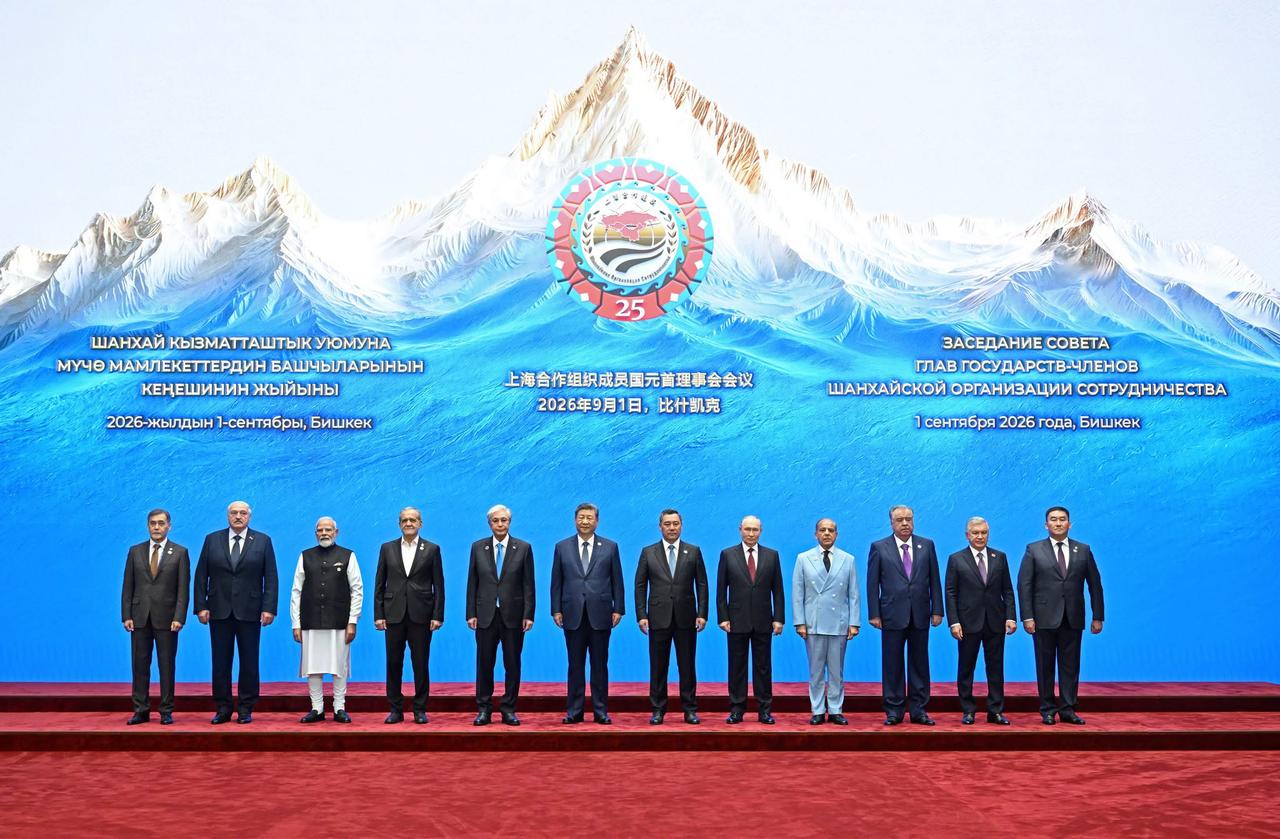
The Shanghai Cooperation Organization Council of Heads of State meeting began on 1 September 2026 (Tuesday) at the Yntymak Ordo complex in Bishkek. Kyrgyz President Sadyr Japarov welcomed the heads of state and government in the meeting hall, after which the leaders posed for a traditional family photograph. In his opening address, Japarov noted that the meeting coincides with the organization’s 25th anniversary and that this year’s theme is “Together for Sustainable Peace, Development and Prosperity”.
Japarov stated that the organization has transformed from a mechanism focused on border security into an influential global actor on the international stage, noting that its member states account for more than 40 percent of the world’s population and approximately one quarter of global GDP.
Japarov summarized the philosophy underpinning Kyrgyzstan’s presidency with the phrase “Unity is the foundation of prosperity”, emphasizing that this reflects the essence of the Shanghai Spirit. He expressed confidence that decisions made in consensus among member states would launch a new phase in the organization’s development, and formally opened the meeting. The meeting continued behind closed doors, with leaders expected to sign the “Bishkek Declaration” marking the SCO’s 25th anniversary.
Attendees included Xi
Anadolu Ajansı. “Shanghai Cooperation Organization Summit Begins in Kyrgyz Capital Bishkek.” Accessed August 31, 2026.https://www.aa.com.tr/en/world/shanghai-cooperation-organization-summit-begins-in-kyrgyz-capital-bishkek/4043325
News.am. “Shanghai Cooperation Organization Summit Kicks Off in Bishkek.” Accessed August 31, 2026.https://news.am/en/news/1058837
Qazinform. “SCO Summit Kicks Off in Bishkek.” Accessed August 31, 2026.https://qazinform.com/news/sco-summit-kicks-off-in-bishkek-12f017

Bishkek, the capital of Kyrgyzstan, has completed preparations for the 2026 Summit marking the 25th anniversary of the Shanghai Cooperation Organization (SCO). Chinese President Xi Jinping Iranian President Masoud Pezeshkian and Turkish President Recep Tay
No Discussion Added Yet
Start discussion for "2026 Shanghai Cooperation Organization (SCO) Summit" article
August 31, 2026
History and Location of the Summit
August 31, 2026
Leaders Attending the Summit
August 31, 2026
Bilateral Diplomatic Meetings
August 31, 2026
Key Issues on the Summit Agenda
August 31, 2026
Pre-Summit Preparations
August 31, 2026
Expected Outcome Documents and Transition of Presidency
August 31, 2026
President Erdoğan’s Participation in the Summit
August 31, 2026
History and Structure of the Shanghai Cooperation Organization
September 1, 2026
Official Opening of the Council of Heads of State Meeting