


This article was automatically translated from the original Turkish version.
+2 More
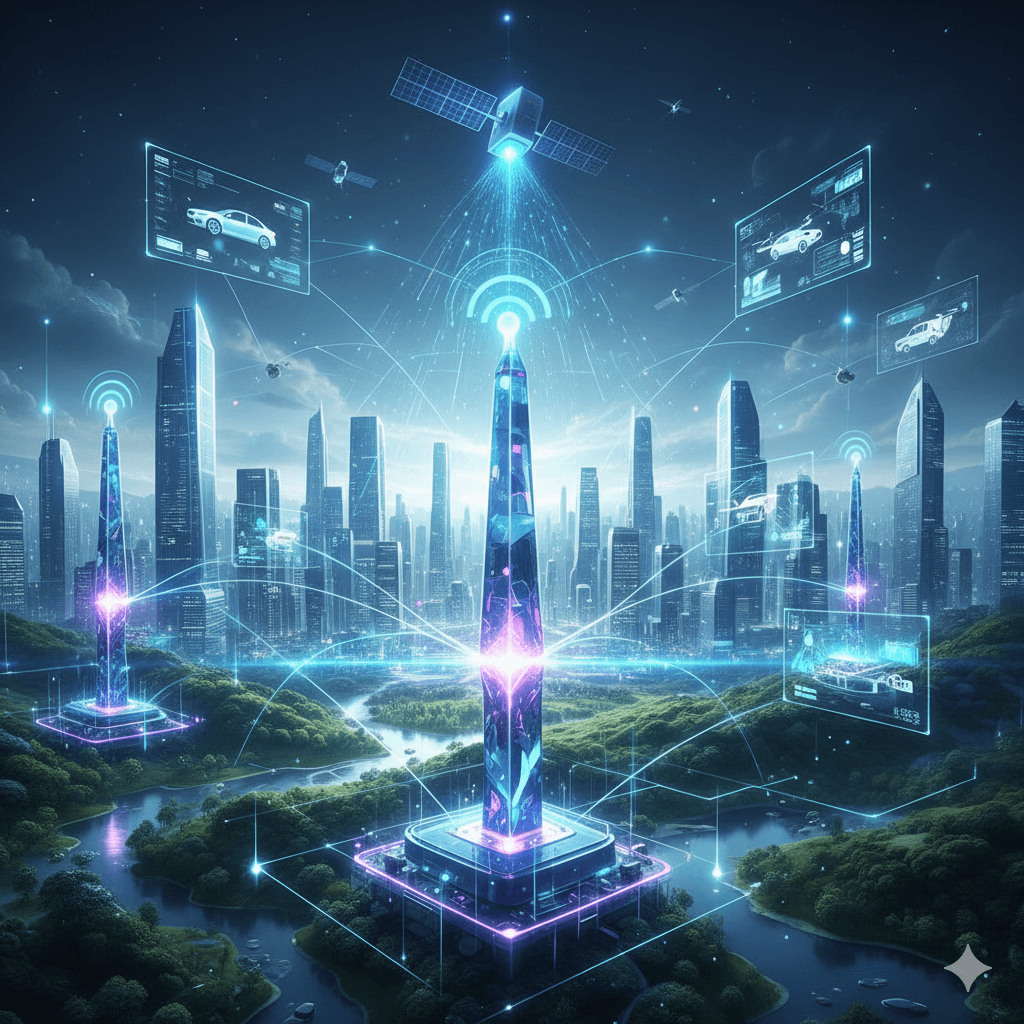
(Generated by Artificial Intelligence)
5G Technology
Core Technologies | Network Slicing, Internet of Things (IoT), Artificial Intelligence, Mobile Edge Computing (MEC), Terahertz (THz) Frequencies | ||||||||
|---|---|---|---|---|---|---|---|---|---|
6G Commercial Use | Approximately 2030 | ||||||||
6G Expected Latency | Microsecond level | ||||||||
5G Latency | Millisecond level | ||||||||
6G Expected Speed | One terabyte per second (Tbps) | ||||||||
5G Maximum Speed | Up to 70 Gbps | ||||||||
Future Generation | 6G (Sixth Generation) | ||||||||
Current Generation | 5G (Fifth Generation) | ||||||||
Previous Generation | 4G (LTE) | ||||||||
5G Technology is a wireless communication standard developed following fourth-generation (4G) mobile communication systems, designed to meet the growing demands for data, speed, and connectivity in the digital world. 5G technology delivers high data transfer rates, low latency, and massive connection capacity, enabling critical advancements in both individual user experiences and industrial applications. In this regard, it serves as a foundational infrastructure not only for smartphones and mobile devices but also for smart cities, autonomous vehicles, industrial automation systems, and the Internet of Things (IoT) ecosystem.
Compared to previous generations of technology—1G, 2G, 3G, and 4G—5G distinguishes itself through gigabit-per-second data transfer speeds, millisecond-level latency, and network density capable of supporting millions of devices simultaneously. These features create the foundation for seamless operation of advanced technologies such as remote surgery, vehicle-to-vehicle communication, real-time data analytics, and augmented reality (AR).
Global projections indicate that in the coming years, a large portion of the world’s population will have access to 5G, and the technology will begin to be widely adopted. This transition has the potential to strengthen the structural foundation of digital transformation and drive comprehensive restructuring across economic, social, and technological systems.
5G technology is designed as an advanced standard offering comprehensive technical improvements over previous mobile communication systems. It is characterized by high data transfer speeds, low latency, wide bandwidth capacity, and support for simultaneous connections of numerous devices. The technical objectives of 5G include high network availability, broad coverage, and energy efficiency. As a result, IoT devices requiring low power consumption can operate reliably and continuously over extended periods.
The high speed and capacity provided by 5G are based on the use of high-frequency bands with shorter wavelengths. These frequencies offer significantly wider bandwidths, substantially increasing data transfer rates. However, this level of speed and performance may vary depending on the frequency range used, environmental conditions, and regional infrastructure.
Architecturally, 5G is built on innovative building blocks such as network virtualization and network slicing. Network slicing enables a single physical network infrastructure to be logically divided according to different service types. This allows applications requiring high speed, such as mobile broadband, and applications requiring low latency, such as autonomous systems or industrial automation solutions, to be supported simultaneously on the same infrastructure. This flexibility makes 5G viable across numerous sectors including automotive, healthcare, energy, transportation, and defense.
In addition, 5G enables the integrated operation of terrestrial networks with satellite-based systems, aiming to provide uninterrupted connectivity across air, sea, and land. This unified architecture is expected to form the basis of a more accessible, reliable, and sustainable global communication infrastructure in the future, paving the way for 6G.
5G technology is regarded as one of the core components of Industry 4.0, the fourth industrial revolution. Thanks to its features—high data transmission speed, low latency, and massive connection capacity—5G occupies a central position in digital transformation processes. It is recognized not merely as an advancement in mobile communication but as an infrastructure standard enabling structural changes across numerous domains, from manufacturing to healthcare, and from transportation to urban governance.
In industrial production, 5G replaces wired communication systems, enabling more flexible, scalable, and efficient production lines. This allows real-time communication between sensors, machines, and robots; enhances the stability of automation systems; and enables remote monitoring and optimization of production processes. Within the Industrial Internet of Things (IIoT), continuous interaction among factory devices enables critical gains in predictive maintenance, fault prevention, and energy efficiency.

5G Technology (Generated by Artificial Intelligence)
In the healthcare sector, 5G plays a critical infrastructure role in applications requiring high speed and low latency. It enables the secure and uninterrupted implementation of telemedicine, robotic surgery, real-time image transmission, and remote patient monitoring. These capabilities particularly support improved quality of healthcare services in rural or access-limited regions.
In media and entertainment, 5G significantly enhances user experience in data-intensive fields such as high-resolution broadcasting, augmented reality (AR), and virtual reality (VR) applications. Low latency in applications requiring instant response, such as e-sports events and cloud-based gaming systems, results in smoother and more responsive interactions.
In transportation, 5G forms the foundation of Vehicle-to-Everything (V2X) systems, enabling vehicles to communicate with their environment and with each other. This communication allows autonomous vehicles to navigate traffic safely, prevents accidents, and enables more efficient use of transportation infrastructure. Another significant impact of 5G is its contribution to the proliferation of smart city technologies. Rapid urbanization demands more effective solutions in areas such as transportation, energy, waste management, and security. The 5G infrastructure supports the real-time collection and analysis of data from sensors and connected devices across the city. This enables more efficient implementation of applications such as smart traffic management, energy distribution optimization, disaster management, and environmental monitoring.
This integrated structure demonstrates that 5G has moved beyond being merely a communication standard to become one of the fundamental components of the digital economy, sustainable urban planning, and technological innovation.
As 5G technology becomes widely adopted globally, the communications industry has intensified research and development efforts toward the next generation: 6G (Sixth Generation) technology. 6G is not merely an extension of current systems but is regarded as a new paradigm aiming to transform the fundamental operation of communication networks. The primary goal of this new generation is to integrate interactions between digital, physical, and biological systems by providing higher speed, lower latency, and greater energy efficiency.
It is anticipated that 6G will achieve theoretical data transmission speeds of up to one terabit per second and latency levels far below the millisecond range. These capabilities are intended to enable artificial intelligence, augmented reality (AR), virtual reality (VR), mixed reality (MR), and digital twin technologies to operate in a more synchronized and real-time manner. Furthermore, the architecture of 6G networks is being designed to support fully autonomous systems, with the goal of enabling networks to learn, detect errors, and repair themselves autonomously.
In the development of this technology, integrated sensing and communication (ISAC) systems are emerging as key differentiators from 5G. ISAC enables networks not only to transmit data but also to acquire environmental sensing capabilities. As a result, 6G can be applied in areas such as positioning, object recognition, weather forecasting, and health monitoring.
6G also aims to provide significantly wider bandwidth for data-intensive applications through the use of terahertz (THz) frequency bands. This frequency band is designed for high-capacity systems such as data centers, autonomous systems, remote education, virtual meetings, and space-based communication networks.
In the future, 6G is expected to rely on a multi-layered network architecture spanning space, air, land, and sea. In addition to terrestrial base stations, low Earth orbit (LEO) satellites, unmanned aerial vehicles, and marine platforms may become integral components of the communication infrastructure. Such a structure aims to provide uninterrupted global connectivity and coverage.
For 6G to become fully implementable, intensive efforts over the next decade will be required in hardware development, energy efficiency, cybersecurity, and international standardization. This process is viewed not merely as a technological advancement but as a transformative shift that will usher in a new era of communication powered by AI-supported societies and industrial ecosystems.
Ha, Song Son, Florian Foerster, Thomas Robert Doebbert, Tim Kittel, Dominik Merli, and Gerd Scholl. "Testbed and Software Architecture for Enhancing Security in Industrial Private 5G Networks." *arXiv* (2025). Accessed February 18, 2026. https://arxiv.org/abs/2507.20873.
John, Jobish, Md. Noor-A-Rahim, Aswathi Vijayan, H. Vincent Poor, and Dirk Pesch. "Industry 4.0 and Beyond: The Role of 5G, WiFi 7, and Time-Sensitive Networking (TSN) in Enabling Smart Manufacturing." *Future Internet* 16, no. 9 (2024): 345. Accessed February 18, 2026. https://doi.org/10.3390/fi16090345.
Karrenbauer, Michael, Amina Fellan, Hans D. Schotten, Henning Buhr, Savita Seetaraman, Norbert Niebert, Stephan Ludwig et al. "Towards a Flexible Architecture for Industrial Networking." *arXiv* (2018). Accessed February 18, 2026. https://arxiv.org/abs/1804.04531.
Liu, Guangyi, Lincong Han, Rongyan Xi, Liang Ma, Zixiang Han, Yahui Xue, Hanting Zhao, Jing Jin, Qixing Wang, and Fei Xu. "Cooperative Sensing for 6G ISAC: Concept, Key Technologies, Performance Evaluation, and Field Trial." *Engineering* (2025). Accessed February 18, 2026. https://doi.org/10.1016/j.eng.2025.08.033.
Mourtzis, Dimitris. "Smart Manufacturing and Tactile Internet Powered by 5G: Investigation of Current Developments, Challenges, and Future Trends." *Procedia CIRP* 104 (2021): 1960–1969. Accessed February 18, 2026. https://doi.org/10.1016/j.procir.2021.11.331.
Prasad, S. "Revolutionizing Industry 4.0: The Influence of 5G Technology." *Shanlax International Journal of Management* 12 (2024): 14–19. Accessed February 18, 2026. https://doi.org/10.34293/management.v12i1.7774.
Varga, P., J. Peto, A. Franko, D. Balla, D. Haja, F. Janky, G. Soos, D. Ficzere, M. Maliosz, and L. Toka. "5G Support for Industrial IoT Applications - Challenges, Solutions, and Research Gaps." *Sensors (Basel)* 20, no. 3 (2020): 828. Accessed February 18, 2026. https://doi.org/10.3390/s20030828.
Zhang, Ruoyu, Wen Wu, Xiaoming Chen, Zhen Gao, and Yueming Cai. "Terahertz Integrated Sensing and Communication-Empowered UAVs in 6G: A Transceiver Design Perspective." *IEEE Vehicular Technology Magazine* (2025): 2–11. Accessed February 18, 2026. https://doi.org/10.1109/MVT.2025.3531088.

(Generated by Artificial Intelligence)
5G Technology
Core Technologies | Network Slicing, Internet of Things (IoT), Artificial Intelligence, Mobile Edge Computing (MEC), Terahertz (THz) Frequencies | ||||||||
|---|---|---|---|---|---|---|---|---|---|
6G Commercial Use | Approximately 2030 | ||||||||
6G Expected Latency | Microsecond level | ||||||||
5G Latency | Millisecond level | ||||||||
6G Expected Speed | One terabyte per second (Tbps) | ||||||||
5G Maximum Speed | Up to 70 Gbps | ||||||||
Future Generation | 6G (Sixth Generation) | ||||||||
Current Generation | 5G (Fifth Generation) | ||||||||
Previous Generation | 4G (LTE) | ||||||||
5G Technology and Its Characteristics
Applications and Impacts of 5G
Transition to 6G Technology and Expectations