


This article was automatically translated from the original Turkish version.
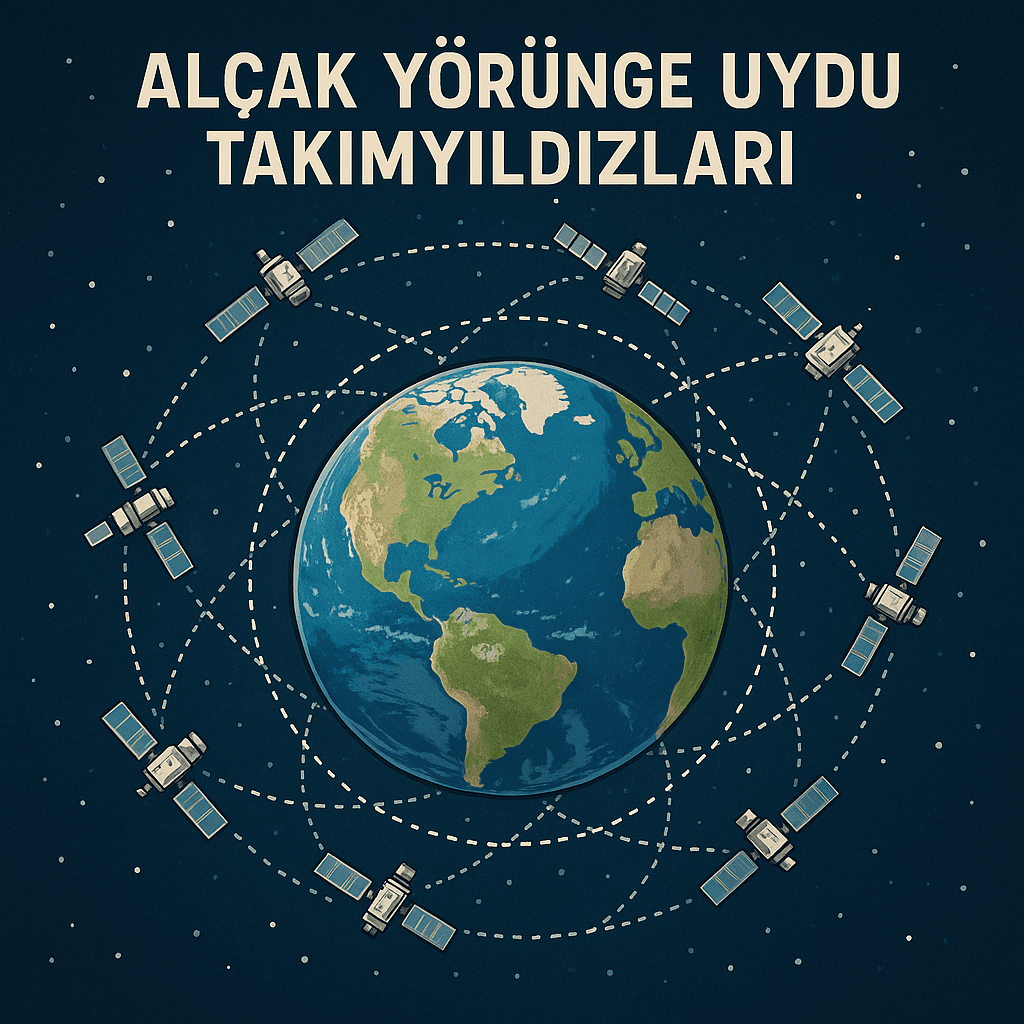
Low Earth Orbit Satellite Constellations
Altitude Range | 500 - 2000 km | ||||||||
|---|---|---|---|---|---|---|---|---|---|
Orbital Period | 90-120 minutes | ||||||||
Applications | Disaster monitoring Military communication Remote sensing IoT Internet | ||||||||
Low Earth Orbit (LEO) satellite constellations are systems composed of numerous satellites operating in coordinated fashion at relatively low altitudes (500–2000 km) above Earth’s surface. These structures provide advantages such as low latency communication, high temporal resolution, and data continuity by enabling continuous and global coverage.
Artificial satellites have marked a strategic turning point in the development of space-based technologies, opening the way for innovative solutions across a broad spectrum including communications, defense, environmental monitoring, and scientific research. Particularly in the 21st century, rapid advances in satellite technology and declining launch costs have increased the accessibility of these systems, making it possible to deploy large numbers of smaller, lighter, and more functional satellites into orbit. Within this context, LEO constellations have become not merely a technical preference but the foundational element of next-generation global infrastructure.
LEO systems generate new capabilities in numerous fields—especially internet access, the Internet of Things (IoT), remote sensing, and security applications—by offering advantages over traditional geostationary (GEO) satellites, including lower latency, faster data transmission, and more frequent update intervals.
Today, LEO satellite constellations lie at the center of geopolitical competition, economic power struggles, and the pursuit of digital sovereignty. The rapid increase in satellite numbers is shaping this domain through multi-layered dynamics such as spectrum sharing, orbital congestion, gaps in international regulation, and public-private partnerships, presenting both opportunities and systemic risks.
Low Earth Orbit (LEO) is one of the closest satellite orbit classifications to Earth’s surface and is generally defined as an altitude range between 500 and 2000 kilometers. Satellites in this band complete an orbit around Earth in approximately 90 to 120 minutes, passing over the same region multiple times per day. This characteristic makes LEO ideal for applications requiring frequent data updates and high temporal resolution.
Comparative Orbit Characteristics Table
Due to their proximity to Earth’s surface, LEO satellites offer significantly lower propagation latency. For example, a data packet transmitted via LEO can reach its destination in approximately 50–100 milliseconds, whereas in GEO (geosynchronous) satellites this delay can reach up to 600 milliseconds. The low latency provided by LEO is critical for real-time applications and interactive data transmission. At the same time, the field of view (footprint) of satellites in this orbit is narrower, preventing them from maintaining prolonged observation of any specific region. Therefore, continuous global coverage requires a large number of satellites operating in coordinated fashion.
Orbital inclination determines the latitudes accessible to LEO satellites. In particular, orbits with high inclination near the poles are essential for constellations aiming for global coverage. These orbits enable the entire surface of the Earth to be scanned as the planet rotates.
LEO satellite constellations are artificial satellite networks composed of numerous satellites positioned in coordinated, typically simultaneous and regular orbits to fulfill specific mission objectives. These constellations can range in size from a few satellites to thousands and are generally designed to achieve goals such as global coverage, high service continuity, or low-latency data transmission.
Each constellation typically consists of satellites distributed across multiple orbital planes at specific inclination angles. These satellites are usually arranged at equal angular intervals to optimize coverage of different regions of the Earth at varying times. While some constellations communicate only with ground stations, more advanced systems enable direct data transfer between satellites via inter-satellite links (ISL).
The size and structure of constellations vary depending on the intended application. For instance, a few dozen satellites may suffice for daily or hourly data needs, while applications requiring instantaneous and continuous data transmission demand hundreds of satellites. The key requirement is that the system must deliver uninterrupted service with temporal and spatial coherence.

Depiction of LEO Satellite Constellations (Generated by Artificial Intelligence)
Interest in LEO constellations began in the 1990s with initiatives aiming to provide global telephone services. Projects such as Iridium, Globalstar, Teledesic, and Odyssey took pioneering steps, attempting to transcend the technological limitations and economic expectations of their time. However, most of these systems failed due to high production and launch costs, limited user demand, and insufficient financial sustainability.
Over the intervening decades, numerous technological and economic advancements have fundamentally transformed this field. Innovations such as small satellite technology, modular satellite platforms, reusable rocket systems, and mass production lines have significantly reduced the cost of LEO satellites. Additionally, emerging needs such as broadband internet, IoT, remote education, and disaster communication have increased demand for these systems.
As a result of this transformation, many private companies and state institutions have launched mega-constellation projects. SpaceX’s Starlink system plans a network of tens of thousands of satellites, while China’s Guowang and Qianfan projects are advancing with comparable scale. This new generation of LEO systems has begun to hold strategic importance not only as technological platforms but also as state-supported infrastructure and components of national security strategies.
The application areas of LEO satellite constellations are increasingly diversifying and integrating into various sectors in line with technological progress. These applications span both civilian and military domains and can be broadly categorized into five key areas:
LEO constellations aim to reduce the digital divide by providing high-speed internet access in rural and remote regions lacking terrestrial infrastructure. Systems such as Starlink have made significant progress toward achieving this goal through low latency and high data rates.
LEO satellites are used to efficiently relay data from low-power sensors in IoT-based applications such as smart cities, agriculture, water resource management, energy grids, and environmental monitoring. They offer cost-effective and reliable solutions for smart network deployments in remote areas.
Due to their high maneuverability, low detectability, and secure data transmission capabilities, LEO systems are employed in critical applications such as military communications, unmanned aerial vehicles, and the integration of battlefield objects (IoBT). These systems are less vulnerable to enemy interference compared to fixed GEO satellites.
When equipped with optical and radar sensors, LEO constellations can perform remote sensing missions with high temporal resolution. They are effective in detecting, monitoring, and issuing early warnings for wildfires, floods, earthquakes, and other natural disasters.
LEO constellations provide mobility-compatible infrastructure for maritime, aviation, and mobile communications. Applications include in-flight internet services, communication in remote oceanic regions, and real-time connectivity via portable terminals.
The technical architecture of LEO satellite constellations is divided into two main categories based on whether inter-satellite communication is implemented: ISL-enabled systems and ISL-disabled systems.
ISL-disabled systems are typically less complex and lower-cost. In these systems, data flow occurs only between the satellite and a ground station. When direct transmission to the target is not possible, satellites relay data solely to ground stations, and re-routing is handled via terrestrial infrastructure. This structure is sufficient for non-latency-sensitive tasks such as environmental observation or periodic data collection. It also allows for simpler hardware design of the satellites.
ISL-enabled systems offer more advanced and flexible architectures by allowing satellites to communicate directly with each other. Since each satellite can exchange data with neighboring satellites, data packets can be routed toward their destination without passing through a ground station. This reduces system latency and decreases dependence on ground infrastructure. However, such systems require onboard routing hardware, more complex antenna systems, and sophisticated software routing algorithms. Consequently, they are preferred for defense, real-time surveillance, IoBT, and latency-sensitive applications.
LEO satellite constellations typically utilize high-frequency spectrum bands such as Ka and V bands to manage high data traffic. While these bands offer high data transmission capacity and narrow beam steering advantages, they also present disadvantages such as atmospheric attenuation, rain fade, and increased interference risk.
The use of the same frequency bands by LEO systems and terrestrial networks introduces interference challenges, especially in densely populated areas. Since satellite signals are directed toward Earth via spot beams spanning thousands of kilometers, overlap and signal interference with terrestrial cellular networks become unavoidable. Several technologies have been developed to address this issue:
These measures play a critical role in enhancing the stability of LEO systems, particularly for low-power IoT terminals and in high-density urban environments.
The economic sustainability of LEO constellations depends on cost components spanning the entire lifecycle of the system, including satellite manufacturing, launch expenses, ground station infrastructure, and user terminal hardware.
Thanks to modern production lines and modular designs, LEO satellites can now be manufactured cost-effectively at scale in factory environments. The production cost of a single LEO satellite is in the range of several hundred thousand dollars. Their lightweight design allows more satellites to be launched per mission, reducing per-launch costs.
The cost of electronically steerable antennas (ESAs) used by end users is a decisive factor in satellite-based broadband systems. Current antenna costs, at several thousand dollars, hinder mass market access. Reducing these costs to the $300–500 range is a critical threshold for unlocking consumer markets.
Today, many private companies finance large-scale investments in this field through internal capital or international funding. Venture capital, state subsidies, and low-interest borrowing form the primary sources of funding. However, total deployment costs exceeding $5–10 billion require substantial economic resilience.
LEO systems play a critical role in IoT applications, particularly in remote, inaccessible, and infrastructure-poor regions. Numerous IoT devices—such as smart meters, environmental sensors, logistics systems, and energy infrastructure—can be connected globally via LEO constellations.
However, this potential brings compatibility challenges with existing terrestrial protocols. While NB-IoT-based LTE systems require continuous connectivity, LEO systems have limited windows of visibility as satellites enter and exit the field of view. Consequently, the following measures are essential:
In addition, routing dynamics in ISL-enabled topologies differ from classical networks. The frequent changes in inter-satellite links require real-time routing tables, snapshot algorithms, and QoS-guaranteed routing strategies.
LEO satellite constellations are no longer merely communication infrastructures; they have become strategic assets in the control of global data flows. Consequently, intense competition has emerged among major states and technology companies.
This competition extends beyond technology. Data transmission via LEO systems carries significance in terms of censorship, surveillance, information security, and military operations. In times of crisis, a country’s dependence on a foreign satellite provider can create security vulnerabilities.
The rapid proliferation of LEO constellations brings several technical and governance challenges:
Airbus U.S. Space & Defense. "LEO Constellations." AIRBUS. Accessed July 14, 2025. Accessed Adresi.
Congressional Budget Office. "Large Constellations of Low-Altitude Satellites: A Primer." cbo.gov. Accessed July 14, 2025. Accessed Adresi.
Daehnick, Chris, Klinghoffer, Isabelle, Maritz, Ben, and Wiseman, Bill. "Large LEO satellite constellations: Will it be different this time?" Aerospace & Defense Practice. McKinsey&Company. Accessed July 14, 2025. Accessed Adresi.
EOS DATA ANALYTICS. "Satellite Constellations: Existing and Emerging Swarms." *eos*. Accessed July 14, 2025. Accessed Adresi.
International Telecommunication Union. "Space Connect: The rise of LEO satellite constellations." ITU. Accessed July 14, 2025. Accessed Adresi.
O'Loughlin, Rex Fox. "Orbital ambitions: LEO satellite constellations and strategic competition." International Institute for Strategic Studies. Accessed July 14, 2025. Accessed Adresi.
Qu, Zhicheng, Gengxin Zhang, Haotong Cao, and Jidong Xie. "LEO satellite constellation for Internet of Things." IEEE Access 5 (2017): 18391-18401. Accessed July 14, 2025. Accessed Adresi.

Low Earth Orbit Satellite Constellations
Altitude Range | 500 - 2000 km | ||||||||
|---|---|---|---|---|---|---|---|---|---|
Orbital Period | 90-120 minutes | ||||||||
Applications | Disaster monitoring Military communication Remote sensing IoT Internet | ||||||||
No Discussion Added Yet
Start discussion for "Low Earth Orbit Satellite Constellations" article
Low Earth Orbit
Low Earth Orbit Satellite Constellations
Historical Development and Commercial Transformation
Application Areas of Low Earth Orbit Constellations
Broadband Internet and Digital Inclusion
Internet of Things (IoT) and Industrial Monitoring
Defense and Military Communications
Remote Sensing and Disaster Management
Aviation and Maritime Transport, Mobile Applications
Inter-Satellite Linked and Non-Linked Systems
ISL-Disabled Systems
ISL-Enabled Systems
Spectrum Usage and Interference Issues
Cost, Production, and Economics
Satellite Production and Launch
User Equipment
Investment and Financing
Satellite-Based IoT Networks and Integration Challenges
Geopolitical Competition and Future Scenarios
Challenges and Governance Requirements