


This article was automatically translated from the original Turkish version.
+3 More
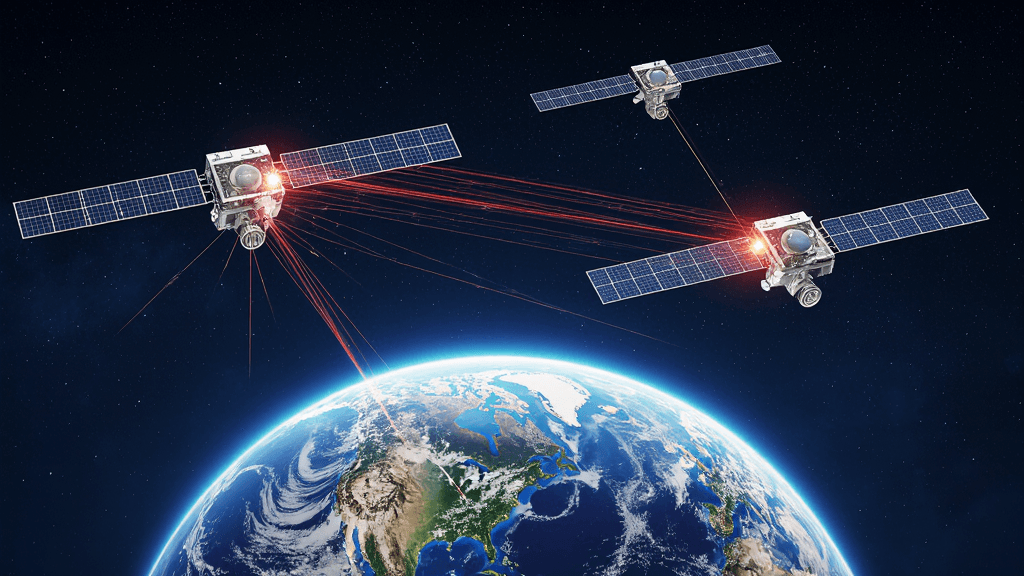
Generated with Artificial Intelligence.
Next Generation Communication Satellite
Orbital Types | Low Earth Orbit (LEO), Medium Earth Orbit (MEO), Geostationary Orbit (GEO) | ||||||||
|---|---|---|---|---|---|---|---|---|---|
Core Technology | Fully Electric Propulsion System, Software-Based Payload | ||||||||
Launch Method | Multi-Launch (Stack/Rideshare) | ||||||||
Important Projects | Starlink, Project Kuiper, OneWeb, TÜRKSAT 6A | ||||||||
Next-generation communication satellites are advanced technological systems developed to deliver traditional satellite services—such as television broadcasting, multimedia applications, mobile and fixed internet access, and secure communications—with higher performance and cost efficiency. These satellites are distinguished by innovative design approaches such as "Small-GEO" (compact communication satellites) and Low Earth Orbit (LEO) constellations.
Modern communication satellites represent a significant transformation in satellite communications through advanced electric or hybrid propulsion systems, software-reconfigurable payloads, and multi-launch capabilities. These technologies enable satellites in orbit to dynamically adjust their mission profiles, optimize coverage areas, and flexibly allocate bandwidth according to user demands.
When examining the historical development of satellite communication technology, the process began with the launch of the first communication satellite, SCORE, in 1958, and continued with Telstar 1 in 1962, which enabled the first real-time transatlantic television broadcast. These advancements laid the technical foundation for global communications and paved the way for the widespread adoption of geostationary (Geostationary Earth Orbit, GEO) systems in the following decades. Today’s next-generation systems are designed to make communication independent of geographic and infrastructural constraints, aiming to provide access to every region.
In this context, next-generation communication satellites are positioned as essential components of an integrated global communication infrastructure, meeting the demands of the data-intensive digital age through high data transmission rates, low latency, and flexible network architectures.
The concept of satellite-based communication began to take concrete form in the mid-20th century, grounded in technological and scientific advancements. The Soviet Union’s launch of Sputnik 1 on 4 October 1957 marked a historic milestone as the first artificial satellite carrying a radio transmitter. This development served as a practical beginning for the concept of space-based communication. Following Sputnik, the SCORE (Signal Communications by Orbiting Relay Equipment) satellite, launched on 18 December 1958, conducted the first communication relay test from space and became the first satellite to transmit voice signals from space to Earth. This success demonstrated that satellite technology could be used not only for military or scientific purposes but also as a direct component of communication infrastructure.
The commercial and civilian potential of the technology became evident with the launch of Telstar 1 by the United States on 10 July 1962. As the first active, real-time communication satellite, Telstar 1 enabled telephone calls, high-speed data transfers, and the first live transatlantic television broadcast. This achievement is widely regarded as the beginning of the global communications era. Another major milestone in orbital technology occurred on 16 July 1963 with the placement of Syncom 2 into a geosynchronous orbit. Syncom 2, positioned in an orbit synchronized with Earth’s rotation, provided continuous communication and established the technical foundation for modern communication networks. This development was commercialized with the launch of Intelsat 1 (Early Bird) on 6 April 1965, the first commercial communication satellite operating in geostationary orbit, which spearheaded the establishment of the economic and institutional infrastructure for international communication networks.
Türkiye established its presence in satellite communication with the launch of Türksat 1B on 10 August 1994. This step granted Türkiye its own satellite communication capacity and laid the foundation for an independent infrastructure in regional broadcasting and data transmission. These historical developments created the groundwork for today’s multi-layered, global communication networks that integrate Low Earth Orbit (LEO), Medium Earth Orbit (MEO), and Geostationary Earth Orbit (GEO) systems. Thus, satellite communication has become a fundamental component of global information flow, both commercially and strategically.
Communication satellites are placed in different orbits based on their mission requirements and technological infrastructure. These orbits directly determine the satellite’s speed, coverage area, signal latency, and overall performance characteristics. Fundamentally, three main orbit types exist: Geostationary (GEO), Medium Earth Orbit (MEO), and Low Earth Orbit (LEO) systems.
Geostationary Orbit (GEO) is positioned approximately 35,786 kilometers above Earth’s equator. Satellites in this orbit move at the same angular velocity as Earth’s rotation, appearing stationary to observers on the ground. Due to this feature, a single satellite can cover vast geographic regions, making GEO ideal for television broadcasting, meteorology, and wide-area communication services. However, due to their high altitude, signal round-trip latency reaches approximately 500–700 milliseconds, which acts as a performance-limiting factor in real-time, interactive applications such as video conferencing or online gaming.
Medium Earth Orbit (MEO) typically operates at altitudes between 8,000 and 20,000 kilometers, offering a balance between GEO and LEO. Satellites in this band are primarily used in global positioning systems (e.g., GPS, Galileo, GLONASS) and regional communication networks. MEO satellites provide lower latency and higher data transmission rates than GEO, while requiring fewer satellites than LEO systems to achieve broad coverage.
Low Earth Orbit (LEO) represents the region closest to Earth’s surface, ranging from approximately 500 to 2,000 kilometers in altitude. This proximity reduces signal latency to 20–40 milliseconds, delivering communication performance comparable to fiber-optic infrastructure. LEO satellites are considered an ideal solution for next-generation broadband internet services, Internet of Things (IoT) applications, and 5G/6G network integration due to their high data speeds, low power consumption, and rapid response times. However, because each satellite has a limited coverage area, large-scale constellations of hundreds or even thousands of satellites are required to achieve global access.
Together, these three orbit types form today’s multi-layered communication infrastructure. GEO systems provide high coverage and stability, while LEO and MEO systems serve as complementary elements in global communication networks, offering low latency and high data throughput.
Next-generation communication satellites are advanced technology platforms developed to surpass the limitations of traditional satellite architectures, offering more flexible, efficient, and cost-sustainable solutions. These systems are built on highly modular and adaptable architectures with redefined hardware and software components. Key concepts include Small-GEO satellites, Low Earth Orbit (LEO) constellations, High Throughput Satellite (HTS) systems, and software-defined payloads.
This concept aims to deliver the communication capacity of traditional geostationary (GEO) satellites on more compact, lightweight, and optimized platforms. With masses ranging from approximately 1,000 to 3,000 kilograms, Small-GEO satellites significantly reduce both production and launch costs through electric propulsion systems and modular designs. Electric propulsion increases fuel efficiency, extends mission life, and enables more precise orbital maneuvers. Designed for average lifespans of 15 years or more, these satellites offer cost-effective alternatives for commercial and government communication needs.
These systems consist of hundreds or thousands of small, interconnected satellites positioned in low Earth orbit (500–1,200 km), forming a network that provides global coverage. Projects such as SpaceX’s Starlink, Amazon’s Project Kuiper, and OneWeb are leading examples in this field. The primary goal of LEO constellations is to deliver high-speed, low-latency internet connectivity in rural, maritime, or disaster-affected areas where terrestrial infrastructure is absent. These systems provide uninterrupted communication infrastructure for critical sectors such as maritime, aviation, defense, disaster management, and autonomous transportation technologies. The most significant advantage of LEO networks is their ability to deliver a user experience comparable to fiber-optic connections, with latencies of 20–40 milliseconds.
HTS technology is equipped with advanced payloads that offer significantly higher data transmission capacity than traditional satellites. Using multi-spot beam technology, these systems reuse the same frequency bands across geographically distinct areas, increasing data transmission capacity by orders of magnitude. HTS satellites play a crucial role in high-data-demand applications such as broadband internet, video streaming, and enterprise network solutions.
One of the most notable features of next-generation communication satellites is their software-reconfigurable payloads, which reduce hardware limitations. Through commands sent from the ground after launch, coverage areas, frequency allocations, bandwidths, and power levels can be dynamically adjusted. This enables satellites to rapidly adapt to changing market conditions, extraordinary events such as disasters, or sudden spikes in user demand. This flexibility significantly enhances operational efficiency for both commercial operators and public institutions.
When evaluated together, these technological approaches establish the foundation for a more scalable, reliable, and sustainable model in global communication infrastructure.
One of the most distinctive features of next-generation communication satellites is their integration of advanced technological components that enhance operational efficiency while significantly reducing costs. These technologies optimize satellite performance during both launch and orbital operations, contributing to the sustainability of global communication infrastructure. Key innovations include electric propulsion systems, multi-launch configurations, modular and reconfigurable designs, and wide frequency support.
Electric propulsion systems, widely adopted in next-generation satellites, offer far higher fuel efficiency than traditional chemical propulsion systems. In these systems, thrust is generated by accelerating ionized gases using electrical energy. This method requires significantly less propellant than chemical systems, reducing the satellite’s total mass and lowering launch costs. It also enables multiple satellites to be launched on a single rocket or the use of smaller launch vehicles. Although electric propulsion requires longer durations for orbital transfer maneuvers, it provides substantial advantages in operational costs. For example, Türksat 5A, Türkiye’s first fully electric-propulsion communication satellite, exemplifies the effective use of this technology.
Optimization of satellite platform volume, mass, and energy requirements enables modern launch systems to deploy multiple satellites simultaneously into space. Methods known as “stacking” or “rideshare” allow launch costs to be shared among multiple operators. This approach is highly economical for small and medium-sized satellites. Launch vehicles such as Ariane VI, SpaceX’s Falcon 9, and Blue Origin systems are designed to support multi-launch operations.
Modern satellite platforms are designed with scalable architectures tailored to user requirements. The modular design approach allows satellite components to be easily replaced or reconfigured according to different mission profiles and capacity needs. This structure can be utilized for both commercial and military missions with system capacities ranging from 0.5 to 2 tons. As a result, flexibility is achieved during production, while maintenance and upgrade costs are reduced.
Next-generation communication satellites feature multi-band operational capabilities to serve diverse application areas. These satellites can operate across a broad frequency spectrum, including Ka, Ku, X, C, S, L, and UHF bands. Ka and Ku bands are preferred for high-speed data transmission and broadband internet, while X and UHF bands are used in military and secure communication systems. Additionally, modern satellites support both encrypted and unencrypted (non-encrypted) communication modes, meeting the security requirements of both civilian and defense sectors.
The convergence of these technological advancements has transformed next-generation communication satellites into essential components of a more resilient, scalable, and multi-purpose global communication infrastructure—not only more efficient and economical but also more adaptable and versatile.
Türkiye is among the 30 countries possessing communication satellites and has strategically set the goal of transitioning from a mere user to a producer of next-generation satellite technology. The projects underway aim to establish Türkiye as a technology-developing and exporting actor in the space industry.
One tangible manifestation of this goal is the Türksat 6A project, Türkiye’s first indigenous and national communication satellite. Developed through collaboration between the Türkiye Space Agency (TUA), TÜBİTAK UZAY, ASELSAN, CTECH, and Türksat A.Ş., the satellite’s assembly, integration, and testing were conducted at the TUSAŞ Space Systems Integration and Test (USET) Center in Ankara. The successful completion of Türksat 6A has placed Türkiye among only 11 countries capable of designing and manufacturing their own communication satellites. This development represents a strengthening of national technological independence and engineering capacity in the space industry.
With the commissioning of Türksat 6A, Türkiye’s satellite coverage area has expanded to include Southeast Asian countries, bringing the total population reach of the Türksat fleet to approximately 5 billion people. Currently operational Türksat 5A and the upcoming Türksat 5B satellite, scheduled for launch soon, enhance Türkiye’s communication infrastructure by increasing Ka-band data transmission capacity, strengthening both civil and commercial dimensions. These satellites also hold strategic importance in securing Türkiye’s long-term orbital rights internationally.
Meanwhile, preparations are underway for a new, more advanced indigenous satellite to replace Türksat 3A, which is nearing the end of its operational life. This new platform is planned to be equipped with higher data capacity, advanced propulsion systems, and software-defined payloads compared to previous generations.
In Türkiye’s future vision, the development of mini satellite constellations (LEO constellations) capable of integration with 5G and 6G network infrastructure is a key priority. To this end, efforts aim to strengthen collaboration between public institutions and the private sector, support R&D activities, and reinforce the domestic production ecosystem. Thus, Türkiye seeks to become a regional production hub for communication satellite technologies and enhance its competitiveness in the global market.
Advancements in next-generation communication satellites are progressing rapidly on a global scale, supported by investments from both public institutions and the private sector. In particular, Low Earth Orbit (LEO)-based constellation projects are playing a central role in reshaping global communication infrastructure. Large-scale initiatives led by U.S.-based companies such as SpaceX (Starlink), Amazon (Project Kuiper), and OneWeb are complemented by similar efforts from China and European countries, which are developing and launching their own next-generation communication test satellites.
China’s next-generation communication test satellites are used to measure the performance of multi-band communication systems, validate high-speed data transmission protocols, and test optical communication technologies in orbital environments. Similarly, the European Space Agency (ESA) and the Japan Aerospace Exploration Agency (JAXA) are conducting research on software-defined communication payloads, laser-based data transmission, and AI-supported network management.
One of the most important objectives of these technological advances is to reduce the digital divide by providing high-speed internet access in regions lacking terrestrial infrastructure. Satellites offer an alternative connectivity channel in areas where fiber-optic infrastructure is absent or economically unfeasible. Additionally, during natural disasters and emergencies, when ground-based systems fail, satellite-based communication ensures uninterrupted connectivity.
Next-generation communication satellites also provide high-bandwidth, low-latency connectivity for maritime, aviation, and industries requiring remote operations. Global maritime transport, civil aviation, and defense sectors benefit from real-time data transfer, route optimization, and secure communication infrastructure.
Another significant application area is the Internet of Things (IoT) ecosystem. In this system, billions of devices generate sensor data and require continuous connectivity. Next-generation satellites enable the global transmission of sensor data through low-power, wide-coverage networks. This ensures uninterrupted data flow in fields such as agriculture, energy, environmental monitoring, logistics, and smart city applications.
As a result of all these developments, satellite communication is evolving into a global infrastructure supported by multi-layered, inter-satellite links, and terrestrial network integration. This integrated structure forms the foundation of future communication systems, working alongside technologies such as 5G, 6G, and AI-driven network management to lay the groundwork for a new era of continuous, secure connectivity across the entire planet.
Adeola, Ona-Olapo, Tosin Daniel Iluyomade, and Tosin Olatunde. “Electrical Propulsion Systems for Satellites: A Review of Current Technologies and Future Prospects.” *International Journal of Frontiers in Engineering and Technology Research* 6, no. 2 (April 2024): 35–44. Accessed October 4, 2025. https://doi.org/10.53294/ijfetr.2024.6.2.0034.
O’Reilly, Dillon, Georg Herdrich, and Darren F. Kavanagh. “Electric Propulsion Methods for Small Satellites: A Review.” *Aerospace* 8, no. 1 (2021): 22. Accessed October 4, 2025. https://doi.org/10.3390/aerospace8010022.
Saleh, Joseph Homer, Fan Geng, Michelle Ku, and Mitchell L. R. Walker II. “Electric Propulsion Reliability: Statistical Analysis of On-Orbit Anomalies and Comparative Analysis of Electric versus Chemical Propulsion Failure Rates.” (2017). Accessed October 4, 2025. https://arxiv.org/abs/1706.10129.
TUSAŞ. "Haberleşme Uyduları." Accessed October 4, 2025. https://www.tusas.com/urunler/uzay/haberlesme-uydulari.
TUSAŞ. "Yeni Nesil Haberleşme Uyduları Ürün Ailesi." Accessed October 4, 2025. https://www.tusas.com/urunler/uzay/haberlesme-uydulari/yeni-nesil-haberlesme-uydulari-urun-ailesi.
Tosun, Buğra. “LEO Satellite Communication Systems.” Accessed October 4, 2025. https://doi.org/10.13140/RG.2.2.34124.33925.
TÜBİTAK. “İlk Yerli ve Milli Haberleşme Uydumuz TÜRKSAT 6A Uzaya Fırlatıldı.” Accessed October 4, 2025. https://tubitak.gov.tr/tr/haber/ilk-yerli-ve-milli-haberlesme-uydumuz-turksat-6a-uzaya-firlatildi.
Ünal, Arife Yıldız. “Türkiye'nin Aktif Uydusu Türksat 5A'nın Hizmete Girmesiyle 7'ye Ulaştı.” Anadolu Ajansı, June 29, 2021. Accessed October 4, 2025. https://www.aa.com.tr/tr/isdunyasi/teknoloji/turkiyenin-aktif-uydu-sayisi-turksat-5anin-hizmete-girmesiyle-7ye-yukseldi/665891.


Generated with Artificial Intelligence.
Next Generation Communication Satellite
Orbital Types | Low Earth Orbit (LEO), Medium Earth Orbit (MEO), Geostationary Orbit (GEO) | ||||||||
|---|---|---|---|---|---|---|---|---|---|
Core Technology | Fully Electric Propulsion System, Software-Based Payload | ||||||||
Launch Method | Multi-Launch (Stack/Rideshare) | ||||||||
Important Projects | Starlink, Project Kuiper, OneWeb, TÜRKSAT 6A | ||||||||
No Discussion Added Yet
Start discussion for "Next Generation Communication Satellites" article
Historical Development
Satellite Orbit Types and Technologies
Next-Generation Satellite Concepts
Small-GEO Satellites
LEO Constellations
High Throughput Satellite (HTS) Systems
Software-Defined Flexible Payloads
Technological Features and Advantages
Electric Propulsion Systems
Multi-Launch Configuration
Modular and Reconfigurable Design
Wide Frequency Support
Türkiye’s Next-Generation Satellite Initiatives
Global Developments and Application Areas