


This article was automatically translated from the original Turkish version.
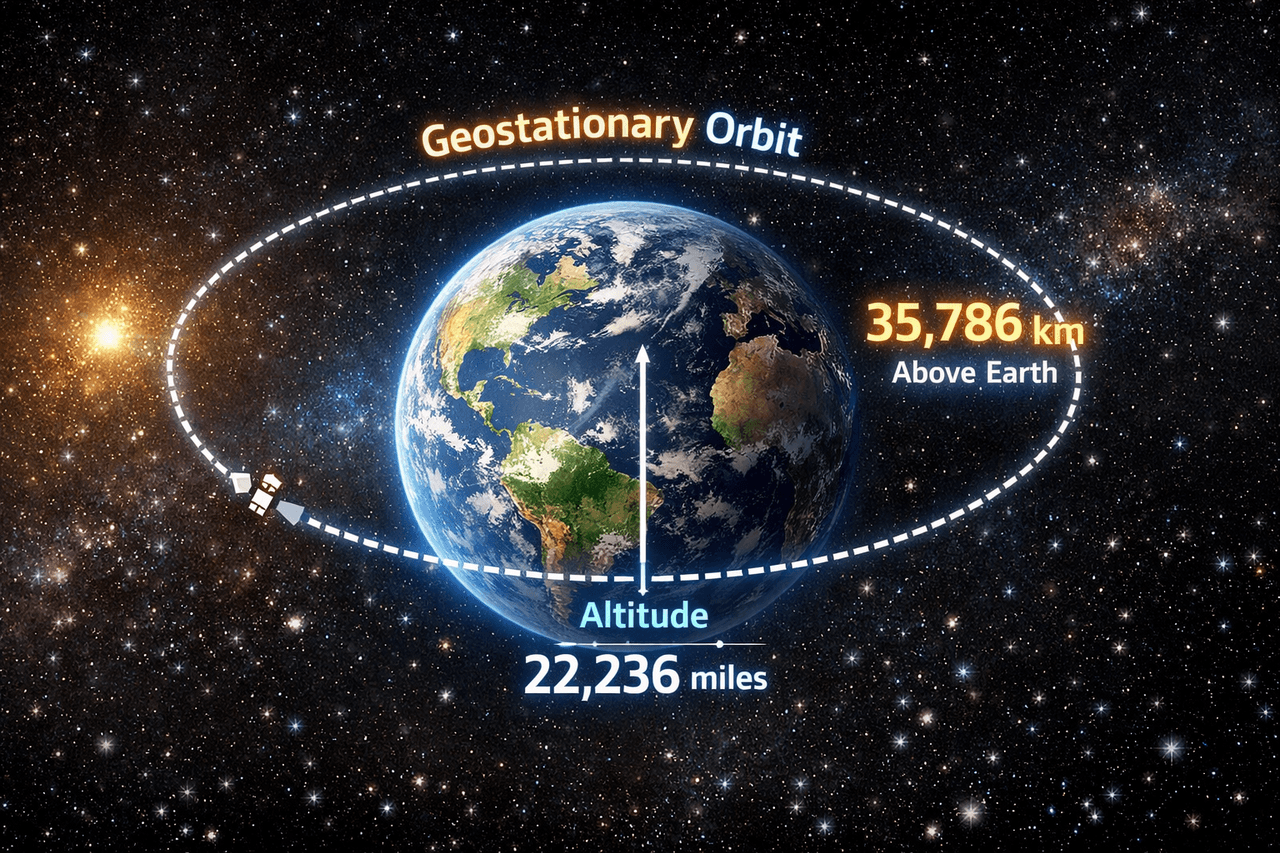
GEO Orbit (generated with artificial intelligence)
Orbital Shape | circular | ||||||||
|---|---|---|---|---|---|---|---|---|---|
Orbital Period | 23 hours 56 minutes 4 seconds (1 sidereal day) | ||||||||
Orbital İnclination | 0° (equatorial plane) | ||||||||
Radius from Earth’s Center | ~42.164 km | ||||||||
Average Altitude Above Ground | 35.786 km | ||||||||
Geostationary orbit (GEO) is a special orbit located in the equatorial plane, in which a spacecraft orbits at the same angular velocity as Earth’s rotation. Under these conditions, satellite appears fixed at the same longitude in the sky to an observer on Earth’s surface. This stationary appearance is the defining characteristic of the geostationary orbit.

Space Environment GEO Orbit (generated by AI)
The geostationary orbit is located at an altitude of approximately 35,786 km above Earth’s surface. At this altitude, a satellite moves with a period of 23 hours 56 minutes and 4 seconds, matching Earth’s sidereal day, and has an orbital speed of approximately 3 km/s. When these geometric and dynamic conditions are met together, the satellite remains in synchronous position with Earth.
The geostationary orbit is a special case of the geosynchronous orbit. In geosynchronous orbits, the orbital period equals Earth’s rotational period; however, these orbits may be inclined relative to the equator. In a geostationary orbit, the orbit satisfies the geosynchronous condition and lies exactly in the equatorial plane. Therefore, the ground track of satellites in geostationary orbit remains unchanged over time.
The high altitude of the geostationary orbit enables a wide coverage area. A single geostationary satellite can cover a large portion of Earth’s surface simultaneously. Three geostationary satellites placed at appropriate longitudinal intervals can provide continuous coverage over most of Earth.
The geostationary orbit is widely used for communication and broadcasting satellites, as well as meteorological observation satellites. Because the satellite appears fixed in the sky, ground station antennas can be permanently pointed in one direction, eliminating the need for complex tracking systems. In meteorological missions, continuous monitoring of the same region becomes possible.
One of the important engineering consequences of the geostationary orbit is communication delay. Due to the large distance between the satellite and ground stations, the round-trip delay caused solely by signal propagation reaches approximately 0.24 seconds. This delay must be accounted for in system design, particularly in interactive communication applications.
Insertion into the geostationary orbit is typically achieved through a two-stage process. The satellite is first placed into an elliptical geostationary transfer orbit (GTO); then, maneuvers performed at the farthest point of the ellipse circularize the orbit and align it with the equatorial plane. Once these procedures are completed, the satellite settles into its geostationary position.
The geostationary position is not naturally stable against external influences. Earth’s non-spherical gravitational field, the gravitational effects of Sun and Moon, and solar radiation pressure cause gradual deviations in the orbit over time. Therefore, geostationary satellites perform station-keeping maneuvers throughout their operational life. These maneuvers directly affect the satellite’s fuel consumption and are among the key factors determining its mission lifetime.
Sustainability is critical at the end of a satellite’s operational life in geostationary orbit. Decommissioned satellites are moved to graveyard orbits located just above the geostationary belt. This practice aims to preserve the heavily used geostationary orbital region and reduce the risk of collisions.
The concept of the geostationary orbit was proposed in 1945 by Arthur C. Clarke as a satellite system for global communications. The first practical implementation of this concept was achieved in 1964 with the satellite Syncom-3, which was placed into geostationary orbit. Today, the geostationary orbit is a fundamental component of global communications and meteorological observation infrastructure.
European Space Agency. "Types of Orbits: Geostationary Orbit (GEO)." Accessed January 3, 2026.
Gorove, Stephen. “The Geostationary Orbit: Issues of Law and Policy.” *American Journal of International Law* 73, no. 3 (July 1979): 444–461. Accessed January 3, 2026. https://www.cambridge.org/core/journals/american-journal-of-international-law/article/abs/the-geostationary-orbit-issues-of-law-and-policy/8ACF5E11ABED469ADDF75EC555EA6647
International Telecommunication Union (ITU). "Radio Regulations." Geneva, 2020. Accessed January 3, 2026.
National Aeronautics and Space Administration (NASA). "Basics of Space Flight: Chapter 5-1 – Orbits." Accessed January 3, 2026.
National Oceanic and Atmospheric Administration (NOAA) OSPO. "GOES Eclipse Schedule." Accessed January 3, 2026.

GEO Orbit (generated with artificial intelligence)
Orbital Shape | circular | ||||||||
|---|---|---|---|---|---|---|---|---|---|
Orbital Period | 23 hours 56 minutes 4 seconds (1 sidereal day) | ||||||||
Orbital İnclination | 0° (equatorial plane) | ||||||||
Radius from Earth’s Center | ~42.164 km | ||||||||
Average Altitude Above Ground | 35.786 km | ||||||||
No Discussion Added Yet
Start discussion for "Geostationary Orbit (GEO)" article
Orbital Altitude, Speed, and Period
Relationship to Geosynchronous Orbit
Coverage Characteristics
Applications
Communication Delay
Orbital Insertion Process
Station Keeping
End-of-Life and Orbit Management
History