

This article was automatically translated from the original Turkish version.
Registration Number | 574 | ||||||||
|---|---|---|---|---|---|---|---|---|---|
Registration Date | 26.10.2020 | ||||||||
Application Number | C2019/185 | ||||||||
Application Date | 14.11.2019 | ||||||||
Name of the Geographical Indication | Adana Aşlama | ||||||||
Product / Product Group(s) | Aşlama / Non-Alcoholic Beverages | ||||||||
Type of Geographical Indication | Certification Mark | ||||||||
Applicant/Registrant(s) | Adana Chamber of Commerce | ||||||||
Address of the Registrant | Karasoku Neighborhood, Abidinpaşa Street No:22, Seyhan, ADANA | ||||||||
Geographical Boundary | Adana Province | ||||||||
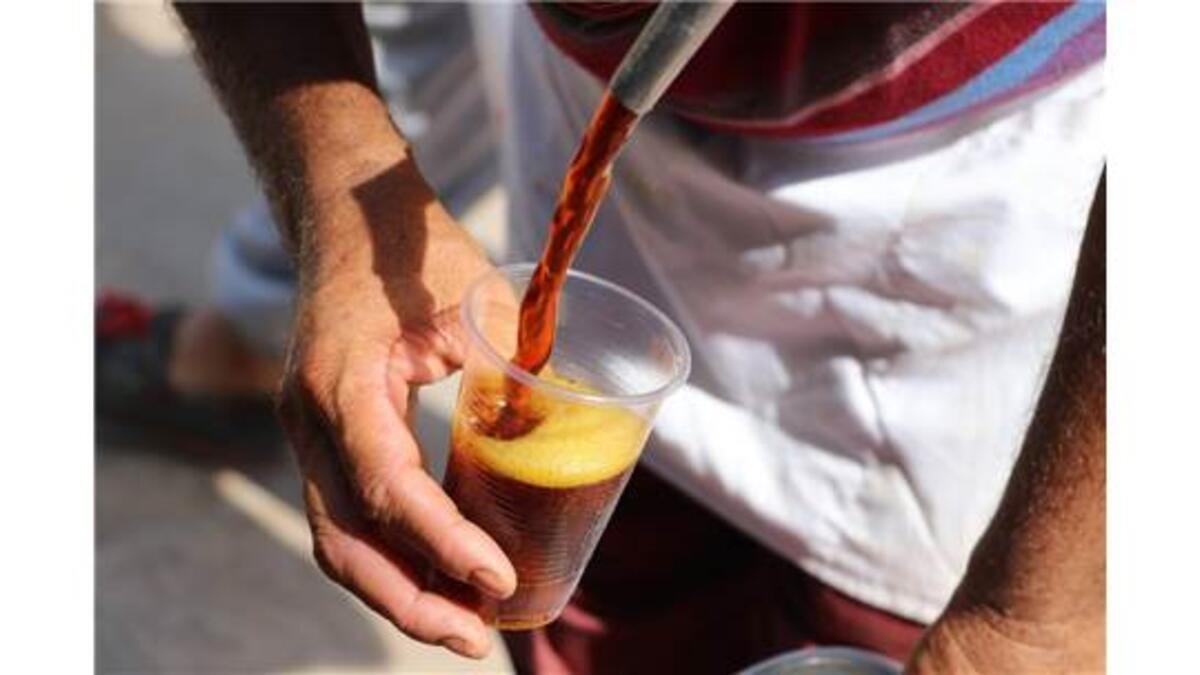
Adana aşlama is a traditional non-alcoholic beverage specific to the province of Adana, prepared by steeping and filtering licorice root (Glycyrrhiza glabra) fibers in drinking water with block ice. This beverage contains no additives, is prepared daily, and served cold and frothy. Traditional vendors, dressed in regional attire, serve it using a specialized set of equipment: a metal güğüm carried on the back, a belt-mounted glass holder, a water jug for rinsing glasses, and two rice bowls struck together to produce sound. The preparation of aşlama involves careful filtration and dilution using precise ratios of water and licorice root.
The preparation of Adana aşlama requires specific skill and attention. One kilogram of prepared licorice root fibers is washed several times with drinking water in a large container until the water takes on color. Then, ten liters of drinking water are added, and the mixture is left to stand for two hours. Block ice is placed on top of the fibers, after which the filtration process begins. A sponge is attached to the spout of the container, and filtration is carried out slowly. The resulting dark licorice extract is diluted with five liters of cold water to make it ready for consumption. This method yields approximately fifty glasses of Adana aşlama.
The texture, flavor, and cooling effect of this beverage are enhanced by the addition of block ice. On average, about eight kilograms of ice are added to fifteen liters of aşlama. Aşlama is produced only fresh and consumed on the same day.
The presentation of Adana aşlama includes a traditional service style unique to the region. Vendors wear traditional attire and use a specially designed serving set consisting of: a metal güğüm carried on the back, a glass holder fastened to the waist, a water jug held in one hand for rinsing glasses, and two rice bowls held in the other hand and struck together to produce sound. The sound of the rice bowls serves to announce the vendor’s presence. During service, glasses are filled from the güğüm, and the frothing of the beverage is considered a desirable characteristic by consumers.
The production of Adana aşlama is permitted only within the boundaries of Adana Province. Due to its reliance on artisanal skill and local knowledge, the beverage has a strong geographical indication. Its preparation and service remain strictly bound to traditional methods, which constitute key distinguishing features justifying its registration.
The production of Adana aşlama under its geographical indication is monitored by a six-member oversight body coordinated by the Adana Chamber of Commerce. This body includes representatives from the Adana Chamber of Commerce (two members), the Adana Restaurant and Kebab Masters Association, the Adana Metropolitan Municipality, the Seyhan District Municipality, and the Adana Provincial Directorate of Agriculture and Forestry. Inspections are conducted at least once annually and may be repeated as needed or upon complaint. During inspections, factors such as the ratio of licorice root to water, the type of ice blocks used, traditional attire, and the serving equipment are verified. Cooperation with public or private institutions or the procurement of services from such institutions may also be arranged.
The term “Adana Aşlama” and its official geographical indication emblem must be used on all products and packaging. If these markings cannot be applied directly to the packaging or product, they must be clearly displayed within the business premises.
Turkish Patent and Trademark Office. *Adana Aşlama Geographical Indication Registration Certificate*. PDF file. Accessed August 16, 2025. https://ci.turkpatent.gov.tr/Files/GeographicalSigns/7ef4867e-6b7a-40d2-9e6c-da22ccc07716.pdf.
Türk Patent ve Marka Kurumu. "Adana Aşlama." Accessed August 16, 2025. https://ci.turkpatent.gov.tr/cografi-isaretler/detay/1213.

Registration Number | 574 | ||||||||
|---|---|---|---|---|---|---|---|---|---|
Registration Date | 26.10.2020 | ||||||||
Application Number | C2019/185 | ||||||||
Application Date | 14.11.2019 | ||||||||
Name of the Geographical Indication | Adana Aşlama | ||||||||
Product / Product Group(s) | Aşlama / Non-Alcoholic Beverages | ||||||||
Type of Geographical Indication | Certification Mark | ||||||||
Applicant/Registrant(s) | Adana Chamber of Commerce | ||||||||
Address of the Registrant | Karasoku Neighborhood, Abidinpaşa Street No:22, Seyhan, ADANA | ||||||||
Geographical Boundary | Adana Province | ||||||||
Recipe/Production Method
Service and Traditional Serving Equipment
Geographical Boundaries and Production Conditions
Monitoring and Protection
Labeling and Usage Format