

This article was automatically translated from the original Turkish version.
+1 More
Registration Number | 575 | ||||||||
|---|---|---|---|---|---|---|---|---|---|
Registration Date | 26.10.2020 | ||||||||
Application Number | C2019/189 | ||||||||
Application Date | 14.11.2019 | ||||||||
Name of the Geographical Indication | Adana Şırdan | ||||||||
Product / Product Group(s) | Şırdan / Dishes and Soups | ||||||||
Type of Geographical Indication | Mahreç Sign | ||||||||
Applicant/Registrant(s) | Adana Chamber of Commerce | ||||||||
Address of the Registrant | Karasoku Neighborhood, Abidinpaşa Street No:22, Seyhan, ADANA | ||||||||
Geographical Boundary | Adana Province | ||||||||
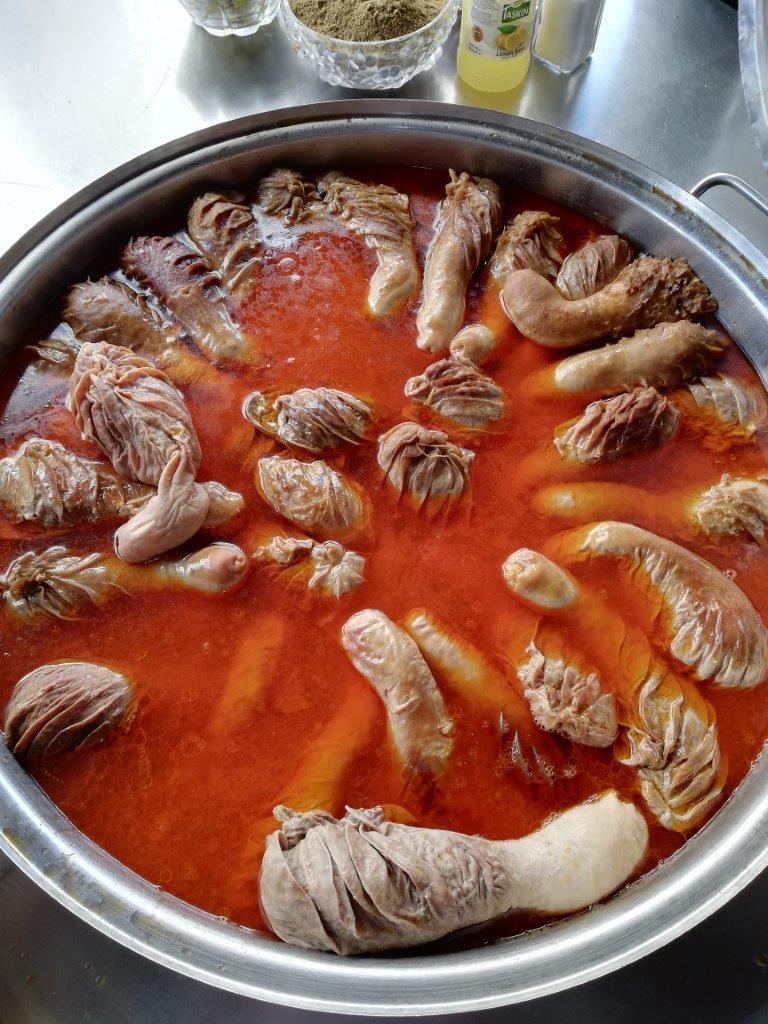
Adana şırdan is a traditional dish specific to the Adana region, made by stuffing the shirdan—a section of the sheep’s stomach—with a filling prepared from rice, internal (perde) fat, black pepper, cumin, salt, and pepper paste, then sewn shut using a specialized technique and cooked by boiling in rock salt water. The shirdan, which requires considerable skill to prepare, is typically served either on a plate or in the hand, sprinkled with salted cumin and hot red pepper flakes, accompanied by pickled hot ornamental peppers.
Adana şırdan is a traditional dish produced by stuffing the shirdan, one of the four chambers of a sheep’s stomach, with a precisely proportioned filling, sewing it closed, and boiling it to cook. Only sheep shirdan and its distinctive internal fat (perde fat) are used; these ingredients define the product’s regional character. The production process involves skilled techniques for stuffing and sewing, as well as cooking with rock salt. Additionally, its presentation—served with cumin, red pepper flakes, and pickled ornamental peppers—distinguishes Adana şırdan from similar dishes.
The following ingredients are used to prepare one Adana şırdan:
For cooking, 50 grams of rock salt is added to 5 liters of water to prepare salted boiling water.
The shirdan is first thoroughly rubbed with salt and rinsed several times with water. After being soaked for a period in lemon-infused salted water, it is rinsed again with clean water. The layer of fat lining the inner surface of the shirdan—known as perde fat—is separated, minced, and added to the filling. The filling is prepared by mixing washed rice with perde fat, black pepper, cumin, salt, and pepper paste.
During stuffing, approximately 1.5 tablespoons of filling are placed into each shirdan. The opening is then sewn shut using a non-melting, food-grade stainless steel needle and thread, approximately 6 mm in thickness. Proper stitching is essential to ensure the filling remains inside during cooking and to prevent excessive water from seeping in.
The sewn shirdans are rinsed again and placed into 5 liters of boiling water prepared with 50 grams of rock salt. They are boiled for approximately 1 hour and 45 minutes with the lid open, during which foam on the surface is regularly removed. At the end of cooking, the heat is turned off and the shirdans are left to rest in the residual steam. After about 30 minutes of resting, the product is ready for consumption.
Adana şırdan is served either on a plate or in the hand. When served by hand, it is presented wrapped in appropriately sized serving paper. Consumption typically begins from the sewn end of the shirdan. It is offered to the consumer either with or without the thread removed, depending on preference. During service, it is sprinkled with cumin and red pepper flakes, and pickled hot ornamental peppers are always served alongside.
Adana şırdan is a product whose production is mandatory within the boundaries of Adana Province. Every stage of production relies on traditional knowledge and local craftsmanship. As a result, a direct link exists between the product and its region of origin. All production, processing, and serving activities must be carried out within the geographical limits of Adana Province.
The protection and monitoring of Adana şırdan as a geographical indication product are coordinated by the Adana Chamber of Commerce. The monitoring board consists of representatives from the following institutions:
Regular inspections are conducted at least once a year, with extraordinary inspections carried out as needed or upon complaint. Inspections cover the suitability of ingredients, adherence to the traditional recipe, and whether production occurs within the designated geographical boundaries. Expert support from public or private institutions may be sought during the inspection process. The registering institution has the authority to carry out all necessary legal procedures.
Turk Patent and Trademark Office. "Adana Şırdan." Geographical Indications Portal. Accessed August 16, 2025. https://ci.turkpatent.gov.tr/cografi-isaretler/detay/1217.
Turkish Patent and Trademark Office. Adana Şırdan - Geographical Indication Registration Certificate (PDF). Accessed August 16, 2025. https://ci.turkpatent.gov.tr/Files/GeographicalSigns/ae0033e7-e8db-458e-90fd-08e5e08a0051.pdf.

Registration Number | 575 | ||||||||
|---|---|---|---|---|---|---|---|---|---|
Registration Date | 26.10.2020 | ||||||||
Application Number | C2019/189 | ||||||||
Application Date | 14.11.2019 | ||||||||
Name of the Geographical Indication | Adana Şırdan | ||||||||
Product / Product Group(s) | Şırdan / Dishes and Soups | ||||||||
Type of Geographical Indication | Mahreç Sign | ||||||||
Applicant/Registrant(s) | Adana Chamber of Commerce | ||||||||
Address of the Registrant | Karasoku Neighborhood, Abidinpaşa Street No:22, Seyhan, ADANA | ||||||||
Geographical Boundary | Adana Province | ||||||||
Distinctive Features
Ingredients and Composition
Production Process
Service Method
Geographical Boundaries and Production Requirements
Monitoring Mechanism