

This article was automatically translated from the original Turkish version.
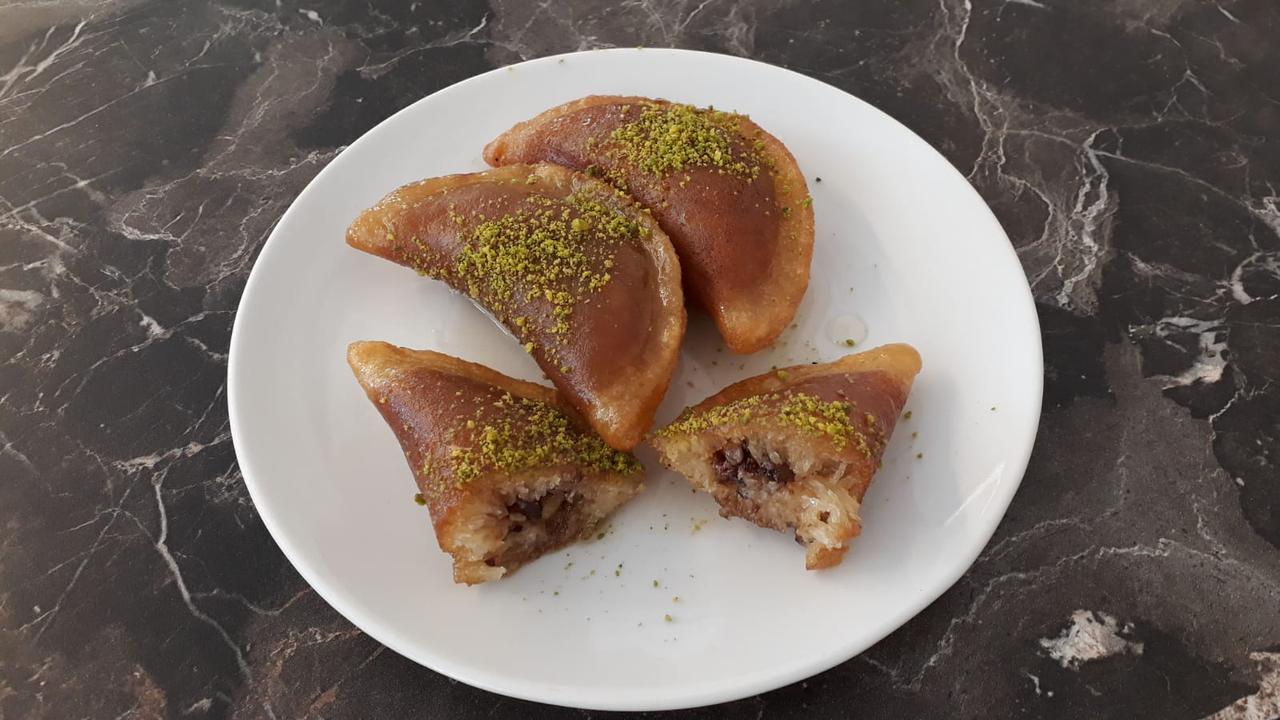
Adana stone kadayıfı is a traditional dessert prepared by placing large crushed walnuts inside a circular, porous dough that has been cooked only on its lower surface, folding it, frying it, and then soaking it in syrup. This dessert, approximately 9–10 cm in diameter and 1 cm thick, is shaped into a semicircle with the cooked surface facing outward, fried in hot sunflower oil, and then immersed in syrup at room temperature. Daily produced Adana stone kadayıfı is typically served sprinkled with crushed walnuts or Antep pistachios.
Adana stone kadayıfı is a traditional dessert variety unique to Adana province, made by placing walnuts inside a circular dough cooked only on one side, folding it, frying it, and then soaking it in syrup. The product is circular, approximately 9–10 cm in diameter and 1 cm thick. The cooking process is applied exclusively to the lower surface of the dough, while the upper surface remains characteristically porous and uncooked. After folding into a semicircular shape, the dough is filled with walnut pieces, sealed tightly at the edges, fried in hot oil, and then immersed in syrup. The product is produced fresh daily and is generally served sprinkled with crushed walnuts or geographically registered Antep pistachios.
The production of Adana stone kadayıfı consists of three main stages: preparation of syrup, preparation of dough, and frying and shaping of the kadayıf.
The syrup is prepared by mixing 5 kg of powdered sugar with 3.5 kg of water and boiling the mixture. Once boiling begins, one tablespoon of lemon juice is added and the mixture is cooked for 30 minutes. The resulting syrup is then cooled to room temperature.
The dough is prepared using 10 kg of special-purpose wheat flour, 10 kg of water, and a leavening agent (15 g of baking powder or 60 g of sodium bicarbonate in summer; 2.5 g of sour yeast in winter). Water temperature varies by season: 35–40 °C in summer and 60–65 °C in winter. All ingredients are mixed until the dough reaches a cake batter consistency.
From the prepared dough, circles approximately 9–10 cm in diameter are cooked on an iron sheet, with cooking applied only to the lower surface. When cooking is complete, the bottom of the dough turns from light yellow to brown, while the upper surface retains its porous structure.
The dough circles are lifted with a spatula, and approximately 4–5 g of large crushed walnut pieces are placed in the center of the uncooked surface. The folded semicircular dough pieces are pressed at the edges to seal them and then fried in hot sunflower oil for approximately 1.5 minutes. Once the kadayıfı turn brown, they are immediately immersed in syrup at room temperature, left for one minute, and then drained.
The production of Adana stone kadayıfı is carried out exclusively within the boundaries of Adana province. This geographical limitation is closely tied to the specialized craftsmanship, regional production knowledge, and local consumption culture required for its preparation. The dessert’s history in Adana dates back to ancient times and is closely linked to various social practices such as offerings, ceremonies, and festivals. This connection underscores the product’s inseparable bond with its geographical origin.
The term "Adana Taş Kadayıfı" and its official emblem must appear on the product packaging or directly on the product itself. If physical placement is not feasible, the term and emblem must be displayed in a clearly visible location within the production facility.
The production process of Adana stone kadayıfı is monitored by a six-member oversight body established under the coordination of the Adana Chamber of Commerce. This body includes representatives from the Adana Chamber of Commerce, the Adana Restaurant and Kebab Masters Association, the Adana Metropolitan Municipality, the Seyhan Municipality, and the Adana Provincial Directorate of Agriculture and Forestry.
Inspections are conducted at least once annually on a regular basis and may also be carried out at any time in response to complaints or specific needs. Inspection criteria include the appropriateness of materials and production methods, compliance with product size and shape standards, the requirement for daily production, and adherence to labeling rules. In necessary cases, services may be obtained from public or private institutions or their personnel. The registering institution is responsible for overseeing legal procedures.

No Discussion Added Yet
Start discussion for "Adana Stone Kadayıfı" article
Distinguishing Features
Recipe/Production Method
Syrup
Dough
Cooking and Shaping
Production Location and Geographical Link
Usage Format
Monitoring and Protection