


This article was automatically translated from the original Turkish version.
+2 More
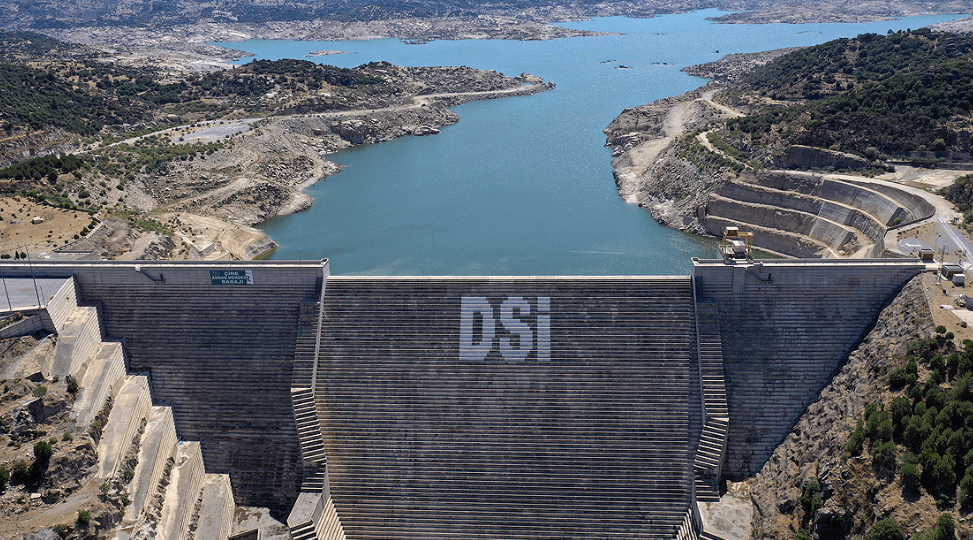
Adnan Menderes Dam is a multi-purpose dam located in the boundaries of Aydın Province, Türkiye, with significant importance for agriculture, energy production, and water resource management. Situated on the Çine Çayı, this dam is also known as the Çine Adnan Menderes Dam and Hydroelectric Power Plant (HES). The dam provides essential functions in hydroelectric power generation, irrigation water supply, and flood control like and makes significant contributions to the regional economy. However, fluctuations in water levels and changes in water quality are among the factors requiring careful monitoring for the dam’s usage and sustainability.

Adnan Menderes Dam, Source: Anadolu Agency
Adnan Menderes Dam is one of the projects developed by Türkiye to manage its water resources and increase energy production. The dam, completed in 2010, is built on the Çine Çayı and lies within the boundaries of the Çine district of Aydın Province.
Dam Type: Concrete embankment
Height: 118 metres
Reservoir Capacity: Approximately 140 million m³
Irrigation Area: Approximately 17,000 hectares of agricultural land
Installed Power (HES): 46 MW
Annual Electricity Production: 118 GWh
Water Supply: Used for drinking and agricultural purposes
Main River: Çine Çayı
Adnan Menderes Dam provides a major economic resource for Aydın and surrounding provinces. According to Anadolu Agency, the dam’s contribution to the economy is estimated at 2.2 billion Turkish Lira.
The hydroelectric power plant within the dam plays a vital role in meeting regional energy demands. Through optimization efforts, the dam’s energy production efficiency has increased by 21 percent.
The dam significantly contributes to the irrigation of agricultural lands in Aydın and its surroundings. Approximately 17,000 hectares of land are irrigated using water from the dam, making this a key factor in enhancing the region’s agricultural productivity important.
During periods of time, declines in water levels have been observed at Adnan Menderes Dam. Due to the drought experienced in 2021, the water level in the dam dropped by up to 19 percent. This situation negatively affected both agricultural production and energy generation.
According to research conducted on the Büyük Menderes River and its tributaries, the dam’s water quality has changed over time due to pollution from industrial waste, sewage, and agricultural activities. The most polluted sections of the Büyük Menderes River are the Sarayköy and Nazilli areas. In these regions, levels of un-ionized ammonia nitrogen (NH₃-N) and total coliform bacteria are notably high.
Similarly, water quality in the Çine Çayı has also varied over the years. Analyses conducted at the Kayırlı and Çakırbeyli water quality monitoring stations have revealed degradation in certain water parameters.
Adnan Menderes Dam has generated significant impacts on the local ecosystem. In particular, freshwater mussels and fish populations are directly affected by the dam’s presence.
Before the dam’s construction, freshwater mussels such as Unio crassus and Unio terminalis were present in the Çine Çayı. These mussels are organisms that play a critical role in the biological purification of water. However, after the dam’s construction, mussel populations declined substantially.
Sweet mussel larvae attach themselves to the gills of certain fish species to complete their development. Research has shown that fish of the genus Andinoacara serve as important host species for these mussels.
Adnan Menderes Dam is a critical structure for the sustainable management of water resources. However, declining water levels, pollution, and negative ecological impacts present challenges for the dam’s long-term management.
Energy production has been increased through optimization efforts in hydroelectric generation.
To improve the efficient use of irrigation water, modern agricultural practices should be promoted.
Waste management and water treatment systems must be strengthened to preserve water quality.
Regular monitoring of water levels and the development of improved management policies are necessary.
Rainwater harvesting and alternative water sources should be evaluated.
Water management strategies must be developed with consideration of climate change impacts.
Adnan Menderes Dam is a vital structure for energy production, agricultural irrigation, and water resource management. However, fluctuations in water levels, variations in water quality, and ecosystem impacts require careful attention for effective dam management. Comprehensive measures must be implemented to ensure the sustainable use of water resources in the future.
Anadolu Ajansı. "Adnan Menderes Barajındaki Su Seviyesi Kuraklık Nedeniyle Yüzde 19’a Geriledi." Accessed March 13, 2025. https://www.aa.com.tr/tr/ekonomi/adnan-menderes-barajindaki-su-seviyesi-kuraklik-nedeniyle-yuzde-19a-geriledi/2297807.
Anadolu Ajansı. "Avrupa’nın En Yüksek Barajı’ndan Ekonomiye Dev Katkı." Accessed March 13, 2025. https://www.aa.com.tr/tr/ekonomi/avrupanin-en-yuksek-barajindan-ekonomiye-dev-katki/1425654.
Anadolu Ajansı. "Çine Adnan Menderes Barajı Ekonomiye 2,2 Milyar Liralık Katkı Sağladı." Accessed March 13, 2025. https://www.aa.com.tr/tr/ekonomi/cine-adnan-menderes-baraji-ekonomiye-2-2-milyar-liralik-katki-sagladi/2211785.
Duran, Sinem. "Çine Adnan Menderes Barajı ve Hidroelektrik Santrali için Sezgisel Optimizasyon Yöntemi ile Kural Eğrisi Oluşturulması." Master's thesis,Pamukkale Üniversitesi Institute of Natural Sciences, 2022.
Güler, Mehmet, Deniz Çoban, and Birsen Kırım. "Observations on the Reproductive Biology of Unio Terminalis (Bivalvia: Unionidae)." Ege Journal of Fisheries and Aquatic Sciences 34, no. 3 (2017): 303-309.
Küçük, Semra. "Büyük Menderes Nehri Su Kalite Ölçümlerinin Su Ürünleri Açısından İncelenmesi." ADÜ Ziraat Fakültesi Dergisi 4, no. 1-2 (2007): 7-13.
Yeşilırmak, Ercan. "Çine Çayı Su Kalitesi Eğilimleri." ADÜ Ziraat Fakültesi Dergisi 8, no. 1 (2011): 47-55.
Yılmaz, Özgen, and Murat Barlas. "Dipsiz-Çine Çayı (Aydın)’nda Yaşayan Tatlısu Midyesi Unio Crassus (Philipsson, 1788) Populasyonunun Morfometrik Özellikleri." Türk Tarım-Gıda Bilim ve Teknoloji Dergisi 4, no. 10 (2016): 877-881.

History
Technical Specifications
Economic Contribution
Hydroelectric Power Generation
Agriculture and Irrigation
Water Level and Drought Impacts
Water Quality and Pollution
Ecological Impacts
Freshwater Mussels and the Ecosystem
Fish Species and Habitat Changes
Water Resource Management and Future Perspectives
Optimization and Efficient Use
Measures Against Drought and Water Scarcity