


This article was automatically translated from the original Turkish version.
+2 More
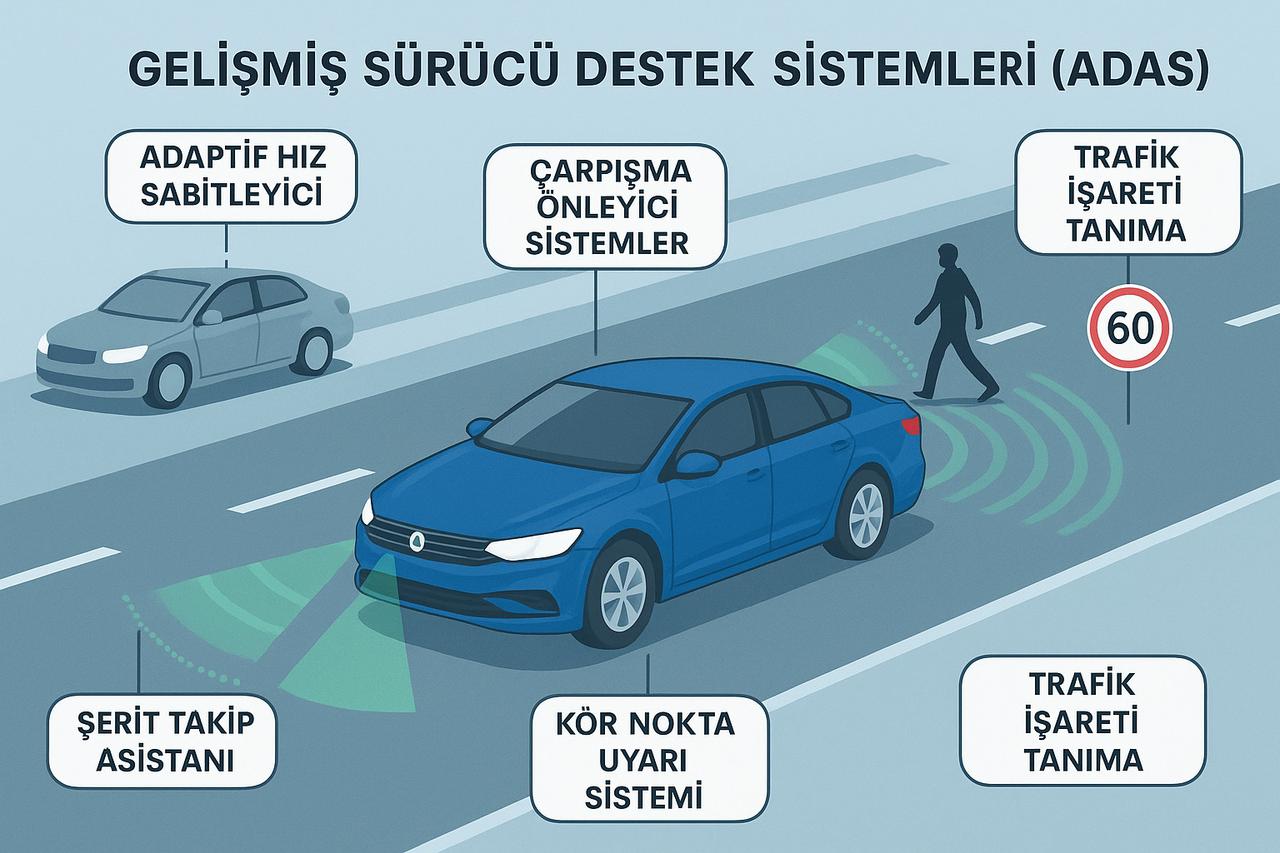
Advanced Driver Assistance Systems (ADAS)
ADAS | Driver Assistance Systems | ||||||||
|---|---|---|---|---|---|---|---|---|---|
Technology | Radar Lidar Camera | ||||||||
Advanced Driver Assistance Systems (ADAS) are a suite of electronic systems designed to enhance driver safety, simplify driving, and prevent accidents.
ADAS has become increasingly common in modern vehicles and forms the foundational technology for autonomous driving. These systems detect the vehicle’s surroundings using a range of technologies such as sensors, cameras, radar, and lidar, process the data, and either provide the driver with various alerts or intervene directly when necessary.
The origins of ADAS can be traced back to the 1950s with the introduction of basic safety measures in the automotive industry such as seat belts and ABS (Anti-lock Braking System). However, significant development began in the 1990s with advances in electronic control units (ECUs) and sensor technology. Early generations of ADAS were limited to relatively simple systems such as cruise control and parking sensors. Today, ADAS has evolved to the point where it enables partial autonomous driving.
ADAS systems operate primarily through environmental sensors such as cameras, radar, lidar, and ultrasonic sensors. Data collected from the vehicle’s surroundings is analyzed in real time by central processing units. Based on this analysis, the system can inform the driver through auditory, visual, or haptic alerts or perform automatic interventions in emergency situations such as automatic braking.

Autonomous Driving - Anadolu Agency
ADAS systems correspond to Level 1 and Level 2 automation as defined by the Society of Automotive Engineers (SAE). At Level 2, the system can control both steering and speed simultaneously, but the driver must remain attentive at all times. Further development of ADAS technology is required to achieve higher levels of autonomy (Levels 3–5).
Dey, Vikas, and Seung-Kyum Choi. Autonomous Driving: The Road to Safer, Cleaner, and More Efficient Vehicles. Berlin: Springer, 2021.
European Commission. “Automated and Connected Mobility.” Accessed March 10, 2025. https://ec.europa.eu/transport/themes/urban/automated-driving_en.
Li, Jun, and Xin Sun. “Vehicle Automation for Advanced Driver Assistance Systems.” *Journal of Intelligent Transportation Systems* 26, no. 4 (2022): 303–315. .
Nassar, Tamer. Advanced Driver Assistance Systems: Design, Development, and Applications. 2. baskı. Cambridge: Cambridge University Press, 2020.
National Highway Traffic Safety Administration. “Automated Vehicles for Safety.” Accessed April 25, 2025. .
Zhang, Hong, and Yanyan Zhang. “Current Trends and Future Directions in ADAS Technologies.” *IEEE Transactions on Intelligent Transportation Systems* 20, no. 5 (2019): 1754-1763. .

Advanced Driver Assistance Systems (ADAS)
ADAS | Driver Assistance Systems | ||||||||
|---|---|---|---|---|---|---|---|---|---|
Technology | Radar Lidar Camera | ||||||||
No Discussion Added Yet
Start discussion for "Advanced Driver Assistance Systems (ADAS)" article
History
Working Principle
Main Sensors Used
Key ADAS Functions
ADAS and Autonomous Driving
