

This article was automatically translated from the original Turkish version.
+1 More
AEgir (Epsilon Eridani b), is a controversial gas giant exoplanet candidate proposed to orbit Epsilon Eridani (officially named Ran), a young, Sun-like star located approximately 10.5 light years from Earth in the direction of the Eridanus constellation.
The planet’s discovery was announced in 2000 using the radial velocity method. Subsequently, it was claimed that its existence had been confirmed by astrometric measurements made with the Hubble Space Telescope. However, more precise observations and analyses conducted in the following years produced strong evidence that the observed signal originated not from a planetary orbit but from the star’s own magnetic activity cycle.
This has rendered Epsilon Eridani b not only a disputed exoplanet candidate but also a significant case study reflecting the challenges encountered in exoplanet research and the self-correcting nature of the scientific method.
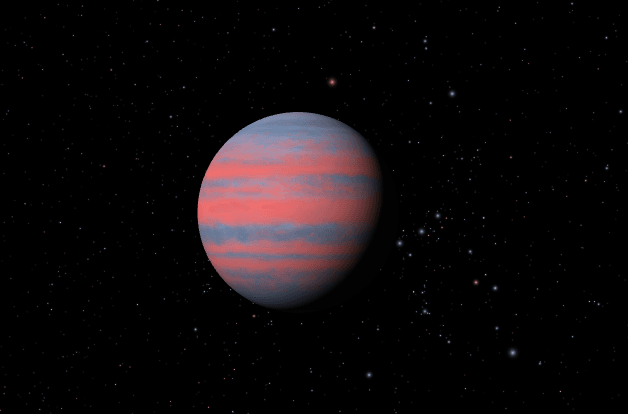
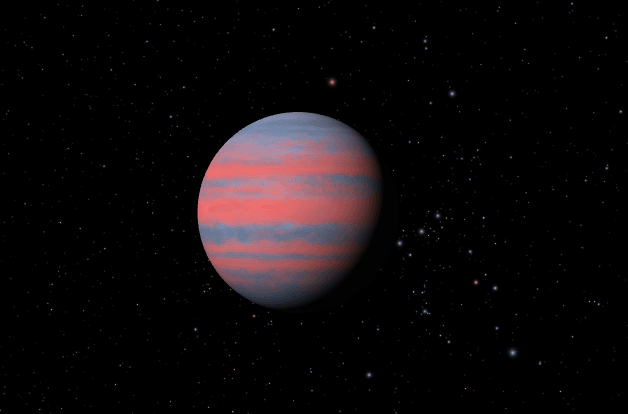
Epsilon Eridani b (NASA)
The first hints of a possible planet orbiting Epsilon Eridani stemmed from astrometric observations by astronomers such as Peter van de Kamp in the 1980s; however, these early claims were never confirmed.
The modern discovery process began on 7 August 2000 when a research team led by Artie Hatzes announced the detection of a periodic oscillation with a period of approximately seven years in Epsilon Eridani’s motion, based on radial velocity data from the Lick, Keck and McDonald observatories. This signal was interpreted as evidence of a planet with a mass similar to Jupiter. However, given that Epsilon Eridani is a young and highly magnetically active star, serious doubts arose that the observed signal might instead originate from star spots or surface activity.
In 2006, a team led by G. Fritz Benedict of the University of Texas analyzed over a decade of astrometric data collected by the Hubble Space Telescope’s Fine Guidance Sensors (FGS) and reported confirmation of the planet’s existence. Astrometry measures tiny “wobbles” in the star’s position on the sky caused by an orbiting planet, allowing determination of the orbital inclination (30.1 ± 3.8 degrees) and thus calculation of the planet’s true mass rather than just its minimum mass. This study was regarded at the time as significant support for the planet’s existence.
Nevertheless, debate continued. Later observations revealed that the radial velocity signal changed in amplitude and phase over time and showed correlation with indicators of the star’s chromospheric activity. Comprehensive analyses published in the early 2020s, which combined radial velocity, astrometric and stellar activity data, concluded that the seven-year cycle is more likely attributable to the star’s magnetic activity cycle than to a planetary companion.
As a result, the existence of Epsilon Eridani b is now largely rejected or considered unconfirmed by the scientific community. This situation serves as an example of the methodological challenges in exoplanet research and the dynamic nature of scientific validation.
Epsilon Eridani (ε Eri) is an orange dwarf star of spectral class K2V and one of the closest stars to the Solar System. Its mass is approximately 82% that of the Sun, and its radius is about 74%. Its age is estimated to be between 400 and 800 million years, making it considerably younger than the Sun. This youth explains its high level of magnetic activity, strong stellar winds and frequent surface flares.
Epsilon Eridani is also notable for hosting a complex debris disk system. This system includes two distinct asteroid belts located at approximately 3 AU and 20 AU from the star, as well as a wide, cold outer dust belt extending from 35 to 100 AU, analogous to the Kuiper Belt. Thus, Epsilon Eridani is an important observational target for studying planet formation and early evolutionary processes, due to both its youth and its disk structures.
According to some studies supporting the existence of Epsilon Eridani b, the proposed physical and orbital characteristics of the planet are as follows. However, it must be remembered that these values are only “proposed” or “claimed,” as the planet’s existence is now seriously questioned:
The proposed high eccentricity indicates that the planet’s orbit is highly elliptical. This would bring it as close as approximately 1 AU to the star at periastron and as far as 5.8 AU at apastron. Such an orbital dynamics is thought to have significantly shaped the structure and position of the inner asteroid belt in the Epsilon Eridani system.
As of 2024, evidence for the existence of Epsilon Eridani b is considered weak. A strong scientific consensus has emerged that the observed signals most likely originate from the star’s magnetic activity. Leading databases such as the NASA Exoplanet Archive classify its status as “controversial” or “retracted.”
Ironically, before its existence became suspect, the planet was officially named in 2015 under the International Astronomical Union’s (IAU) NameExoWorlds project. Following a proposal by Mount Hood Community College in the United States, the planet was named AEgir, after a sea giant from Norse mythology, while the host star was named Ran, after AEgir’s wife and the goddess of the sea. Although the planet’s scientific status remains uncertain, this naming has secured its place in the cultural history of astronomy.

No Discussion Added Yet
Start discussion for "AEgir (Epsilon Eridani b)" article
Discovery History and Controversies
Host Star: Epsilon Eridani (Ran)
Proposed Physical and Orbital Characteristics
Current Status and Naming