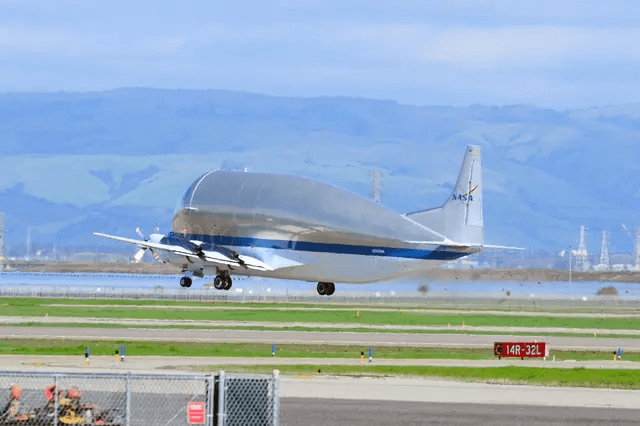
+2 More

Name(s) | Aero Spacelines Super Guppy | ||||||||
|---|---|---|---|---|---|---|---|---|---|
Category | Oversized Cargo Aircraft | ||||||||
Origin(s) | USA (Aero Spacelines) | ||||||||
Engine(s) | 4 x Allison 501-D22C turboprop engines | ||||||||
First Flight(s) | Prototype: 1962 / Super Guppy Turbine: 1970 | ||||||||
Crew | 4 | ||||||||
Length(s) | 43.84 m | ||||||||
Wingspan | 47.62 m | ||||||||
Maximum Takeoff Weight | Approximately 77,000 kg | ||||||||
Aero Spacelines Super Guppy is a large-size cargo aircraft designed for American aviation and space programs. Produced by modifying the Boeing 377 Stratocruiser passenger aircraft, the Super Guppy was developed for the purpose of transporting large and bulky components that could not fit into standard cargo aircraft.

Super Guppy (Ian Abbott)
The development of the Super Guppy began when Jack M. Conroy, the founder of the Aero Spacelines company and a former US Air Force pilot, identified the logistical need for transporting rocket components for NASA's space program. Conroy developed a solution for this need by widening the fuselage of a Boeing 377 Stratocruiser.
Super Guppy (AirshowStuffVideos)
The Super Guppy has a design optimized for voluminous cargo. The main features of the Super Guppy Turbine model are:

Super Guppy (wrightbrosfan)
The Super Guppy has been used for transporting large components in various aviation projects.

Super Guppy (fsll2)
Today, four of the produced Super Guppy aircraft are exhibited in museums. One of these aircraft is located at the Pima Air & Space Museum in California, and another is at the Museum of Outdoor Cargo in Washington. The fifth and final Super Guppy Turbine model produced is still operational and is used for missions by NASA's Lyndon B. Johnson Space Center in Houston, Texas.
Abbott, Ian. “Aero Spacelines Super Guppy.” Flickr. Accessed: October 20, 2025. https://www.flickr.com/photos/ian_e_abbott/50514827401
Aero Corner. “Aero Spacelines Super Guppy.” Aero Corner. Accessed: October 20, 2025. https://aerocorner.com/aircraft/aero-spacelines-super-guppy
Aviationtag. “The Aero Spacelines Super Guppy Turbines (F-BTGV) Story.” Aviationtag. Accessed: October 20, 2025. https://www.aviationtag.com/de-eu/blogs/blog/the-aero-spacelines-super-guppy-turbines-f-btgv-story?srsltid=AfmBOorW1YSYsPL7B-IpkYl_oO-OdF7WE2c8UfuInmErotov15d5mXwt
Britairliners. “A Fisherman’s Tale.” Britairliners. Accessed: October 20, 2025. https://www.britairliners.org/airliners-article?title=a-fisherman’s-tale&id=31 fsll2. “Aero Spacelines Super Guppy.” Flickr. Accessed: October 20, 2025. https://www.flickr.com/photos/classic_aviation/6881391782/in/photolist-bu5W2U-CAURKj-2hRgPFS-S8TE3f-cWUsCG-DyqkC6-2mJ2vym-p2JxzG-WcvBRf-cWUtQW-RbsUCC-C8HwXJ-2oz8PTE-mCvtH5-aVhyKP-cWUsa5-mCtEtP-mCtFeX-9yopEL-CXVXxR-C8QD9B-LK6z2G-VCHCJR-2n7hdtT-Dr9Q2v-DoRdef-2d3Eixb-jAdofA-ticzpG-2pfmtpM-CB3rRR-DoR8kN-pAiTU5-2fpbfRR-RXQkX2-27HYirf-pGATYa-Dw7B6j-CB3cjV-2o6dXEE-D6e3Uv-DyqQfB-aXybjF-Dw6zLs-PXvdqw-D6dN1c-jAaf8t-VqWWDX-VCHDqa-odQKvH
Interesting Engineering. “The Super Guppy: The Airborne Elephant That Can Carry Anything!.” YouTube. Accessed: October 20, 2025. [suspicious link removed] NASA Fandom Wiki. “Aero Spacelines Super Guppy.” NASA Fandom Wiki. Accessed: October 20, 2025. https://nasa.fandom.com/wiki/Aero_Spacelines_Super_Guppy
NASA. “Super Guppy.” NASA. Accessed: October 20, 2025. https://www.nasa.gov/specials/jsc-aircraft-ops/guppy.html#top Pima Air & Space Museum. “Aero Spacelines 377G Super Guppy.” Pima Air & Space Museum. Accessed: October 20, 2025. https://pimaair.org/museum-aircraft/aero-spacelines-377g-super-guppy
Skybrary. “Aero Spacelines Super Guppy.” Skybrary. Accessed: October 20, 2025. https://skybrary.aero/aircraft/sgup#:~:text=T Şimşek, Alaeddin. “Aero Spacelines Super Guppy.” Kokpitteyiz. Accessed: October 20, 2025. https://www.kokpitteyiz.com/aero-spacelines-super-guppy
Wrightbrosfan.“Aero Spacelines Super Guppy.” Flickr. Accessed: October 20, 2025. https://www.flickr.com/photos/53497385@N07/7841254722/in/photolist-cWUtQW-RbsUCC-C8HwXJ-2oz8PTE-mCvtH5-aVhyKP-cWUsa5-mCtEtP-mCtFeX-9yopEL-CXVXxR-C8QD9B-LK6z2G-VCHCJR-2n7hdtT-Dr9Q2v-DoRdef-2d3Eixb-jAdofA-ticzpG-2pfmtpM-CB3rRR-DoR8kN-pAiTU5-2fpbfRR-RXQkX2-27HYirf-pGATYa-Dw7B6j-CB3cjV-2o6dXEE-D6e3Uv-DyqQfB-aXybjF-Dw6zLs-PXvdqw-D6dN1c-jAaf8t-VqWWDX-VCHDqa-odQKvH-ticUS9-cpgPD5-oM3SUB-2hPHFR5-78c5FJ-mue16F-J6sMP7-muW8Er-Pypm6

Name(s) | Aero Spacelines Super Guppy | ||||||||
|---|---|---|---|---|---|---|---|---|---|
Category | Oversized Cargo Aircraft | ||||||||
Origin(s) | USA (Aero Spacelines) | ||||||||
Engine(s) | 4 x Allison 501-D22C turboprop engines | ||||||||
First Flight(s) | Prototype: 1962 / Super Guppy Turbine: 1970 | ||||||||
Crew | 4 | ||||||||
Length(s) | 43.84 m | ||||||||
Wingspan | 47.62 m | ||||||||
Maximum Takeoff Weight | Approximately 77,000 kg | ||||||||
No Discussion Added Yet
Start discussion for "Aero Spacelines Super Guppy" article
Design and Development Phases
Technical Specifications and Performance
Operational Role and Historical Significance
Current Status
This article was created with the support of artificial intelligence.