

This article was automatically translated from the original Turkish version.
+1 More
Registration Number | 73 | ||||||||
|---|---|---|---|---|---|---|---|---|---|
Registration Date | 02.08.2005 | ||||||||
Application Number | C2003/028 | ||||||||
Application Date | 31.12.2003 | ||||||||
Name of the Geographical Indication | Afyon Pastırma | ||||||||
Product/Product Group | Pastırma/Processed and Unprocessed Meat Products | ||||||||
Type of Geographical Indication | Certification Mark | ||||||||
Applicant/Registrant(s) | Afyon Chamber of Commerce | ||||||||
Address of the Registrant | Dumlupınar Neighborhood, Chamber of Commerce Building, AFYONKARAHİSAR | ||||||||
Geographical Boundary | Afyon Province | ||||||||
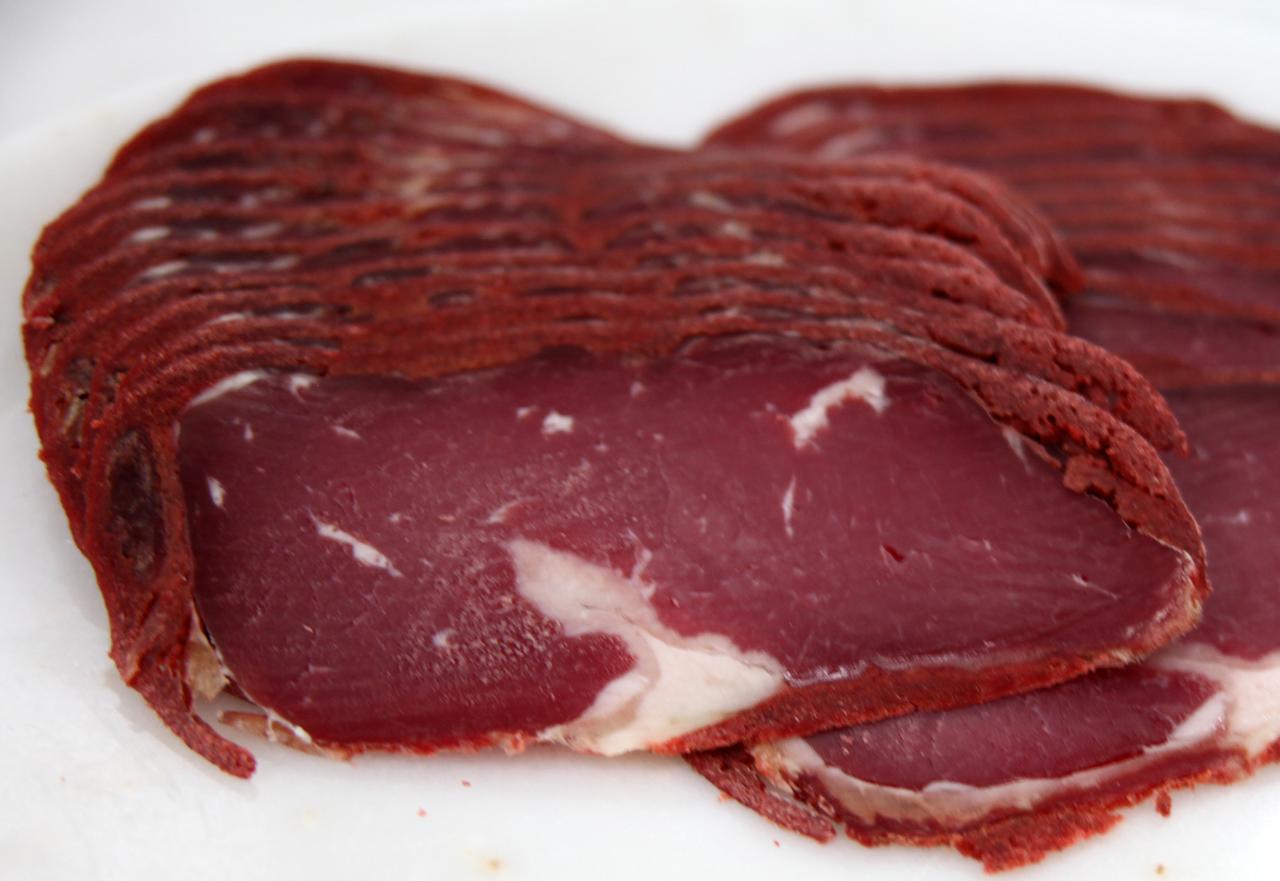
Afyon pastırması is a traditional meat product made from beef or water buffalo meat, uniquely produced in the province of Afyonkarahisar. In its production, animals must be raised within the boundaries of Afyon province for at least three months. After slaughter, the meat is rested and salted using specific cuts, then dried under controlled climatic conditions or in a natural environment. After drying and pressing, the product is coated with a mixture called çemen and dried again, distinguishing itself by its unique aroma and durability. Çemen consists of a blend of çemen flour (ground buy herb seeds), red paprika powder, garlic, salt, and water.
The production of Afyon pastırması is an original and controlled process consisting of multiple stages.
1. Meat Preparation and Resting: After slaughter, the meat is separated from the bones and cleaned of undesirable tissues on the surface. The cuts intended for pastırma are removed from the carcass and rested for at least 24 hours.
2. Salting: Incisions (shaklama) are made on the surface of the meat pieces to allow salt to penetrate the inner layers. Salting is carried out in large containers at temperatures below 4°C for at least 24 hours. The meat is then washed to remove excess salt.
3. First Drying and Pressing: The washed meat is dried for an average of 35 days in natural conditions or in climate-controlled rooms with 65–70% relative humidity and a temperature of 20–22°C. After drying, the meat is stacked crosswise and subjected to pressure. This first pressing lasts at least six hours at room temperature.
4. Second Drying and Pressing: The pressed meat is hung and dried again. The duration of this drying phase varies depending on the season. After drying, the meat is pressed a second time.
5. Çemen Coating: The pastırma pieces are coated with a traditional çemen dough made from a mixture of buy herb (çemen seed) flour, red paprika powder, garlic, salt, and water. For every 100 kg of çemen, approximately 25 kg of çemen flour, 7 kg of red paprika powder, 18 kg of finely minced garlic, and sufficient water are used. The coated meat is left to rest in vats for at least 15 hours.
6. Çemen Drying: The çemen-coated meat is hung with the ends facing downward and dried in environments with air circulation for at least three days. The final drying stage is completed for at least two days in natural conditions or at least 24 hours in climate-controlled rooms.
Afyon pastırması was officially registered on 2 August 2005 under number 73, following an application submitted on 31 December 2003 (Application No: C2003/028). The registering body is the Afyon Chamber of Commerce. Production is permitted only within the boundaries of Afyon province.
The monitoring process is coordinated by the Afyonkarahisar Chamber of Commerce and Industry and is conducted at least once a year by an eight-member monitoring board comprising experts from relevant municipalities, trade associations, universities, and agricultural directorates. Monitoring covers criteria related to the feeding duration of the animals used in production, compliance with production methods, and proper use of the official logo.
The distinctive characteristics of Afyon pastırması are not limited solely to the use of çemen or the type of meat. The entire production process is directly linked to the geographical, climatic, and cultural conditions of Afyon province. In particular, Afyon’s breezy spring and summer weather significantly contributes to the natural drying process. Therefore, the product must be produced within its defined geographical boundary. Drying, resting, and çemen coating can be carried out in both natural and controlled environments (climate-controlled rooms).
Turk Patent and Trademark Office. Afyon Pastırması Coğrafi İşaret Tescil Belgesi. Registration No: 73. PDF. Accessed August 16, 2025. https://ci.turkpatent.gov.tr/Files/GeographicalSigns/c59cfaa9-f194-4234-9321-a5246a146ce0.pdf.
Turkish Patent and Trademark Office. "Afyon Pastırması." *Coğrafi İşaretler Portalı*. Accessed August 16, 2025. https://ci.turkpatent.gov.tr/cografi-isaretler/detay/37935.

Registration Number | 73 | ||||||||
|---|---|---|---|---|---|---|---|---|---|
Registration Date | 02.08.2005 | ||||||||
Application Number | C2003/028 | ||||||||
Application Date | 31.12.2003 | ||||||||
Name of the Geographical Indication | Afyon Pastırma | ||||||||
Product/Product Group | Pastırma/Processed and Unprocessed Meat Products | ||||||||
Type of Geographical Indication | Certification Mark | ||||||||
Applicant/Registrant(s) | Afyon Chamber of Commerce | ||||||||
Address of the Registrant | Dumlupınar Neighborhood, Chamber of Commerce Building, AFYONKARAHİSAR | ||||||||
Geographical Boundary | Afyon Province | ||||||||
Recipe/Production Process
Registration and Monitoring Information
Geographical Boundary and Production Linkage