

This article was automatically translated from the original Turkish version.
+1 More
Registration Number | 737 | ||||||||
|---|---|---|---|---|---|---|---|---|---|
Registration Date | 29.04.2021 | ||||||||
Application Number | C2020/125 | ||||||||
Application Date | 09.06.2020 | ||||||||
Name of the Geographical Indication | Afyon Velense Dough Vaccine / Afyonkarahisar Velense Dough Vaccine | ||||||||
Product / Product Group(s) | Food / Food and Soups | ||||||||
Type of Geographical Indication | Mahreç Sign | ||||||||
Applicant/Registrant(s) | Afyonkarahisar Municipality | ||||||||
Address of the Registrant | Karaman Mah. Albay Reşat Çiğiltepe Cad. No:11 03200 AFYONKARAHİSAR | ||||||||
Geographical Boundary | Afyonkarahisar Province | ||||||||
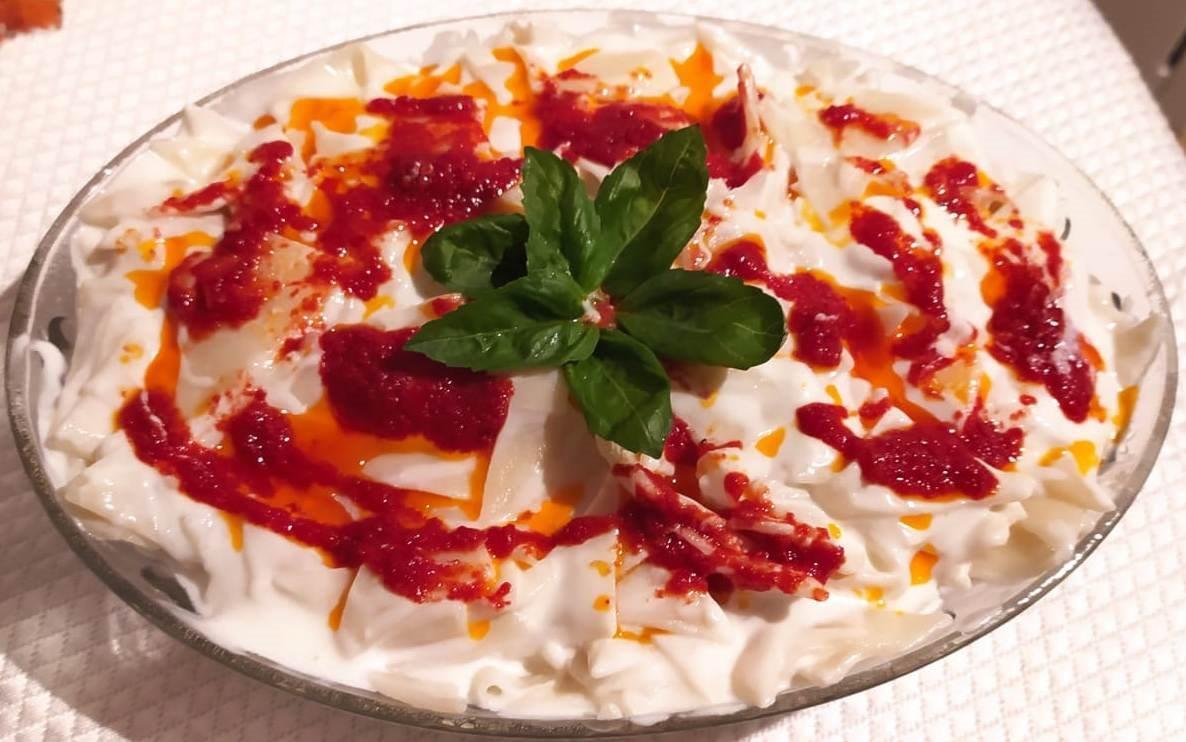
Afyon velense hamur aşı / Afyonkarahisar velense hamur aşı is a traditional dish unique to Afyonkarahisar province, made by cutting dough into square pieces, drying them, then boiling and serving with garlic-infused yogurt and butter sauce. It is commonly offered during local events such as condolences, circumcisions, pilgrimage send-offs, and dowry presentations. The dough is prepared by mixing flour, egg, water, olive oil, and salt, then rolled out, cut into small squares, and dried. Once dried, the pieces are boiled, covered with garlic-infused yogurt, and topped with melted butter, served either hot or cold.
The production process of Afyon velense hamur aşı consists of two main stages:
1) Preparing and drying the dough and
2) Boiling the dried dough and preparing it for serving.
Within this approximately 30-minute process, traditional knowledge and skills are essential.
The velense dough is made using 480 grams of special-purpose wheat flour, three eggs, 10 grams of salt, 30 milliliters of olive oil, and 250 milliliters of water. The flour is spread on a large surface, a well is made in the center, and the eggs are added and mixed. Olive oil and salt are then incorporated to form a dough, which is covered and left to rest. From the rested dough, palm-sized portions are taken and rolled into thick sheets approximately 60 centimeters in diameter. The sheets are cut into 2-centimeter squares, lightly dusted with flour, arranged on trays, and left to dry.
The dried dough pieces are boiled in boiling water, drained, and placed on serving plates. A sauce is poured over them to complete the presentation. The sauce is prepared using two to three cloves of crushed garlic and 300 grams of strained yogurt. Finally, 30 grams of butter are melted in a pan, and the melted butter is poured over the yogurt mixture to finish the dish. This dish can be consumed either hot or cold.
The dried hamur aşı is packaged in two different ways for sale:
1) Plastic, sealed transparent boxes and
2) Cotton fabric pouches with a transparent window on the front.
Both packaging types ensure the product remains safely preserved throughout its shelf life.
The production, traditional consumption patterns, and historical origins of the product are directly linked to Afyonkarahisar province. Therefore, all stages of production—particularly kneading, rolling, cutting, and drying the dough—must be carried out exclusively within these geographical boundaries. Since the traditional preparation method relies on skill-based knowledge transfer, production outside these boundaries is not considered appropriate for preserving the geographical indication.
The production, labeling, and packaging of Afyon velense hamur aşı are inspected at least once annually. The inspection is conducted by a six-member oversight body composed of representatives from the Afyonkarahisar Municipality, Afyonkarahisar Provincial Directorate of Agriculture and Forestry, Chamber of Commerce and Industry, Kocatepe University, Union of Craftsmen and Artisans, and Provincial Directorate of Health, under the coordination of the Afyonkarahisar Municipality. Additional inspections may be carried out when deemed necessary or upon complaint.
During inspections, the following elements are examined:
The oversight body may seek support from or procure services from expert individuals from the public or private sector as needed. The Afyonkarahisar Municipality, as the entity that registered the product, is responsible for carrying out legal procedures.
Turkish Patent and Trademark Office. "Afyon Velense Hamur Aşı / Afyonkarahisar Velense Hamur Aşı." *Coğrafi İşaretler Portalı*. Accessed August 16, 2025. https://ci.turkpatent.gov.tr/cografi-isaretler/detay/2070.
Turkish Patent and Trademark Office. *Afyon Velense Hamur Aşı / Afyonkarahisar Velense Hamur Aşı*, Registration No: 737, Certification Mark, Registrant: Afyonkarahisar Municipality, Registration/Application Dates: 09.06.2020 / 29.04.2021. PDF file. Accessed August 16, 2025. https://ci.turkpatent.gov.tr/Files/GeographicalSigns/6a50161d-a8a2-4fa7-aa1a-8d8343c57331.pdf

Registration Number | 737 | ||||||||
|---|---|---|---|---|---|---|---|---|---|
Registration Date | 29.04.2021 | ||||||||
Application Number | C2020/125 | ||||||||
Application Date | 09.06.2020 | ||||||||
Name of the Geographical Indication | Afyon Velense Dough Vaccine / Afyonkarahisar Velense Dough Vaccine | ||||||||
Product / Product Group(s) | Food / Food and Soups | ||||||||
Type of Geographical Indication | Mahreç Sign | ||||||||
Applicant/Registrant(s) | Afyonkarahisar Municipality | ||||||||
Address of the Registrant | Karaman Mah. Albay Reşat Çiğiltepe Cad. No:11 03200 AFYONKARAHİSAR | ||||||||
Geographical Boundary | Afyonkarahisar Province | ||||||||
No Discussion Added Yet
Start discussion for "Afyon Velense Dough Paste/Afyonkarahisar Velense Dough Paste" article
Production Process and Technology
Preparation of the Dough
Cooking and Serving
Packaging and Storage
Geographical Boundaries and Production Conditions
Monitoring and Protection Process