This article was automatically translated from the original Turkish version.
Kingdom(s) | Plantae (Plants) | ||||||||
|---|---|---|---|---|---|---|---|---|---|
Division | Tracheophyta (Vascular plants) | ||||||||
Class | Monocotyledonae (Monocots) | ||||||||
Order | Asparagales | ||||||||
Family | Asparagaceae (Asparagus family) | ||||||||
Genus | Agave | ||||||||
Number of Species | Approximately 200 different species | ||||||||
Natural Distribution | Mexico, Central and South America, southwestern United States | ||||||||
Agave is a perennial plant genus belonging to the Asparagaceae (asparagus family) and exhibiting succulent characteristics. Typically growing in arid and semi-arid regions, agave is recognized by its rosette structure formed by fleshy leaves. The genus name originates from Ancient Greek and means “noble” or “magnificent.” With approximately 200 species, this plant is notable for flowering only once in its lifetime. Agave is naturally distributed across Central and South America and the southwestern desert regions of the United States.

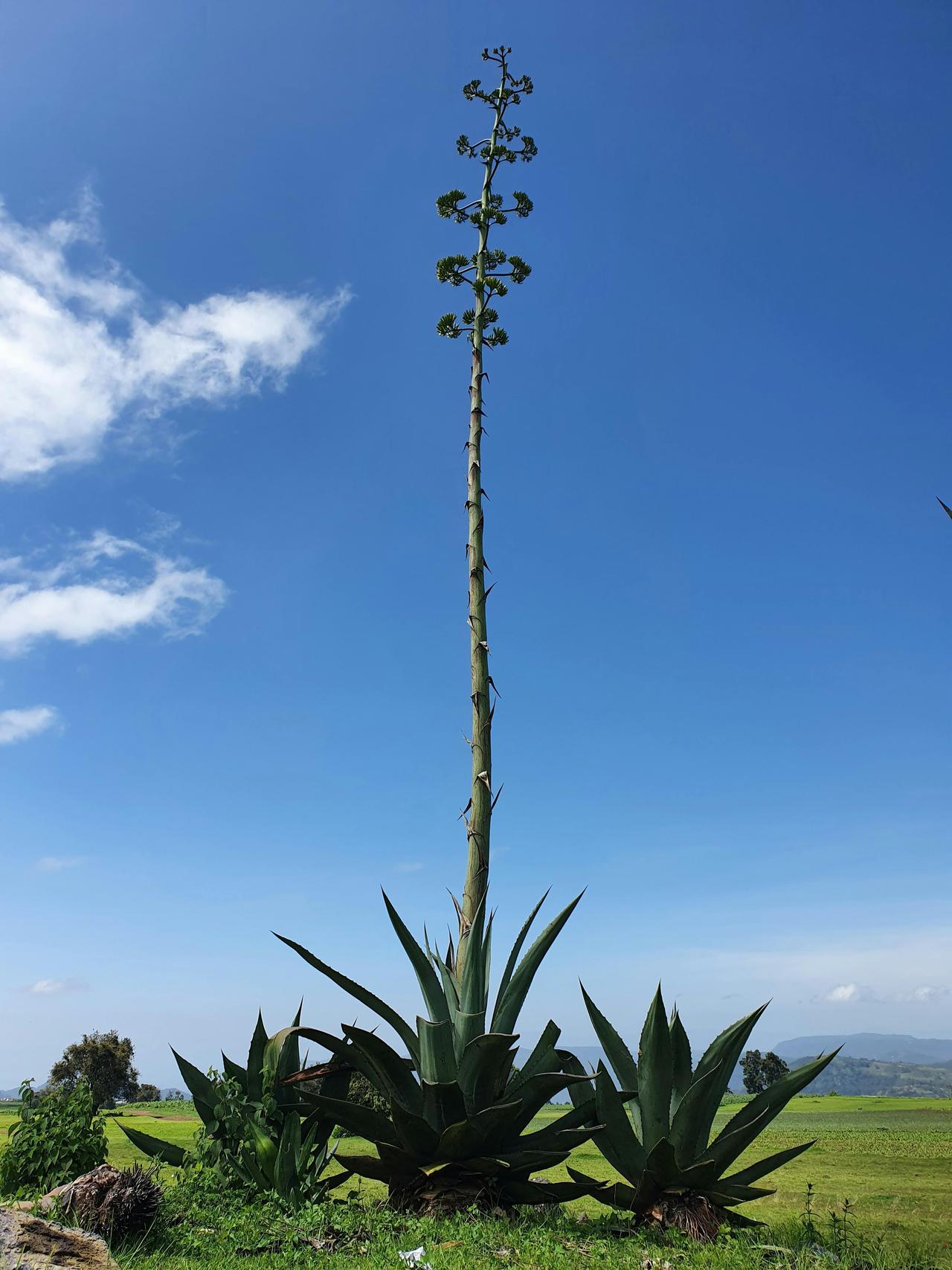
Agave (Pexels)
The agave plant is characterized by a rosette structure composed of thick, fleshy, and often spiny leaves. The leaves are typically sessile or have very short stalks; their edges bear sharp teeth and their tips end in pointed spines. Leaf shape varies by species but is generally oblong-elliptic (spatulate) or spatula-shaped. Their color ranges from pale green to blue-gray, and some species display variegated or striped patterns.
Throughout its life, the agave plant produces a single tall, tubular flower spike, usually between 15 and 60 years of age, after which the main plant dies. The flowers are white, green, or yellow and typically bloom during the summer months. This flowering structure is supported by specialized anatomical adaptations that enable the plant to store water and withstand drought conditions.

Flowering of the Agave Plant (Anadolu Agency)
The genus Agave is native to Central America, northern South America, and the southwestern states of the United States, with Mexico being its primary center of distribution. These plants thrive primarily in desert and semi-desert ecosystems, especially in well-drained sandy or stony soils. Agave species exhibit high adaptability to hot, sunny, and dry conditions, storing water in their leaf tissues to survive prolonged droughts. Although it has no natural distribution in Türkiye, it is cultivated ornamentally, particularly along the Mediterranean and Aegean coasts, and can even adapt to cooler climates such as Istanbul. While some species have invasive potential, agave generally exhibits limited spread and is maintained in controlled environments.
Agave species provide direct or indirect food sources for numerous organisms in their natural habitats. Particularly during flowering, the nectar they produce serves as a vital energy source for hummingbirds, butterflies, bees, and various insect species. Additionally, some mammals and reptiles utilize the mature flower stalks or fruit structures. In certain regions, such as the southwestern United States, the Palmer agave plays a critical role in sustaining long-nosed bats that rely almost exclusively on this plant for food during late summer. Agave also indirectly influences the moisture balance of surrounding microhabitats through its leaf structure, which aids in water retention in the soil. Within ecological systems, these plants contribute to species continuity by forming symbiotic relationships with pollinators and support biodiversity in arid environments.
Agave has diverse economic and industrial applications. The species Agave tequilana is the primary raw material for tequila, a traditional Mexican spirit, making its agricultural production strategically important at the national level. In addition, fibers from the leaves of certain species are used in textile and rope production; these fibers, due to their strength and flexibility, are employed in making cordage, fabrics, and nets. The plant’s sap, particularly that derived from nectar, is used as a sweetener in the food industry and is preferred by consumers seeking natural alternatives to refined sugar. Traditionally, indigenous communities have consumed the flower stalks and roots, either cooked or dried, as food sources. Overall, agave is a versatile plant resource in both agricultural production and industrial processing.
While certain agave species possess medicinal potential, they can also cause toxic effects due to their chemical constituents. Specifically, certain compounds in the leaf sap may induce irritant reactions such as contact dermatitis in sensitive individuals upon skin contact. This necessitates caution during pruning or handling of the plant. In traditional uses, certain parts of agave—particularly the flower stalk and heart—were cooked and consumed, valued by local populations for their digestive and nutritive properties. However, such uses are only sparsely documented in modern pharmacological research, and no standardized medicinal formulation has been developed. Therefore, any medicinal use must be approached with caution, taking into account potential toxic effects.
Although a large proportion of agave species are widespread in their natural habitats, some are threatened by habitat loss due to their limited geographic distribution and dependence on specific pollinators. For instance, species such as Agave palmeri rely on specialized pollinators like long-nosed bats, and declines in these pollinator populations directly impact the plant’s reproductive success. However, more recent studies indicate that in some areas, bees, hummingbirds, and other insects can also contribute to pollination, partially enhancing the resilience of these species. Nevertheless, large-scale agricultural conversion, urbanization, and the shrinking of natural habitats continue to threaten populations of endemic agave species.
Accessed November 26, 2025.
Accessed November 26, 2025.
Anadolu Ajansı. "Agave Bitkisi İstanbul’da Çiçek Açtı (Görsel)." Anadolu Ajansı, August 28, 2019. Accessed July 7, 2025. https://cdnuploads.aa.com.tr/uploads/Contents/2019/08/28/thumbs_b_c_49d53213eb45467d706b70db147933a6.jpg
Anadolu Ajansı. "Agave, Yıllar Sonra İstanbul’da Çiçek Açtı." Anadolu Ajansı, August 8, 2019. Accessed July 7, 2025. https://www.aa.com.tr/tr/yasam/agave-yillar-sonra-istanbulda-cicek-acti/1567011.
NC State Extension. "Agave." *NC State Extension Plants*. Accessed July 7, 2025. https://plants.ces.ncsu.edu/plants/agave/.
National Park Service. "Agave." National Park Service. Accessed July 7, 2025. https://www.nps.gov/coro/learn/nature/agave.htm.
Peyzaj, Manzara, Alan, Tarla. Pexels, Accessed July 7, 2025.
Peyzaj, Manzara, Doğa, Kırsal Bölge. Pexels, Accessed July 7, 2025.

Kingdom(s) | Plantae (Plants) | ||||||||
|---|---|---|---|---|---|---|---|---|---|
Division | Tracheophyta (Vascular plants) | ||||||||
Class | Monocotyledonae (Monocots) | ||||||||
Order | Asparagales | ||||||||
Family | Asparagaceae (Asparagus family) | ||||||||
Genus | Agave | ||||||||
Number of Species | Approximately 200 different species | ||||||||
Natural Distribution | Mexico, Central and South America, southwestern United States | ||||||||
Botanical Characteristics
Habitat and Distribution
Ecological Importance
Economic and Industrial Uses
Medicinal and Toxic Effects
Conservation Status