
This article was automatically translated from the original Turkish version.
+2 More
Signature Date | 27 November 2019 | ||||||||
|---|---|---|---|---|---|---|---|---|---|
Signature Place | Istanbul | ||||||||
Signatories | Türkiye Republic Libyan National Accord Government | ||||||||
Entry into Force Date | 7 December 2019 | ||||||||
International Registration | Registered with the United Nations | ||||||||
Agreement on the Delimitation of Maritime Jurisdiction Areas between Türkiye and Libya is a bilateral maritime boundary agreement signed in Istanbul on 27 November 2019 between the Republic of Türkiye and the Libyan State National Accord Government. It formally defines the continental shelf and Exclusive Economic Zone (EEZ) boundaries in the Eastern Mediterranean in accordance with international law. The agreement is a legal document that establishes a mutual maritime boundary (median line) between Türkiye and Libya in the Eastern Mediterranean based on the principles of equity, geographical superiority and the priority of mainland coastlines.【1】
The historical background of the Agreement on the Delimitation of Maritime Jurisdiction Areas between Türkiye and Libya has been shaped by legal and political disputes over the determination of maritime jurisdiction areas in the Eastern Mediterranean. From the early 2000s onward, the discovery of hydrocarbon resources in the Eastern Mediterranean created conditions for increased efforts by coastal states to define their continental shelf and EEZ boundaries.【1】 During this process, differing legal approaches and state practices regarding the sharing of maritime jurisdiction areas became one of the elements of regional relations.
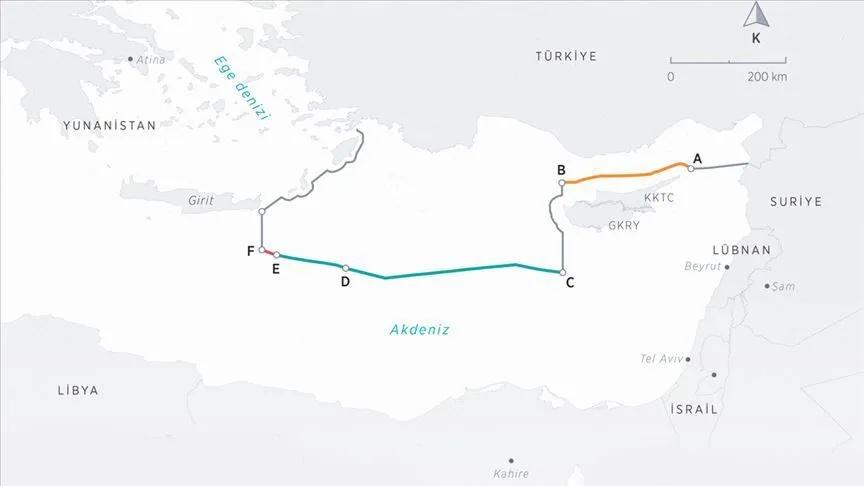
Türkiye-Libya Agreement (TRT News)
Türkiye has shaped its approach to maritime jurisdiction areas in the Eastern Mediterranean on the principle of equity and has argued that the delimitation of maritime jurisdiction areas must be assessed in accordance with principles developed in international judicial decisions.【2】 Türkiye has articulated its views on maritime boundary delimitation at international forums and submitted its maritime boundaries in the Eastern Mediterranean to the United Nations.【2】
From Libya’s perspective, its declaration of an Exclusive Economic Zone under the framework of the United Nations Convention on the Law of the Sea made it one of the parties involved in discussions over maritime jurisdiction areas in the Eastern Mediterranean. Political and military developments in Libya after 2011 resulted in the National Accord Government assuming responsibility for the country’s policies regarding maritime jurisdiction areas.【3】
Unilateral steps taken without prior maritime boundary agreements have led to the emergence of political and legal issues in the region. The first steps in this process were taken by the Greek Cypriot Administration (GCA), which signed EEZ delimitation agreements with Egypt on 17 February 2003, with Lebanon on 17 January 2007, and with Israel on 17 December 2010.【4】 Türkiye and the Turkish Republic of Northern Cyprus (TRNC) have protested these unilateral agreements, asserting that the GCA lacks the authority to represent the entire island, disregards the equal rights of Turkish Cypriots, and violates Türkiye’s continental shelf rights.【5】
Under the fundamental principles of international law, bilateral maritime boundary agreements must not infringe upon the rights and claims of third parties and must be suspended at points of overlap; the GCA-Israel agreement also overlapped with areas claimed by Lebanon, prompting Lebanon’s objection.【5】 In response to the GCA’s unilateral actions, Türkiye and the TRNC have countered with both legal and political measures as well as on-the-ground activities. On 21 September 2011, a Continental Shelf Delimitation Agreement was signed between Türkiye and the TRNC, followed by the TRNC granting exploration licenses to the Turkish Petroleum Corporation (TPAO) and concluding a detailed cooperation agreement on 2 November 2011.【6】 Seismic surveys initiated by the R/V Piri Reis were later expanded to include the seismic and drilling vessels Fatih, Yavuz, Kanuni and Oruç Reis, which operated in the Eastern Mediterranean under the escort of the Turkish Navy.【7】
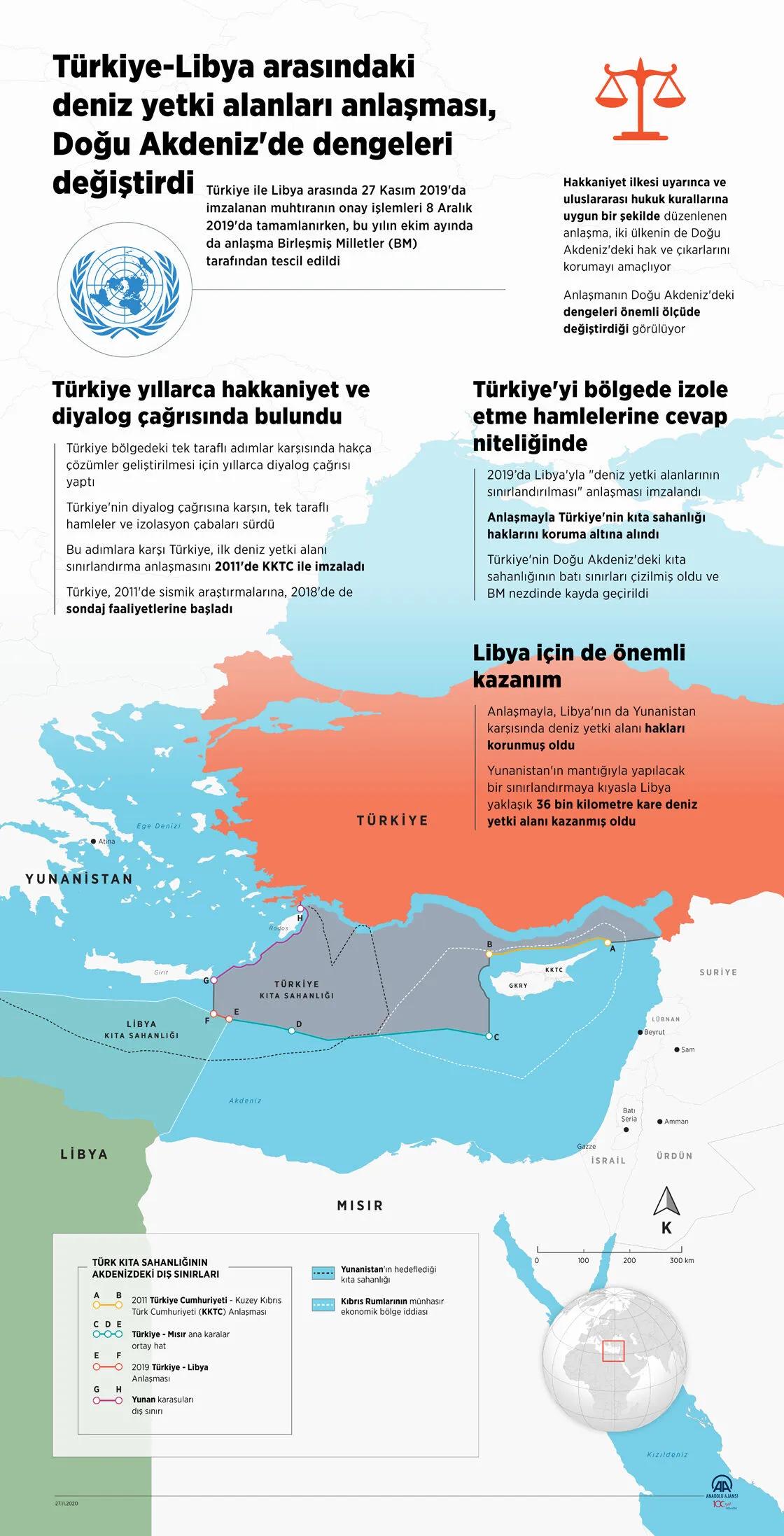
Türkiye-Libya Arasındaki Deniz Yetki Alanları Anlaşması İnfografisi (Anadolu Ajansı)
The delimitation dispute in the region acquired an economic dimension alongside the discovery of natural gas reserves in the Eastern Mediterranean. Estimated reserves of 122 trillion cubic meters of natural gas have been identified in fields such as Tamar and Leviathan in Israel, Zohr in Egypt, and Aphrodite, Calypso and Glaucus in the GCA. Initiatives such as the Eastern Mediterranean Gas Forum, established by Egypt, Greece, the GCA and Israel, and the EastMed pipeline project aimed at transporting regional gas to Europe, sought to exclude Türkiye and Libya from the energy dynamics of the Eastern Mediterranean.【8】
During this period, the EU Foreign Ministers adopted restrictive measures against Türkiye on 11 November 2019.【5】 Türkiye emphasized that the EU cannot act as a court in matters of member states’ sovereignty claims, lacks authority to determine maritime boundaries and must remain neutral in overlapping areas.【9】
The Memorandum of Understanding on the Delimitation of Maritime Jurisdiction Areas in the Mediterranean was signed by the foreign ministers of both countries following negotiations between President Recep Tayyip Erdoğan of the Republic of Türkiye and Fayez al-Sarraj, Chairman of the Presidency Council of the Libyan State National Accord Government.【10】
The Grand National Assembly of Türkiye adopted a law finding it appropriate to ratify the agreement; subsequently, a Presidential Decree approving the agreement was published in the Official Gazette and entered into force. During the same period, Libyan authorities completed their domestic legal procedures, and the agreement entered into force after both parties fulfilled their respective national requirements. Following the completion of domestic procedures, the United Nations (UN) registered the agreement between Türkiye and Libya under Article 102 of the UN Charter.【11】
Article 1 of the agreement defines the coordinates of the continental shelf and Exclusive Economic Zone boundaries between Türkiye and Libya. Based on the maps, a boundary line (median line) has been established extending from Point A (33° 53' 59.8" N - 026° 10' 01.6" E) to Point B (34° 08' 28.6" N - 026° 49' 33.0" E), with a length of approximately 18.64 nautical miles (30 km).【12】
Article 2 refers to the maps illustrating the delimitation subject to the memorandum and the coordinates of the delimitation points used to determine the median line, and declares that these annexes form an integral part of the memorandum.【13】 Article 3 stipulates that after entry into force, the agreement shall be registered with the United Nations Secretariat.【13】 Article 4 of the memorandum regulates the procedures for resolving disputes arising from its implementation.【13】
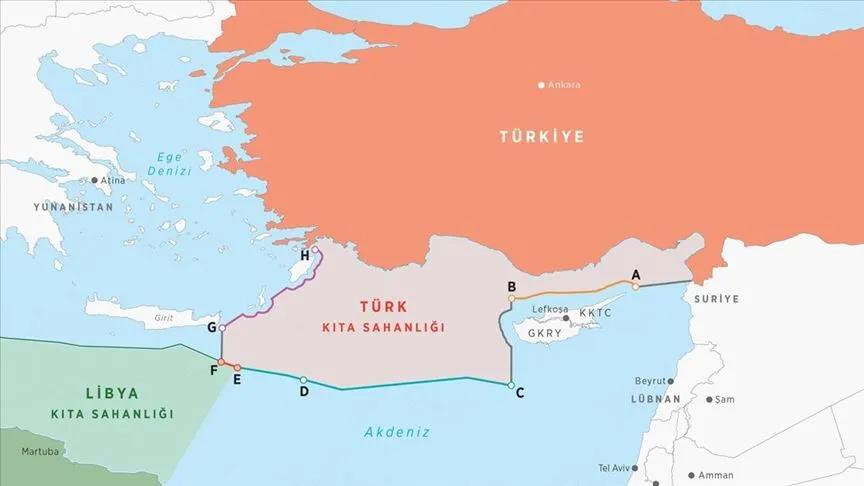
Harita Üzerinde Türkiye ile Libya Arasındaki Anlaşma (Anadolu Ajansı)
Article 5 of the agreement provides that requests for review of the memorandum must be communicated in writing through diplomatic channels between the parties and that any amendments shall enter into force only upon mutual consent of both parties.【13】 Article 6 sets out the provisions regarding the entry into force of the memorandum.【13】
In addition to the maritime boundary agreement, on the same date the “Memorandum of Understanding on Security and Military Cooperation” was also signed, providing training and coordination support to the Libyan armed forces.【14】
Greece has lodged a protest with the United Nations, claiming that the agreement violates the continental shelf rights of the islands of Crete, Rhodes, Kastellorizo and Meis and asserting that Türkiye and Libya do not have mutually facing coastlines.【15】 The Athens administration declared Libya’s Ambassador to Athens, Mohamed al-Menfi, persona non grata in December 2019, citing his failure to comply with an ultimatum demanding that Libya present the agreement’s content to Greece.【16】
The expelled al-Menfi, now serving as Chairman of the Libyan Presidency Council, received the Greek Prime Minister Kyriakos Mitsotakis and Foreign Minister Nikos Dendias in Tripoli.【17】 The office of the EU High Representative for Foreign Affairs and Security Policy, Josep Borrell, and the EU Council expressed solidarity with the GCA and Greece and requested that the text of the agreement be submitted to the EU.【18】 NATO Secretary General Jens Stoltenberg stated that “NATO’s role is not to take positions on international issues.” 【2】
Acer, Yücel. "Doğu Akdeniz'de Deniz Yetki Alanları ve Türkiye-Libya Mutabakatı." Siyaset, Ekonomi ve Toplum Araştırmaları Vakfı, no. 301, pp. 1-18. Accessed July 29, 2026.https://media.setav.org/tr/dosya/2019/12/analiz-dogu-akdenizde-deniz-yetki-alanlari-ve-turkiye-libya-mutabakati.pdf
Anadolu Ajansı. "Libya Başbakanı Dibeybe'den Türkiye-Libya deniz yetki anlaşmasına ilişkin açıklama." Accessed July 29, 2026.https://www.aa.com.tr/tr/dunya/libya-basbakani-dibeybeden-turkiye-libya-deniz-yetki-anlasmasina-iliskin-aciklama/2772661.
Anadolu Ajansı. "Türkiye ile Libya arasındaki anlaşma bölgenin 'enerjisini' artıracak." Accessed July 29, 2026.https://www.aa.com.tr/tr/libya/turkiye-ile-libya-arasindaki-anlasma-bolgenin-enerjisini-artiracak-/1673492.
Anadolu Ajansı. "Türkiye-Libya anlaşmasının hukuki ve stratejik boyutları." Accessed July 29, 2026.https://www.aa.com.tr/tr/analiz/turkiye-libya-anlasmasinin-hukuki-ve-stratejik-boyutlari/1668270.
Anadolu Ajansı. "Türkiye-Libya arasındaki deniz yetki alanları anlaşması, Doğu Akdeniz'de dengeleri değiştirdi." Accessed July 29, 2026.https://www.aa.com.tr/tr/info/infografik/21074.
Anadolu Ajansı. "Türkiye-Libya deniz yetki anlaşması, her iki ülkenin egemenlik haklarını korudu." Accessed July 29, 2026.https://www.aa.com.tr/tr/dunya/turkiye-libya-deniz-yetki-anlasmasi-her-iki-ulkenin-egemenlik-haklarini-korudu/2748607
Anadolu Ajansı. "Türkiye-Libya güvenlik ve askeri iş birliği mutabakat muhtırası Resmi Gazete'de." Accessed July 29, 2026.https://www.aa.com.tr/tr/libya/turkiye-libya-guvenlik-ve-askeri-is-birligi-mutabakat-muhtirasi-resmi-gazetede/1684355
Bulut, Mevlüt, and Seher Bulut. “Türkiye ve Libya Arasında Deniz Yetki Alanlarının Sınırlandırılmasına İlişkin Mutabakat Muhtırası: Anlaşmanın Türkiye-İsrail İlişkilerinin Geleceğine Muhtemel Etkileri.” *Bilge Strateji* 12, no. 22 (2021): 25–52. Accessed July 29, 2026.https://www.academia.edu/91104585/T%C3%BCrkiye_ve_Libya_Aras%C4%B1nda_Deniz_Yetki_Alanlar%C4%B1n%C4%B1n_S%C4%B1n%C4%B1rland%C4%B1r%C4%B1lmas%C4%B1na_%C4%B0li%C5%9Fkin_Mutabakat_Muht%C4%B1ras%C4%B1_Anla%C5%9Fman%C4%B1n_T%C3%BCrkiye_%C4%B0srail_%C4%B0li%C5%9Fkilerinin_Gelece%C4%9Fine_Muhtemel_Etkileri
Değer, Filiz. “Türkiye Cumhuriyeti İle Libya Devleti Ulusal Mutabakat Hükümeti Arasında İmzalanan Deniz Yetki Alanlarının Sınırlandırılması Mutabakatının Hukuki Statüsü Ve Geleceği.” *Diplomasi Araştırmaları Dergisi* 2, no. 1 (2023): 1–15. Accessed July 29, 2026.https://dergipark.org.tr/en/pub/jdr/article/890735.
Erciyes, Çağatay. "Deniz Yetki Alanlarının Sınırlandırılması Türkiye’nin Siyasi ve Hukuki Tezleri Sahadaki Uygulamaları." MFA, pp. 1-28. Accessed July 29, 2026.https://www.mfa.gov.tr/data/dogu-akdeniz-deniz-yetki-alanlarinin-sinirlandirilmasi.pdf
EuroNews. "TBMM, Libya ile Akdeniz'de Deniz Yetki Alanlarının Sınırlandırılmasına İlişkin Mutabakatı onayladı." Accessed July 29, 2026.https://tr.euronews.com/2019/12/05/tbmm-libya-ile-akdenizde-deniz-yetki-alanlarinin-sinirlandirilmasina-iliskin-mutabakat-ona
Mira, Emrah Roni. “Türkiye–Libya Arasında İmzalanan ‘Akdeniz’de Deniz Yetki Alanlarının Sınırlandırılmasına İlişkin Mutabakat Muhtırası’nın Türk Dış Politikasına Etkisi.” *Anadolu Strateji Dergisi* 4, no. 1 (2022): 17–37. Accessed July 29, 2026.https://dergipark.org.tr/tr/pub/anasamasd/article/1138568
Paralı, Zeynep. “Türkiye Cumhuriyeti İle Libya Devleti Ulusal Mutabakat Hükümeti Arasında İmzalanan Akdeniz'de Deniz Yetki Alanlarının Sınırlandırılmasına İlişkin Mutabakat Muhtarısının Uluslararası Politikaya Etkileri”. *Nazilli İktisadi ve İdari Bilimler Fakültesi Dergisi* 1, no. 1 (2026): 49–64. Accessed July 29, 2026.https://dergipark.org.tr/tr/pub/niibfd/article/744608
TRT Haber. "Türk karasularını hapsetme planı Türkiye-Libya anlaşması ile bozuldu." YouTube Video. Date Published: June 19, 2020. Accessed July 29, 2026.https://www.youtube.com/watch?v=6c9hJB4gIcM
Şafak, Erdi. "Türkiye ile Libya Arasında İmzalanan 'Deniz Yetki Alanlarının Sınırlandırılmasına İlişkin Mutabakat Muhtırası'nın Geleceği ve Bölgeye Yansımaları." Diplomatik İlişkiler ve Politik Araştırmalar Merkezi, no. 2, pp. 1–8. Accessed July 29, 2026.https://dipam.org/wp-content/uploads/2020/10/Tu%CC%88rkiyeLibyaMoU.pdf.
【1】
Anadolu Ajansı, "Türkiye-Libya anlaşmasının hukuki ve stratejik boyutları." Erişim Tarihi: 29 Temmuz 2026. https://www.aa.com.tr/tr/analiz/turkiye-libya-anlasmasinin-hukuki-ve-stratejik-boyutlari/1668270.
【2】
Anadolu Ajansı, "Türkiye-Libya anlaşmasının hukuki ve stratejik boyutları."
【3】
Zeynep Paralı, “Türkiye Cumhuriyeti İle Libya Devleti Ulusal Mutabakat Hükümeti Arasında İmzalanan Akdeniz'de Deniz Yetki Alanlarının Sınırlandırılmasına İlişkin Mutabakat Muhtarısının Uluslararası Politikaya Etkileri”. *Nazilli İktisadi ve İdari Bilimler Fakültesi Dergisi* 1 (1): 53, Accessed July 29, 2026.
【4】
Yücel Acer, "Doğu Akdeniz'de Deniz Yetki Alanları ve Türkiye-Libya Mutabakatı." Siyaset, Ekonomi ve Toplum Araştırmaları Vakfı, no. 301, p. 10. Accessed July 29, 2026.
【5】
Acer. "Doğu Akdeniz'de Deniz Yetki Alanları ve Türkiye-Libya Mutabakatı." Siyaset, Ekonomi ve Toplum Araştırmaları Vakfı, no. 301, pp. 10.
【6】
Mevlüt Bulut ve Seher Bulut, “Türkiye ve Libya Arasında Deniz Yetki Alanlarının Sınırlandırılmasına İlişkin Mutabakat Muhtırası: Anlaşmanın Türkiye-İsrail İlişkilerinin Geleceğine Muhtemel Etkileri.” Bilge Strateji 12, no. 22 (2021): s.36. Erişim Tarihi: 29 Temmuz 2026. https://www.academia.edu/91104585/T%C3%BCrkiye_ve_Libya_Aras%C4%B1nda_Deniz_Yetki_Alanlar%C4%B1n%C4%B1n_S%C4%B1n%C4%B1rland%C4%B1r%C4%B1lmas%C4%B1na_%C4%B0li%C5%9Fkin_Mutabakat_Muht%C4%B1ras%C4%B1_Anla%C5%9Fman%C4%B1n_T%C3%BCrkiye_%C4%B0srail_%C4%B0li%C5%9Fkilerinin_Gelece%C4%9Fine_Muhtemel_Etkileri.
【7】
Çağatay Erciyes, "Deniz Yetki Alanlarının Sınırlandırılması Türkiye’nin Siyasi ve Hukuki Tezleri Sahadaki Uygulamaları. MFA, s.16, Erişim Tarihi: 29 Temmuz 2026. https://www.mfa.gov.tr/data/dogu-akdeniz-deniz-yetki-alanlarinin-sinirlandirilmasi.pdf.
【8】
Bulut ve Bulut, “Türkiye ve Libya Arasında Deniz Yetki Alanlarının Sınırlandırılmasına İlişkin Mutabakat Muhtırası: Anlaşmanın Türkiye-İsrail İlişkilerinin Geleceğine Muhtemel Etkileri.” Bilge Strateji 12, no. 22 (2021): s.32-33.
【9】
Erciyes, "Deniz Yetki Alanlarının Sınırlandırılması Türkiye’nin Siyasi ve Hukuki Tezleri Sahadaki Uygulamaları. MFA, s.19.
【10】
Anadolu Ajansı, "Türkiye-Libya deniz yetki anlaşması, her iki ülkenin egemenlik haklarını korudu." Erişim Tarihi: 29 Temmuz 2026. https://www.aa.com.tr/tr/dunya/turkiye-libya-deniz-yetki-anlasmasi-her-iki-ulkenin-egemenlik-haklarini-korudu/2748607.
【11】
Paralı. “Türkiye Cumhuriyeti İle Libya Devleti Ulusal Mutabakat Hükümeti Arasında İmzalanan Akdeniz'de Deniz Yetki Alanlarının Sınırlandırılmasına İlişkin Mutabakat Muhtarısının Uluslararası Politikaya Etkileri.” *Nazilli İktisadi ve İdari Bilimler Fakültesi Dergisi* 1, no. 1 (Year): pp. 57–58.
【12】
Paralı. “Türkiye Cumhuriyeti İle Libya Devleti Ulusal Mutabakat Hükümeti Arasında İmzalanan Akdeniz'de Deniz Yetki Alanlarının Sınırlandırılmasına İlişkin Mutabakat Muhtarısının Uluslararası Politikaya Etkileri.” *Nazilli İktisadi ve İdari Bilimler Fakültesi Dergisi* 1, no. 1: pp. 56.
【13】
Bulut ve Bulut, “Türkiye ve Libya Arasında Deniz Yetki Alanlarının Sınırlandırılmasına İlişkin Mutabakat Muhtırası: Anlaşmanın Türkiye-İsrail İlişkilerinin Geleceğine Muhtemel Etkileri.” Bilge Strateji 12, no. 22 (2021): s.39.
【14】
Anadolu Ajansı. "Türkiye-Libya güvenlik ve askeri iş birliği mutabakat muhtırası Resmi Gazete'de." Accessed July 29, 2026.
【15】
Emrah Roni Mira, “Türkiye–Libya Arasında İmzalanan ‘Akdeniz’de Deniz Yetki Alanlarının Sınırlandırılmasına İlişkin Mutabakat Muhtırası’nın Türk Dış Politikasına Etkisi.” Anadolu Strateji Dergisi 4, no. 1 (2022): s.28-29. Erişim Tarihi: 29 Temmuz 2026. https://dergipark.org.tr/tr/pub/anasamasd/article/1138568.
【16】
Paralı, Zeynep. “Türkiye Cumhuriyeti İle Libya Devleti Ulusal Mutabakat Hükümeti Arasında İmzalanan Akdeniz'de Deniz Yetki Alanlarının Sınırlandırılmasına İlişkin Mutabakat Muhtarısının Uluslararası Politikaya Etkileri.” *Nazilli İktisadi ve İdari Bilimler Fakültesi Dergisi* 1, no. 1: pp. 58.
【17】
Paralı. “Türkiye Cumhuriyeti İle Libya Devleti Ulusal Mutabakat Hükümeti Arasında İmzalanan Akdeniz'de Deniz Yetki Alanlarının Sınırlandırılmasına İlişkin Mutabakat Muhtarısının Uluslararası Politikaya Etkileri.” *Nazilli İktisadi ve İdari Bilimler Fakültesi Dergisi* 1, no. 1: pp. 58.
【18】
Acer, "Doğu Akdeniz'de Deniz Yetki Alanları ve Türkiye-Libya Mutabakatı." Politics, Economy and Society Research Foundation, no. 301, pp. 14.
Signature Date | 27 November 2019 | ||||||||
|---|---|---|---|---|---|---|---|---|---|
Signature Place | Istanbul | ||||||||
Signatories | Türkiye Republic Libyan National Accord Government | ||||||||
Entry into Force Date | 7 December 2019 | ||||||||
International Registration | Registered with the United Nations | ||||||||
No Discussion Added Yet
Start discussion for "Agreement on the Delimitation of Maritime Jurisdiction Areas between Türkiye and Libya" article
Historical Background
Emergence of Delimitation Disputes
Signing Process of the Agreement
Provisions of the Memorandum of Understanding
International Reactions and Developments Regarding the Agreement