This article was automatically translated from the original Turkish version.
+1 More
Registration Number | 1271 | ||||||||
|---|---|---|---|---|---|---|---|---|---|
Registration Date | 07.12.2022 | ||||||||
Application Number | C2021/000453 | ||||||||
Application Date | 02.11.2021 | ||||||||
Name of the Geographical Indication | Ağrı Yaprak Döneri | ||||||||
Product / Product Group(s) | Döner / Meals and Soups | ||||||||
Type of Geographical Indication | Qibla indicator | ||||||||
Applicant/Registrant(s) | Qibla indicator | ||||||||
Address of the Registrant | Fırat Mah. Yaşar Kemal Cad. No: 269 Merkez AĞRI | ||||||||
Geographical Boundary | Ağrı Province | ||||||||
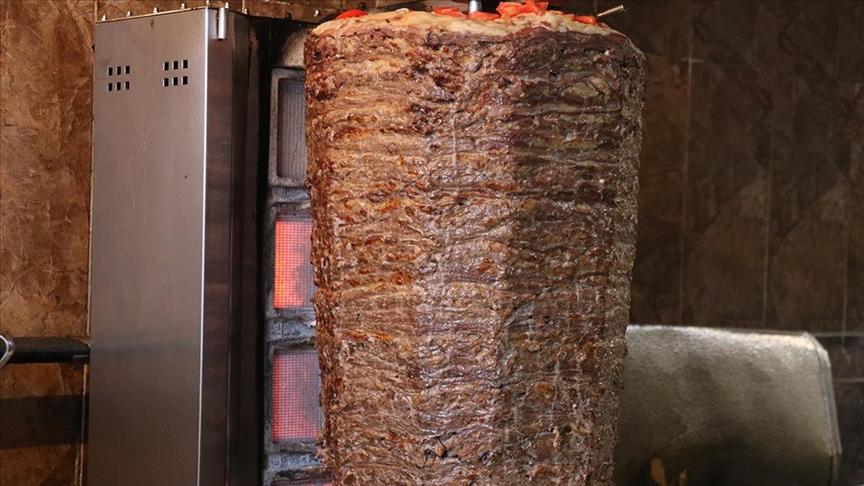
Ağrı Leaf Döner is a traditional meat dish prepared by slicing lean beef from cattle no older than one year into thin leaf-like pieces (maximum 5 mm thick), marinating them in a mixture of yogurt or milk, finely chopped dried onion, black pepper, and salt, arranging the meat on skewers together with tail fat, and cooking it on a vertical rotisserie. After cooking, the döner is sliced into strips no thicker than 2–3 mm for serving. The source of the meat is rooted in the region’s pasture-based livestock farming.
Ağrı Leaf Döner is prepared by slicing lean beef from cattle no older than one year into thin leaf-shaped pieces suitable for döner preparation, followed by a specialized marination process. The thickness of the sliced meat is a maximum of 5 mm, and after cooking, the slicing thickness does not exceed 2–3 mm. During preparation of the döner block, meat and tail fat are stacked alternately on skewers and cooked vertically on a rotisserie oven in a manner that prevents the meat from burning or drying out.
The marination process uses a mixture of yogurt or milk, finely minced dried onion (2–3 mm), black pepper, and salt. The marination period is fixed at three days. The slicing of the meat into leaf form and the marination process are decisive factors determining the sensory and physical characteristics of the product.
The primary components of Ağrı Leaf Döner are as follows:
These ingredients are used in specified proportions to standardize the production method, and these ratios directly influence the compositional structure of the product.
The meat is sourced exclusively from cattle no older than one year within the geographical boundaries of Ağrı Province. Livestock farming in the region is pasture-based. During summer, animals are fed on natural grasses; during winter, their diet is supplemented with barley, hay, and factory feed, while silage is not used.
The meat is sliced into leaf-shaped pieces no thicker than 5 mm using long döner knives. The meat is then marinated in the prepared mixture for three days in a refrigerator. The tail fat is cut into pieces 5 mm thick and sized to cover the skewer. The döner block is assembled by alternating layers of meat and tail fat in a ratio of 3–4 parts meat to 1 part tail fat. Additional tail fat is placed at the top and bottom of the skewer.
The assembled döner block is cooked on the same day it is prepared. If storage is required before cooking, it must first be frozen at -40 °C and then stored at -18 °C for no more than six months.
The cooking process begins by placing the döner block vertically in a rotisserie oven. It is rotated slowly around its own axis over medium heat. It is essential that the outer surface does not burn while the interior cooks thoroughly without drying out. Once cooked, the döner is sliced from top to bottom into strips no thicker than 2–3 mm for serving.
All stages of production of Ağrı Leaf Döner, from meat sourcing to cooking, must be carried out exclusively within the administrative boundaries of Ağrı Province. This requirement is defined by the product’s deep connection to the local livestock and culinary traditions.
To ensure product standards and compliance with geographical indication conditions, inspections are conducted under the coordination of the Ağrı Provincial Special Administration. The inspection team consists of at least three members representing the Ağrı Provincial Directorate of Agriculture and Forestry, the Ağrı Provincial Directorate of Trade, and the Provincial Special Administration. Inspections are carried out regularly at least once per year, with additional inspections conducted as needed or upon complaint.
The inspection criteria include:
Inspection reports are submitted annually to the Turkish Patent and Trademark Office, and appropriate measures are taken in cases of non-compliance. During the inspection process, collaboration may be established with experts or institutions from the public or private sectors, or such services may be procured externally.
Anadolu Ajansı. “Ağrı Yaprak Döneri ve Haşıl Yemeği Coğrafi İşaretle Tescillendi.” *aa.com.tr*. Accessed July 17, 2025. https://www.aa.com.tr/tr/kultur/agri-yaprak-doneri-ve-hasil-yemegi-cografi-isaretle-tescillendi/2770353.
Turkish Patent and Trademark Office. "Ağrı Yaprak Döneri Coğrafi İşaret Tescil Belgesi ve Teknik Şartnamesi." Accessed July 17, 2025. https://ci.turkpatent.gov.tr/Files/GeographicalSigns/d2c207f2-28c1-4b6c-8a23-4a2040b64230.pdf.
Turkish Patent and Trademark Office. "Ağrı Yaprak Döneri." Accessed July 17, 2025. https://ci.turkpatent.gov.tr/cografi-isaretler/detay/6422.

Registration Number | 1271 | ||||||||
|---|---|---|---|---|---|---|---|---|---|
Registration Date | 07.12.2022 | ||||||||
Application Number | C2021/000453 | ||||||||
Application Date | 02.11.2021 | ||||||||
Name of the Geographical Indication | Ağrı Yaprak Döneri | ||||||||
Product / Product Group(s) | Döner / Meals and Soups | ||||||||
Type of Geographical Indication | Qibla indicator | ||||||||
Applicant/Registrant(s) | Qibla indicator | ||||||||
Address of the Registrant | Fırat Mah. Yaşar Kemal Cad. No: 269 Merkez AĞRI | ||||||||
Geographical Boundary | Ağrı Province | ||||||||
Distinctive Features
Ingredients
Recipe/Production Method
Cooking Process
Geographical Boundary and Production Conditions
Monitoring and Control Mechanism