


This article was automatically translated from the original Turkish version.
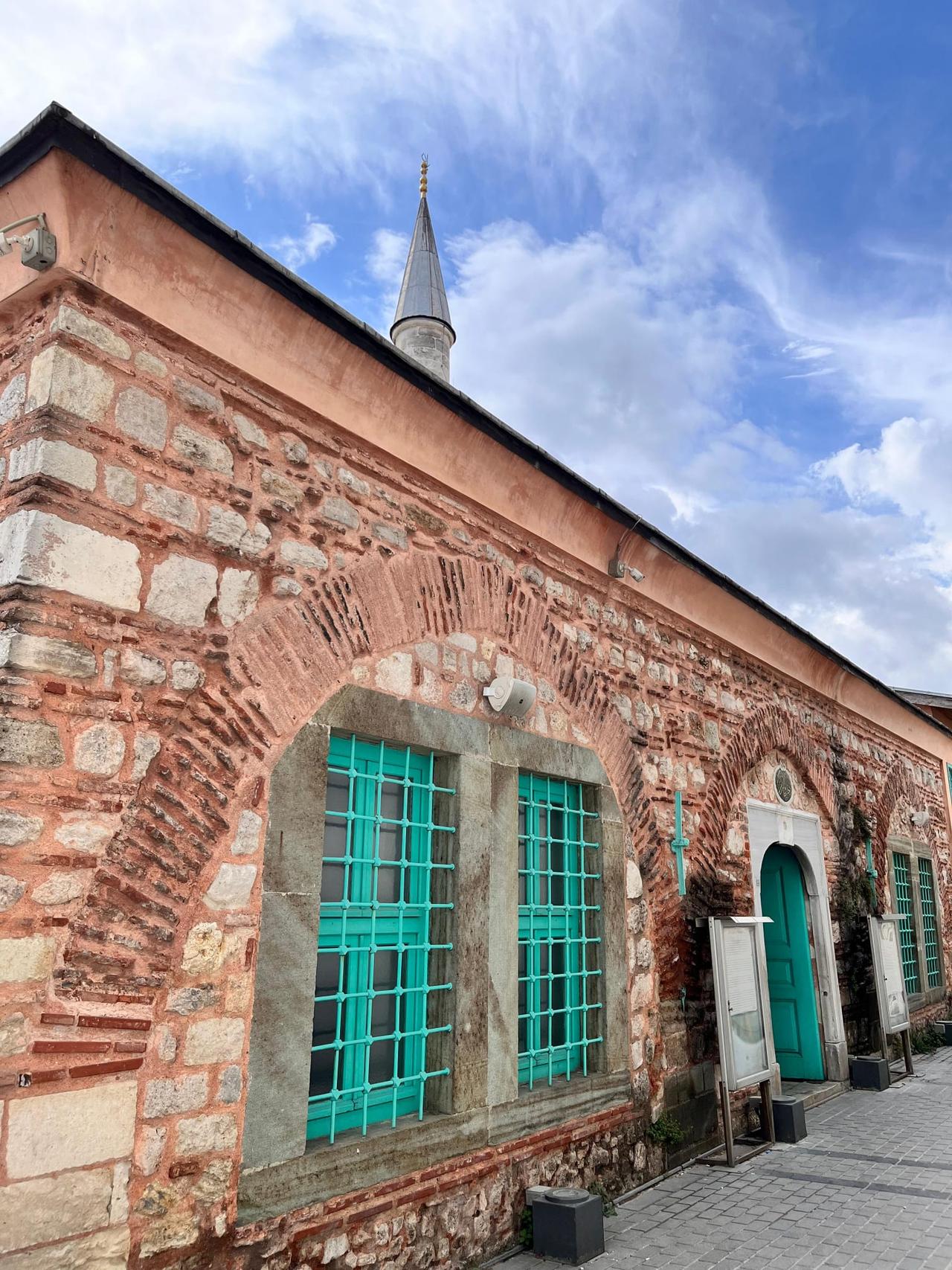
Ahi Çelebi Camii is located in the Eminönü neighborhood of the Fatih district. It is also known as “Kanlıfırın Mescidi” or “Yemişçiler Camii.” Its founder is Ahi Mehmet Çelebi. Some sources list its construction year as 1500. The mosque was destroyed by fire twice, in 1539 and 1653, and suffered major damage during the 1892 earthquake. According to some sources, after the first fire it was repaired and given a new appearance by Mimar Sinan. Other sources indicate that renovations occurred before Mimar Sinan’s time. Evliya Çelebi, in his Seyahatname, states that the mosque was built with halal materials. After the 1892 earthquake, the interior of the mosque was filled with water, and after a duration remained in this state, the waterlogged areas were filled with soil in 1918. To strengthen its structural integrity, the columns were encircled with cut stone and supported by additional arches from two directions.
During the Haliç environment restoration in the 1980s, the mosque suffered further major damage. The mosque, which had awaited restoration for twenty years, was restored between 2005 and 2007 with the permission of the General Directorate of Foundations by an anonymous benefactor and short reopened for worship shortly afterward. During the restoration, piles were driven into the ground to reinforce the foundation, and the collapsed minaret was rebuilt in accordance with its original design.
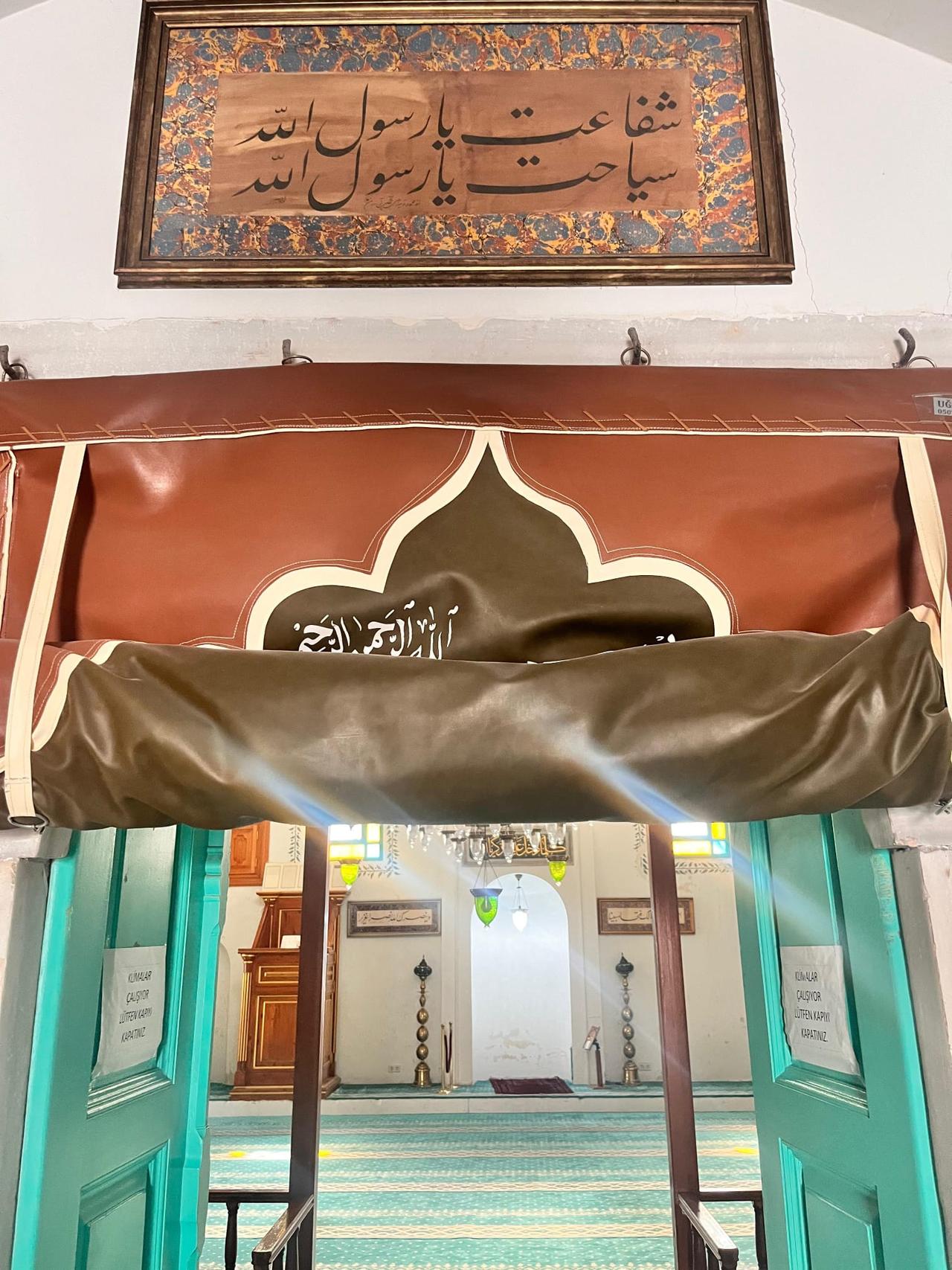
Inside the mosque, calligraphy by [Şuheda Osmanlıoğlu] reads “Şefaat Ya Resulallah” and “Seyahat Ya Resulallah”
Architecturally, the mosque is rectangle planned. It is a single-domed structure built with stone brick, supported by two arches on each side. Although it has only one minaret, its current location features twelve elephant-foot piers supporting two on with six blind domes. The interior space is dim and low. The Dome base is encircled by an iron ring. On the front facade of the mosque there is also a marble fountain. The circular medallion on top of this fountain, commissioned by Abdülaziz, bears the inscription: “Mâşâallah, tevekkeltü Alallâh ve mâ tevfîki illâ billâh/Allâh’ın dilediği olur. Allâh’a reliance on God ettim, güvendim. Başarım da ancak Allah’tandır.” 1281 (1864).
The founder of the mosque, Ahi Çelebi, was born in 1432. His name is also recorded as Ahmed and Mahmud. Various sources mention his origin as Shirvan or Tabriz. Ahi Çelebi practiced medicine as taught by his father. He advanced his profession by receiving instruction from prominent figures of the era, Kutbüddin and Altunîzâde. He began as a physician and later became chief physician at the Fatih Darüşşifası. During the reigns of Bayezid II and Yavuz Sultan Selim, he served as chief court physician. He died in Cairo while returning from a pilgrimage to Hajj at the age of ninety.
Evliya Çelebi describes his connection with the mosque in his Seyahatname as follows: In the month of Rabi I, 1040 AH (19 August 1630), the traveler Evliya Çelebi witnessed a World between wakefulness and sleep. In his dream, he found himself inside the Ahi Çelebi Camii at Yemiş İskelesi, where he saw the great companions of the Prophet entering the mosque one after another in brilliant light: Bilal al-Habashi, Sa’d ibn Abi Waqqas, Hz. Hamza, Mecca, the martyrs of Medina, and many others. When told that the Prophet would come and that he must rise to greet him, shortly afterward, our Master (peace be upon him) entered the mosque accompanied by Hz. Hasan on his right and Hz. Hüseyin on his left. As the divine light increased, Evliya, reminded by the Prophet, rose and performed the ritual standing posture and offered the morning prayer. After the prayer, Evliya Çelebi approached the mihrab and the side of the Prophet, kissed his hands with trembling body, and instead of saying “Şefaat Ya Resulallah,” he said “Seyahat Ya Resulallah.” The Prophet smiled and said, “My Lord, make my intercession, my journey, and my visitation easy with health and well-being.” Evliya Çelebi also received advice from Sa’d b. Abi Waqqas to visit everyone whose hand he had kissed during this gathering, and then he began his travels.

Architectural Features
Who Was Ahi Çelebi?
The Mosque’s Connection with Evliya Çelebi