

This article was automatically translated from the original Turkish version.
+1 More
Ahlat Seljuk Cemetery
Establishment Year | Seljuk period (approximately 12th century) | ||||||||
|---|---|---|---|---|---|---|---|---|---|
Area(s) | Approximately 40 hectares | ||||||||
Location | Ahlat Türkiye Bitlis | ||||||||
Protection Status | Protected area (Under protection) | ||||||||
Ahlat Seljuk Cemetery is a significant historical burial site from the period of the Anatolian Seljuk State, located in the district of Ahlat, within the province of Bitlis in Türkiye. Used between the 12th and 14th centuries, the cemetery covers an area of approximately 40,000 square meters and contains around 8,000 tombstones. Due to its preservation of traces of Seljuk culture in the region and its collection of important examples of Islamic funerary art, the cemetery holds considerable importance in the fields of history and art history.
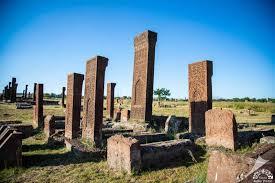
The tombstones in the cemetery are made of volcanic basalt and vary in shape and size. They include rectangular, cubic, conical and cylindrical forms, each inscribed with epitaphs written in Arabic script. These inscriptions provide information about the deceased, including their name, title, profession and date of death. In addition, the stones feature geometric patterns, botanical motifs and figures characteristic of Seljuk art. The tombstones are regarded as important artistic works that reflect the social structure and cultural understanding of the period.

Tombs made of volcanic basalt (Culture Portal)
The Ahlat Seljuk Cemetery is a tangible manifestation of the cultural presence of the Anatolian Seljuk State in Eastern Anatolia. The inscriptions and stone carvings found at the site provide valuable insights into the social structure, religious outlook and artistic sensibilities of the period. In addition to serving as a major burial ground during the Seljuk era, the cemetery contains important examples that illustrate the development of Islamic funerary art.
Conflicts during the First World War caused physical damage to the cemetery. The traces of this damage are being addressed through ongoing conservation and restoration projects. Led by the Ministry of Culture and Tourism, these efforts aim to preserve the cemetery’s original structure and make the site accessible for both academic research and cultural tourism.

As one of the largest Islamic cemeteries in Türkiye, the Ahlat Seljuk Cemetery attracts both domestic and international visitors. The organization and promotion of the cemetery site contribute significantly to cultural tourism in the region. Recent improvements have enhanced the site, providing visitors with a safer and more informative experience.
Introduction to the Ahlat Seljuk Cemetery (Akşam TV)
Accessed November 26, 2025.
Ahlat Belediyesi. "Dünyanın En Büyük İslam Mezarlığı Kapılarını Açtı." Accessed June 6, 2025.
Akşam TV. “Dünyanın En Büyük Türk İslam Mezarlığı: Ahlat Selçuklu Mezarlığı.” Akşam TV Youtube Kanalı. Accessed June 6, 2025. https://www.youtube.com/watch?v=wrdeTuEOZlg
Anadolu Ajansı. "Dünyanın En Büyük İslam Mezarlığı." Accessed June 6, 2025.
Anadolu Ajansı. “Ahlat Selçuklu Meydan Mezarlığında Birinci Dünya Savaşı’nın Oluşturduğu Tahribatın İzleri Siliniyor.” Accessed June 6, 2025. https://www.aa.com.tr/tr/kultur/ahlat-selcuklu-meydan-mezarliginda-birinci-dunya-savasinin-olusturdugu-tahribatin-izleri-siliniyor/3301611
Kültür Portalı. "Selçuklu Meydan Mezarlığı Ören Yeri." Kültür Portalı. Accessed June 6, 2025. https://www.kulturportali.gov.tr/turkiye/bitlis/gezilecekyer/selcuklu-meydan-mezarligi-oren-yeri
Ministry of Culture and Tourism. "Bitlis Ahlat Seljukid Square Cemetery Archaeological Site." Ministry of Culture and Tourism. Accessed June 6, 2025. https://kvmgm.ktb.gov.tr/Eklenti/90882,bitlis-ahlat-selcuklu-meydan-mezarligi-oren-yeripdf.pdf?0
T.C. Ahlat Kaymakamlığı. "Ahlat Selçuklu Mezarlığı." Accessed June 6, 2025.
The provided content contains only an invisible image tag with no translatable text or citation elements. No translation is required.

Ahlat Seljuk Cemetery
Establishment Year | Seljuk period (approximately 12th century) | ||||||||
|---|---|---|---|---|---|---|---|---|---|
Area(s) | Approximately 40 hectares | ||||||||
Location | Ahlat Türkiye Bitlis | ||||||||
Protection Status | Protected area (Under protection) | ||||||||
No Discussion Added Yet
Start discussion for "Ahlat Seljuk Cemetery" article
Cemetery Area and Stone Carving
Historical and Cultural Significance
Conservation and Restoration Efforts
Tourism and Cultural Heritage