


This article was automatically translated from the original Turkish version.
+2 More
Air Transat Flight 961 Crash
History | 2005-03-06 | ||||||||
|---|---|---|---|---|---|---|---|---|---|
Aircraft Type | Airbus A310-308 | ||||||||
Tail Number | C-GPAT | ||||||||
Departure Point | Varadero, Cuba | ||||||||
Arrival Point | Quebec City, Canada | ||||||||
Number of Passengers | 271 people (9 crew - 262 passengers) | ||||||||
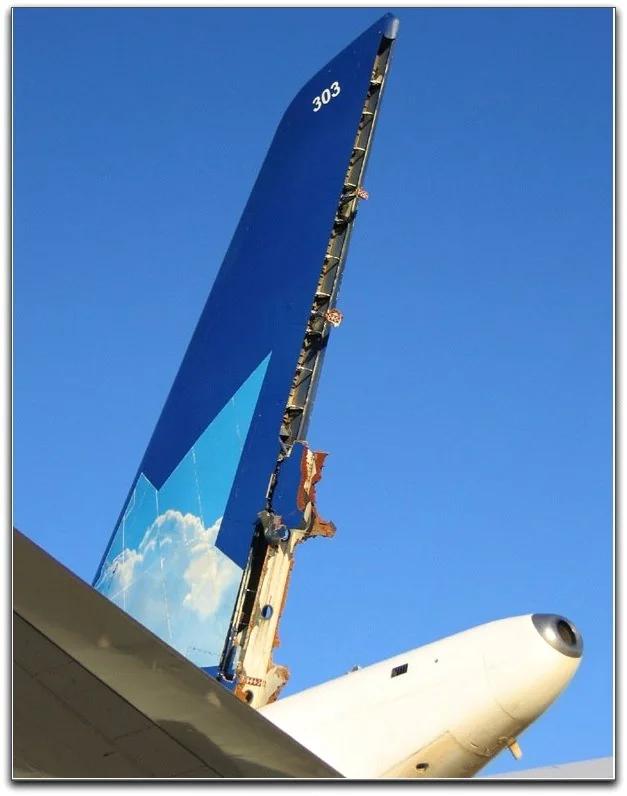
Air Transat Flight 961, 6 March 2005, is one of the rare aviation incidents in which the horizontal stabilizer of an Airbus A310 operated by Air Transat detached in flight.

(Image generated by artificial intelligence)
Approximately 35 minutes after takeoff from Varadero, at an altitude of 35,000 ft (10,668 m), the aircraft lost control after the pilots experienced severe vibrations. For several seconds, the aircraft underwent a sudden dive. Such movement is typically associated with the failure of one of the control surfaces. While analyzing the aircraft’s behavior, the captain noticed unusual noises coming from the tail section. Shortly after, the aircraft began to stabilize, but abnormal flight characteristics persisted. Following the intense vibrations and dive, the aircraft continued to exhibit unstable movements for some time.
Upon reviewing the flight data, the pilots determined that a portion of the horizontal stabilizer may have detached. The stabilizer is critical to maintaining stable flight. Damage or loss of this component can cause severe disruptions to the aircraft’s overall flight balance.
In the initial phase of the incident, an asymmetric balance loss was observed. This condition caused the aircraft to yaw to the right or left, making flight at high altitude extremely difficult. In such a scenario, specific technical procedures must be followed to ensure a safe landing.
To maintain flight safety, the pilots gradually reduced the aircraft’s speed and altitude. Although reducing speed partially compensated for the loss of the horizontal stabilizer’s function, the flight remained highly risky. As a result, the decision was made to return to Varadero. However, this decision posed a significant challenge for the pilots due to the severely diminished maneuverability caused by the lost balance. A controlled descent at high altitude, particularly after such an failure, requires extensive experience. Nevertheless, thanks to the captain’s expertise and the crew’s cooperation, the aircraft made a safe landing at Varadero International Airport.
After landing, safety procedures were activated and passengers were evacuated. Although no one was seriously injured, the aircraft sustained significant damage.
A detailed inspection after landing revealed that nearly the entire left portion of the horizontal stabilizer on the tail had detached. The aircraft had continued flying with only half of its tail stabilizer intact. The horizontal stabilizer is a critical component that balances the aircraft’s pitch movements. Flight control systems depend on this part, and flying without it typically leads to fatal consequences.
Canada Transportation Safety Board (TSB) and Airbus engineers conducted a detailed investigation and determined that:
This situation was determined to be the result of improper implementation of maintenance procedures and insufficient attention to the component’s condition. It was also found that residual stress and micro-damage, which had not been monitored from production to flight, could potentially lead to catastrophic failure during flight.
Air Transat and Airbus reviewed their aircraft maintenance processes and implemented major safety inspections across their entire A310 fleet to prevent similar incidents. In addition, pilot training was enhanced, with additional instruction provided to crews on handling asymmetric stabilizer loss and other abnormal flight conditions.
Airbus, *Airbus A310: Technical Specifications* (Toulouse: Airbus S.A.S.), Accessed April 7, 2025,https://www.airbus.com/en/products-services/commercial-aircraft.
Federal Aviation Administration (FAA), Advisory Circular AC 43-13-1B: Acceptable Methods, Techniques, and Practices – Aircraft Inspection and Repair (Washington, D.C.: U.S. Department of Transportation, 2001).
Flight Safety Foundation, "Stabilizer Separation on Airbus A310 Spurs Maintenance Review," Aviation Safety World, May 2005.
Kompozit ve Havacılık Teknolojileri Dergisi, "Air Transat 961: Karbon Fiber Stabilizatör Arızasının Anatomisi," Kompozit Türkiye, July 2006.
National Transportation Safety Board (NTSB). Official Website. Accessed April 7, 2025.https://www.ntsb.gov/Pages/home.aspx.

Air Transat Flight 961 Crash
History | 2005-03-06 | ||||||||
|---|---|---|---|---|---|---|---|---|---|
Aircraft Type | Airbus A310-308 | ||||||||
Tail Number | C-GPAT | ||||||||
Departure Point | Varadero, Cuba | ||||||||
Arrival Point | Quebec City, Canada | ||||||||
Number of Passengers | 271 people (9 crew - 262 passengers) | ||||||||
No Discussion Added Yet
Start discussion for "Air Transat Flight 961 Crash" article
Flight and Incident Sequence
Landing and Aftermath
Causes of the Incident