

This article was automatically translated from the original Turkish version.
+2 More
Producer(s) | Airbus | ||||||||
|---|---|---|---|---|---|---|---|---|---|
Range(s) | Long-range | ||||||||
Engine(s) | Rolls-Royce | ||||||||
Type(s) | Wide-body | ||||||||
First Flight(s) | 2013 | ||||||||
Material(s) | Carbon Composite | ||||||||
First User | Qatar Airways | ||||||||
Service Entry | 2015 | ||||||||
Model | A350 | ||||||||
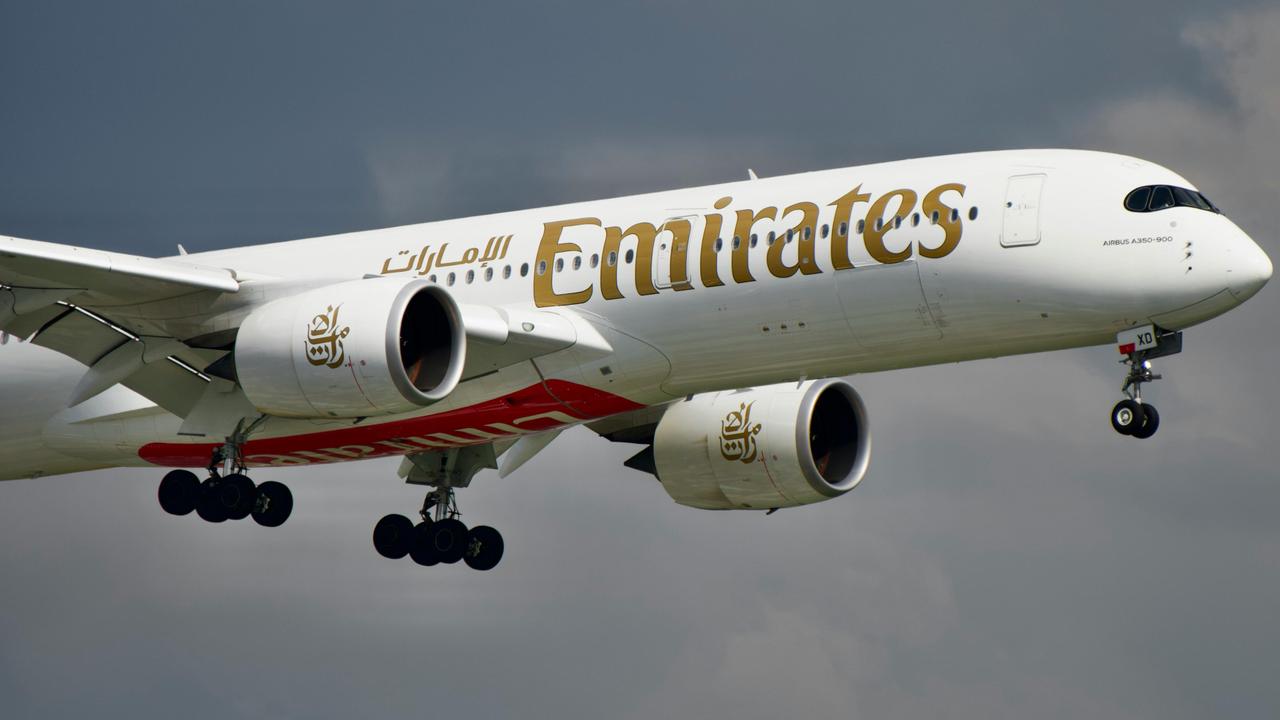
Airbus A350, is a twin-engine, wide-body commercial passenger aircraft designed and manufactured by the European aerospace company Airbus. Developed to compete in the aviation market with the Boeing 787 Dreamliner and Boeing 777 series, it is the first Airbus aircraft to use carbon composite materials extensively in its fuselage and wing structures. The A350 series, whose primary production and assembly center is located in Toulouse, France, represents a technological advancement in commercial aviation through its low fuel consumption and reduced carbon emissions.
Development of the Airbus A350 series began in 2006, with the aircraft designed from a clean-sheet architecture. The first test flight was successfully completed on 14 June 2013.【1】 Official certification processes were approved by the European Aviation Safety Agency (EASA) in September 2014 and by the U.S. Federal Aviation Administration (FAA) in November 2014.【2】 The first model of the series, the A350-900, entered commercial service for the first time in January 2015 with Qatar Airways. The A350-1000 variant, developed in the next phase of the project and featuring a longer fuselage, completed its first commercial flight in February 2018, also with Qatar Airways. Finnair was the first airline in Europe to operate the aircraft.【3】
More than seventy percent of the Airbus A350’s structural integrity is constructed from advanced materials designed for lightness and durability. Fifty-three percent of the fuselage, wings, and tail structures are made of carbon fiber-reinforced polymer (CFRP), while the remaining structural components use corrosion-resistant titanium and aluminum-lithium alloys to prevent metal fatigue.【4】 The 32-meter-long tapered wings, which define the aircraft’s aerodynamic profile, are designed with an adaptive (morphing) technology that alters shape during flight to minimize drag and enhance lift.【5】
Airbus A350 (Pxhere)
All A350 series aircraft are powered by Rolls-Royce Trent XWB turbofan engines, specifically developed for this aircraft model.【6】 These engines, capable of generating between 84,000 and 97,000 pounds of thrust depending on the variant, are ranked as the most efficient power units in their class.【7】 Innovative fuselage materials and aerodynamic design enable the aircraft to consume twenty-five percent less fuel and reduce carbon dioxide emissions per passenger by the same margin compared to previous-generation aluminum-bodied competitors. Additionally, the aircraft’s systems are supported by Integrated Modular Avionics (IMA) and fly-by-wire technology, with digital touchscreen displays installed in the cockpit.【8】
The aircraft’s cabin systems are configured to optimize passenger health and comfort on long-haul flights. Regardless of cruising altitude, the internal cabin pressure is maintained at an equivalent of a maximum of 6,000 feet (approximately 1,800 to 2,600 meters). 【9】 High-Efficiency Particulate Air (HEPA) filters in the climate and ventilation systems remove 99.97 percent of microscopic particles from the air, and the entire cabin air volume is fully refreshed every two to three minutes.【10】 Thanks to vibration isolation and advanced engine nacelles, cabin noise levels are reduced by up to nine decibels compared to competing aircraft models in the same category. Dynamic LED ambient lighting systems, integrated with time zones to minimize circadian rhythm disruption (jet lag), are installed throughout the cabin.
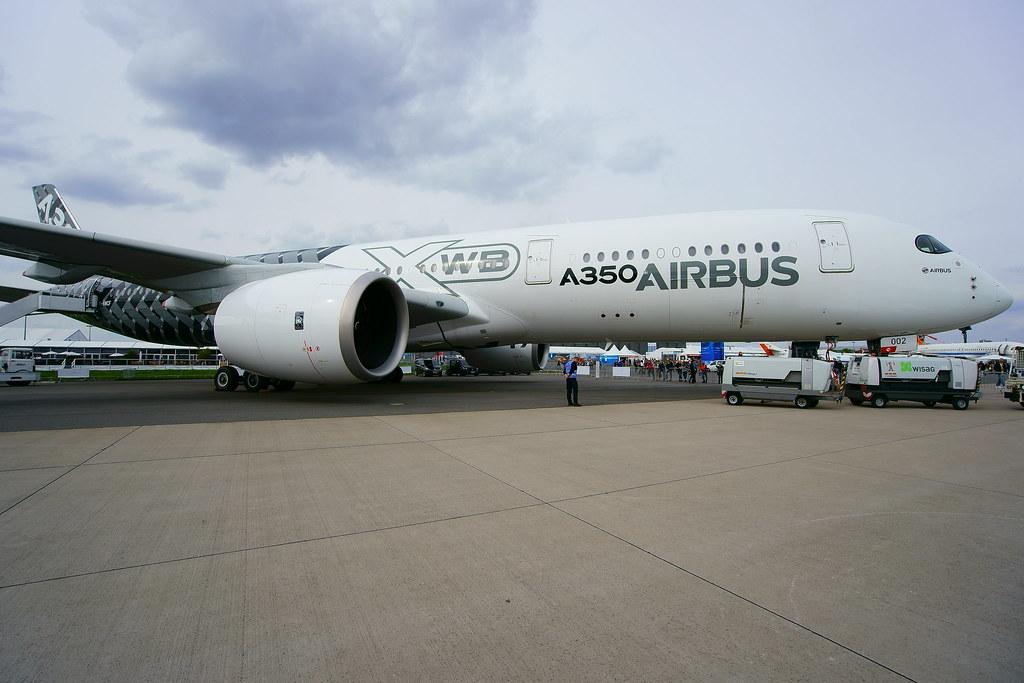
Airbus A350 (Flickr)
The Airbus A350 project was designed with multiple variants to meet diverse capacity and range requirements in the commercial aviation market. The first and most widely used model of the series, the A350-900, has a typical passenger capacity of 300 to 350, depending on airline configuration. The aircraft’s length is approximately 66.8 meters, its wingspan is 64.75 meters, and its height from the ground is about 17.05 meters.【11】
With a maximum fuel capacity of approximately 138,000 liters, it achieves a range of 8,500 nautical miles (approximately 15,740 kilometers). The upgraded variant, the A350-900ULR (Ultra Long Range), designed for the world’s longest commercial routes such as Singapore–New York, enables flights of up to 9,700 nautical miles (approximately 18,000 kilometers) and durations exceeding 19 hours.【12】
The largest model in the series by fuselage volume, the A350-1000, was designed to directly compete with Boeing 777 and 787 models in response to growing market demand. With a fuselage length ranging from approximately 73.8 to 74 meters, this variant can carry between 350 and 410 passengers.【13】 Equipped with more powerful Rolls-Royce Trent XWB-97 engines compared to the A350-900, this variant achieves a maximum takeoff weight of 298 tonnes and offers a range of 9,100 nautical miles (approximately 16,700 kilometers).【14】
In addition to these models, an earlier design concept included a lower-capacity, shorter-fuselage variant (60.7 meters) known as the A350-800, but due to shifts in industry capacity demands, market focus shifted to the A350-900 and A350-1000 variants. The series also includes a dedicated wide-body cargo aircraft model, the A350F, designed exclusively for industrial cargo and freight operations.
Airbus A350 (Youtube)
The Airbus A350 is widely adopted in modern airline fleets to replace older-generation aircraft such as the A340 and Boeing 777. As of December 2024, the series has accumulated a total of 1,345 orders worldwide, with 628 deliveries completed. According to statistics, Singapore Airlines holds the position of the largest global operator with 64 aircraft in its fleet.【15】
The airline with the highest number of A350 orders worldwide is Türk Hava Yolları, with a contract for 110 aircraft. The aircraft are configured in three distinct cabin layouts—Economy, Premium Economy, and Business Class—and provide the foundation for airline-specific customized cabin experiences such as Qatar Airways’ Qsuite or British Airways’ Club Suite.
Airbus. "Airbus A350 Family, Long Range Widebody Aircraft." Accessed March 15, 2026. https://www.airbus.com/en/products-services/commercial-aircraft/passenger-aircraft/a350-family
Ankerstjerne, Jan. "Gratis billeder: airbus, a350, fly, flyselskab, himmel...". PxHere, July 17, 2021. Accessed March 15, 2026. https://pxhere.com/da/photo/1644776
Blohm, Lutz. "Airbus A350-900." Flickr, April 28, 2018. Accessed March 15, 2026. https://www.flickr.com/photos/pixelshowmeine/26893874957/
British Airways. "Airbus A350-1000 | About BA." Accessed March 15, 2026. https://www.britishairways.com/content/information/about-ba/fleet-facts/airbus-a350-1000.
Etihad Airways. "Airbus A350 -Business Süitleri and Destination Points Explored." Accessed March 15, 2026. https://www.etihad.com/tr-tr/plan/fly-with-etihad/our-fleet/airbus-a350
Kozak, Deniz Giray. "Airbus 350." *Online Türkiye Turizm Ansiklopedisi*. Edited by N. Kozak, 2020. Accessed March 15, 2026. https://turkiyeturizmansiklopedisi.com/airbus-350
Qatar Airways. "Qatar Airways Airbus A350." Accessed March 15, 2026. https://www.qatarairways.com/tr-tr/fleet/airbus-a350.html
Simple Flying. "Airbus A350 - Overview." Accessed March 15, 2026. https://simpleflying.com/tag/airbus-a350/
Suomi Aviation Museum. "Airbus A350 XWB." Accessed March 15, 2026. https://ilmailumuseo.fi/en/a350/
Turk Hava Yolları. "Airbus A350 | Filo." Accessed March 15, 2026. https://www.turkishairlines.com/tr-tr/ucak-bileti/ucus-deneyimi/filo/airbus-a350-900/.
WELT Documentary. "AIRBUS A350 - High Tech In The Air | Exceptional Engineering Full Documentary." YouTube, Accessed March 15, 2026. https://www.youtube.com/watch?v=XFfVmvV3a9Y.
[1]
Kozak, Deniz Giray. "Airbus 350". Online Türkiye Turizm Ansiklopedisi, editör N. Kozak. 2020. Erişim tarihi: 15 Mart 2026.
[2]
Kozak, Deniz Giray. "Airbus 350". Online Türkiye Turizm Ansiklopedisi, editör N. Kozak. 2020. Erişim tarihi: 15 Mart 2026.
[3]
Simple Flying. "Airbus A350 - Overview". Simple Flying. Erişim tarihi: 15 Mart 2026.
[4]
Airbus. "Airbus A350 Family: the future of long-haul travel". Airbus. Erişim tarihi: 15 Mart 2026.
https://www.airbus.com/en/products-services/commercial-aircraft/passenger-aircraft/a350-family
[5]
Kozak, Deniz Giray. "Airbus 350". Online Türkiye Turizm Ansiklopedisi, editör N. Kozak. 2020. Erişim tarihi: 15 Mart 2026.
[6]
Airbus. "Airbus A350 Family: the future of long-haul travel". Airbus. Erişim tarihi: 15 Mart 2026.
https://www.airbus.com/en/products-services/commercial-aircraft/passenger-aircraft/a350-family
[7]
Simple Flying. "Airbus A350 - Overview". Simple Flying. Erişim tarihi: 15 Mart 2026.
[8]
Airbus. "Airbus A350 Family: the future of long-haul travel". Airbus. Erişim tarihi: 15 Mart 2026.
https://www.airbus.com/en/products-services/commercial-aircraft/passenger-aircraft/a350-family
[9]
Airbus. "Airbus A350 Family: the future of long-haul travel". Airbus. Erişim tarihi: 15 Mart 2026.
https://www.airbus.com/en/products-services/commercial-aircraft/passenger-aircraft/a350-family
[10]
Airbus. "Airbus A350 Family: the future of long-haul travel". Airbus. Erişim tarihi: 15 Mart 2026.
https://www.airbus.com/en/products-services/commercial-aircraft/passenger-aircraft/a350-family
[11]
Türk Hava Yolları. "Airbus A350 | Filo". Türk Hava Yolları. Erişim tarihi: 15 Mart 2026.
https://www.turkishairlines.com/tr-tr/ucak-bileti/ucus-deneyimi/filo/airbus-a350-900/
[12]
Airbus. "Airbus A350 Family: the future of long-haul travel". Airbus. Erişim tarihi: 15 Mart 2026.
https://www.airbus.com/en/products-services/commercial-aircraft/passenger-aircraft/a350-family
[13]
Kozak, Deniz Giray. "Airbus 350". Online Türkiye Turizm Ansiklopedisi, editör N. Kozak. 2020. Erişim tarihi: 15 Mart 2026.
[14]
Simple Flying. "Airbus A350 - Overview". Simple Flying. Erişim tarihi: 15 Mart 2026.
[15]
Simple Flying. "Airbus A350 - Overview". Simple Flying. Erişim tarihi: 15 Mart 2026.

Producer(s) | Airbus | ||||||||
|---|---|---|---|---|---|---|---|---|---|
Range(s) | Long-range | ||||||||
Engine(s) | Rolls-Royce | ||||||||
Type(s) | Wide-body | ||||||||
First Flight(s) | 2013 | ||||||||
Material(s) | Carbon Composite | ||||||||
First User | Qatar Airways | ||||||||
Service Entry | 2015 | ||||||||
Model | A350 | ||||||||
History and Development Process
Design Features and Technological Innovations
Cabin Interior and Flight Physiology
Models and Technical Specifications
Market Position and Global Operations