


This article was automatically translated from the original Turkish version.

Generated with artificial intelligence.
Ak Sungur (Falco rusticolus)
Taxonomy | English: Gyrfalcon Species: Falco rusticolus Genus: Falco Family: Falconidae | ||||||||
|---|---|---|---|---|---|---|---|---|---|
Size and Morphology | Dark Gray Color Morphs: White Sexual Dimorphism: Females Larger Weight: 1–2 kg Wingspan: 110–130 cm Body length: 48–65 cm | ||||||||
Feeding and Behavior | Migration: Limited Stooping Hunting Method: Aerial Pursuit Small Mammals Prey: Birds | ||||||||
Conservation Status | CITES: Appendix I Fluctuations in Prey Populations Illegal Capture Threats: Habitat Loss Global Status: Least Concern | ||||||||
Ak sungur (Falco rusticolus) is a member of the falcon family (Falconidae) and the largest species in the Falco genus.
Ak sungur (Falco rusticolus) is a member of the falcon family (Falconidae) and the largest species in the Falco genus. The scientific name of the species was described by Carl Linnaeus in 1758. In English it is known as the Gyrfalcon. Within the taxonomy of Falco rusticolus, three color morphs have been identified: white, gray, and dark. Genetic studies have shown that these color forms represent ecotypic variations within a single species.
Ak sungur measures 48–65 cm in length and has a wingspan of 110–130 cm. Females are significantly larger than males. The beak is short, powerful and curved; the talons are long and sharp. Color variation is categorized into three main morphs:
The feathers are dense and insulating, adapted to withstand cold climates.
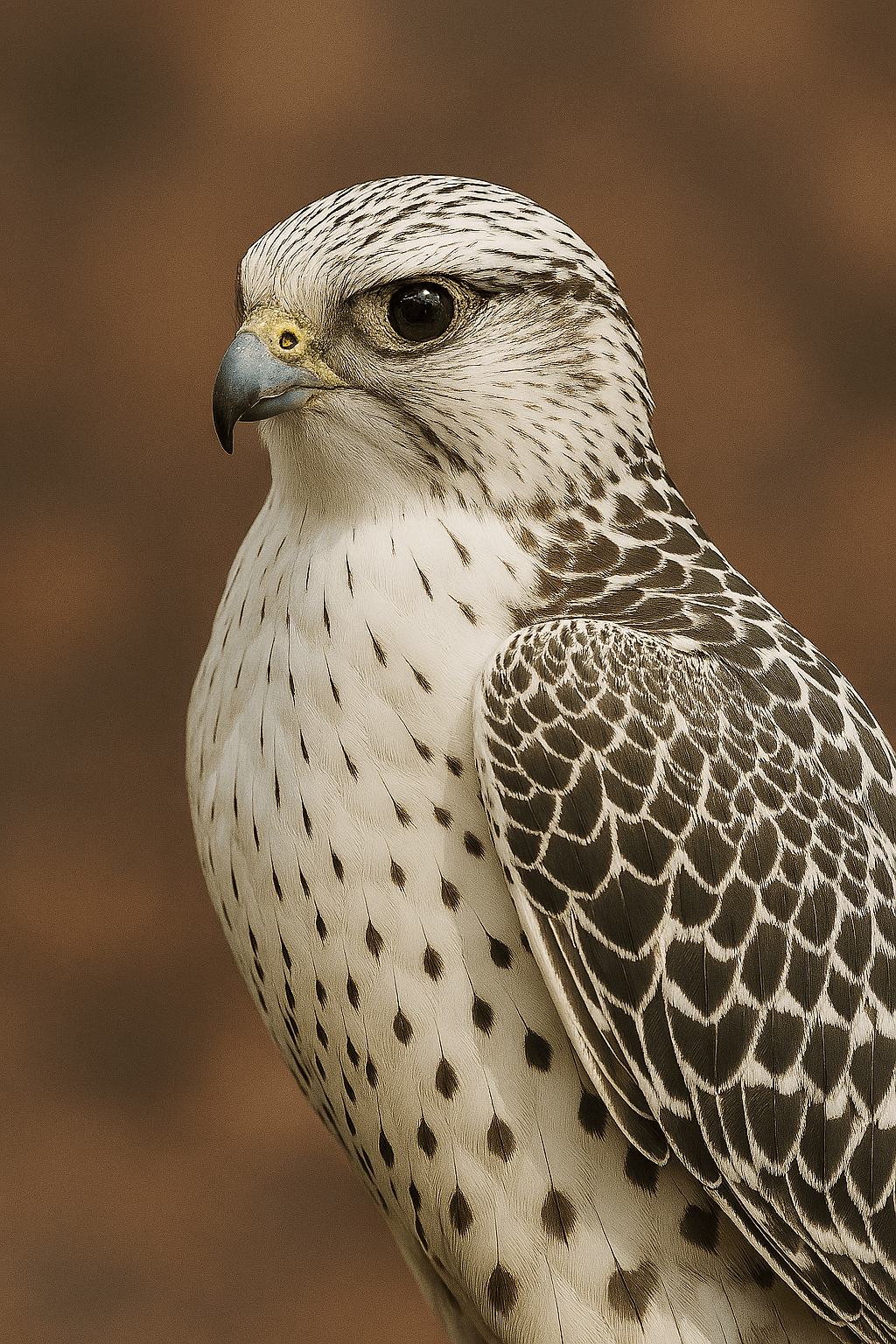
Ak Sungur (Falco rusticolus) (generated by artificial intelligence.)
The species has a broad breeding distribution around the Arctic Circle. Major breeding areas include Greenland, northern Canada, Alaska, Scandinavia, the Arctic coasts of Russia and Siberia. It prefers open tundra, high rocky areas, coastal cliffs and sparse forest-tundra transition zones. Although there is no natural population in Türkiye, historical records indicate that the ak sungur was recognized in Central Asian falconry traditions.
The ak sungur is known for its powerful flight and high speed. It typically pursues prey in flight and captures it with sudden dives. Its diet consists mainly of birds including rock ptarmigan, willow ptarmigan (Lagopus lagopus), gulls and duck species. It also consumes small mammals such as lemmings. Its hunting strategy is based on soaring from height and cutting off the escape route of prey.
The breeding season typically begins in April–May in the Northern Hemisphere. Ak sungur does not build its own nest; instead it uses rock ledges, cliff edges or abandoned nests of other large birds. The female lays 2–5 eggs; the incubation period averages 35 days. Chicks are fed by their parents for 7–8 weeks before they fledge. Breeding success is directly dependent on prey availability and weather conditions.
According to BirdLife International, the species is classified as “Least Concern” globally. However, local populations face several threats:
In Turkic-Islamic culture and Central Asian steppe traditions, the ak sungur has been regarded as one of the most valuable birds of prey in falconry. It is recorded in the Ottoman court as one of the rarest and most expensive birds in the “doğan” class. Archival documents confirm that ak sungurs were presented as gifts to rulers during the Seljuk and Ottoman periods from Central Asia. The bird holds a place in cultural memory not only for its hunting ability but also as a symbol of prestige and power.
BirdLife International. “Gyrfalcon (Falco rusticolus).” Accessed August 16, 2025. https://datazone.birdlife.org/species/factsheet/gyrfalcon-falco-rusticolus.
Çelik, Ahmet. “Türk Kültüründe Doğan (Falco) Türleri ve Avcılık.” İstanbul Üniversitesi Tarih Dergisi 0, no. 73 (2021): 75–100. Accessed August 16, 2025. https://dergipark.org.tr/en/pub/iutarih/issue/9630/120307.
Özkan, Korhan. “Ak Sungur.” *TÜBİTAK Kutup Araştırmaları Ansiklopedisi*. Accessed August 16, 2025. https://ansiklopedi.tubitak.gov.tr/kutup/ansiklopedi/ak-sungur.

Generated with artificial intelligence.
Ak Sungur (Falco rusticolus)
Taxonomy | English: Gyrfalcon Species: Falco rusticolus Genus: Falco Family: Falconidae | ||||||||
|---|---|---|---|---|---|---|---|---|---|
Size and Morphology | Dark Gray Color Morphs: White Sexual Dimorphism: Females Larger Weight: 1–2 kg Wingspan: 110–130 cm Body length: 48–65 cm | ||||||||
Feeding and Behavior | Migration: Limited Stooping Hunting Method: Aerial Pursuit Small Mammals Prey: Birds | ||||||||
Conservation Status | CITES: Appendix I Fluctuations in Prey Populations Illegal Capture Threats: Habitat Loss Global Status: Least Concern | ||||||||
No Discussion Added Yet
Start discussion for "Ak Sungur (Falco rusticolus)" article
Taxonomy and Systematic Position
Morphological Characteristics and Color Morphs
Distribution and Habitat Preference
Behavior and Hunting Strategies
Reproductive Biology
Conservation Status and Threats
Historical and Cultural Significance