This article was automatically translated from the original Turkish version.
Scientific Name(s) | Charadrius alexandrinus | ||||||||
|---|---|---|---|---|---|---|---|---|---|
Mass | 42 g | ||||||||
Branch | Chordata | ||||||||
Superclass | Charadrius | ||||||||
Order | Charadriiformes | ||||||||
Subfamily | Charadriinae | ||||||||
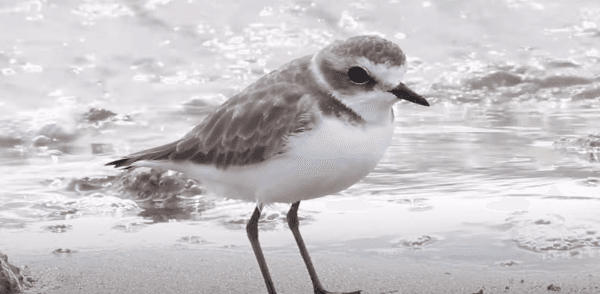
Akça cılıbıt (Charadrius alexandrinus) is among the smallest sandpipers and has proportionally long legs. Its upper body is colored in pale sandy tones, while its underparts are entirely white. It has a thin black bill, dark gray-black legs, and large black eyes.
During the breeding season, males exhibit a white forehead with a black band above it, a faint reddish-brown crown, and a black eye stripe. Additionally, a black shoulder patch and a white collar are visible. Females display a similar pattern, but the black areas are replaced by lighter brown tones. Plumage structure may vary geographically; for example, individuals in North America may have paler, light gray upper feathers and lighter leg coloration compared to Kentish plovers.
During flight, narrow white wing stripes and a prominent dark band at the tail tip are visible.

Image of Akça Cılıbıt (Charadrius alexandrinus) (Generated by Artificial Intelligence.)
The Akça cılıbıt primarily inhabits stony, sandy, and muddy coastal strips. Especially outside the breeding season, it feeds on mudflats. It also inhabits coastal lagoons, dune systems, inland steppes, sandy deserts, tidal flats, salt flats, and extensive sandy shores of rivers and lakes with sparse vegetation.
In winter, it is commonly found along sea coasts.
Charadrius alexandrinus has a very wide geographic range.
Video of Akça Cılıbıt Bird (Nature Association)
Optional polygamy is observed in populations in western North America. Birds typically begin breeding within their first year, 260–360 days after hatching.
The male responds to approaching females by calling and standing upright. During interaction with the female, the male scratches the ground at the site where the nest will be built. Following this behavior, the female also scratches and settles into the nest. During courtship, the male lowers his head toward the ground to display his white tail feathers, after which the female performs a short run. The male then positions himself behind her and copulation occurs. During copulation, the male grasps the nape of the female’s neck with his bill, and both birds flap their wings and fall backward.
The female and male take turns incubating during the day and night. Both individuals have a single brood patch on the belly. The incubation period ranges from 26 to 32 days.
Three to four days before hatching, chicks may emit sounds; vocalizations can be heard one or two days prior. Eggs may hatch at any time of day. Chicks are precocial and develop mobility rapidly.
Animal Diversity Web. "Charadrius alexandrinus (Kentish Plover)." Accessed July 8, 2025. https://animaldiversity.org/accounts/Charadrius_alexandrinus/
Doğa Derneği. "Akça Cılıbıt." YouTube video, 2:39. September 28, 2018. https://www.youtube.com/watch?v=ir4JQIU_muc
Ornito Türkiye. "Akça Cılıbıt (Charadrius alexandrinus)." Accessed July 8, 2025. https://www.ornito.org/Bird/Detail/17
eBird. "Kentish Plover (Charadrius alexandrinus)." Accessed July 8, 2025. https://ebird.org/species/kenplo1?siteLanguage=tr

Scientific Name(s) | Charadrius alexandrinus | ||||||||
|---|---|---|---|---|---|---|---|---|---|
Mass | 42 g | ||||||||
Branch | Chordata | ||||||||
Superclass | Charadrius | ||||||||
Order | Charadriiformes | ||||||||
Subfamily | Charadriinae | ||||||||
No Discussion Added Yet
Start discussion for "Akça Cılıbıt (Anarhynchus alexandrinus)" article
Habitat and Natural Environment
Geographic Distribution
Breeding
Courtship Behavior
Breeding Season and Egg Laying
Incubation