

This article was automatically translated from the original Turkish version.
+2 More
Akçadağ Kömbesi is a traditional dough product produced in the Akçadağ district of Malatya Province, Türkiye, and registered with a geographical indication mark. The dough is made from wholegrain brown flour, rolled into thin sheets, layered with a filling between two layers, and baked over a wood fire on a copper griddle or metal tray. The filling consists of fried or roasted minced meat combined with animal fat and tail fat, along with butter, roasted flour, and optionally crushed walnut kernels. The preparation method, which uses locally grown “kunduru” wheat flour and traditional baking techniques, is intrinsically linked to its geographical origin. Akçadağ Kömbesi is sliced into specific dimensions for serving and is suitable for short-term storage.
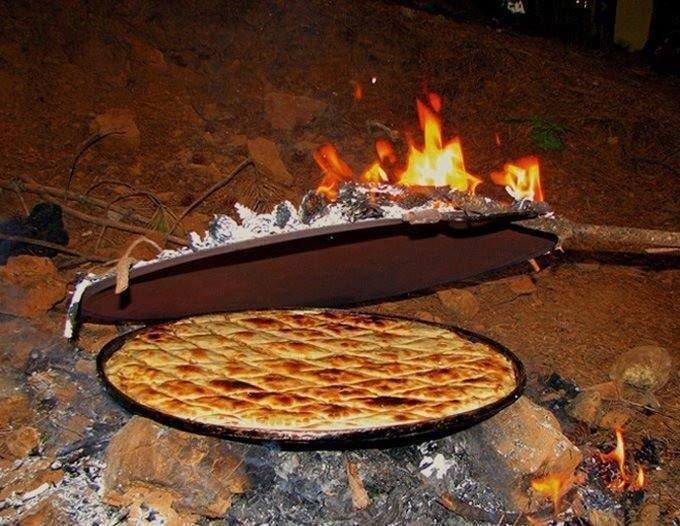
Akçadağ Kömbesi is a product based on the preparation of dough from wholegrain brown flour, which is rolled into thin sheets, divided into two layers, filled with a meat-based mixture, and baked over a wood fire. The filling is prepared using fried or roasted minced meat. Copper cauldrons approximately one meter in diameter, known as “sac” or “teş”, are used in the baking process. Production requires skilled craftsmanship and has a long-standing tradition in the Akçadağ district. Traditionally, it is prepared during Hıdırellez celebrations in Akçadağ and distributed among neighbors.
In the production of Akçadağ Kömbesi, wholegrain brown flour is used, derived from “kunduru” wheat grown in the Akçadağ district. This flour is ground at medium speed in a stone mill without removing the bran. For dough preparation, 2 kilograms of flour, 1 tablespoon of salt, and 3 liters of water are mixed.
The filling is prepared using animal fat and tail fat. For this, 1 kilogram of fried or roasted minced meat, 100 grams of roasted flour, 250 grams of butter, and optionally 1 glass of crushed walnut kernels are combined. The prepared dough is rolled out into thin sheets.
Half of the rolled dough is spread over a copper cauldron, approximately one meter in diameter, known as “sac” or “teş”. Melted butter is then brushed over the dough, followed by the filling. Crushed walnut kernels may be added to the filling as desired. The remaining half of the dough is placed on top and brushed again with butter. Holes are pierced at various points to allow air circulation, and the surface is patterned to lightly mark the slicing lines. A mixture of one dessert spoon of tomato paste and half a tea cup of water is brushed over the top.
Baking is carried out on the “sac” or “teş” over a bed of embers from a wood fire. The Kömbesi is covered with a lid, and hot embers are placed on top of the lid to ensure even heat from both sides. Alternatively, baking may also be performed in large wood-fired ovens. The baked Akçadağ Kömbesi is sliced into pieces measuring 6 x 6 cm or 6 x 8 cm for sale. The product can be stored for up to three days under refrigeration conditions between 2 °C and 4 °C.
The production of Akçadağ Kömbesi must be carried out exclusively within the geographical boundaries of the Akçadağ district of Malatya Province. The product’s historical heritage and the use of local raw materials—particularly the wholegrain brown flour derived from “kunduru” wheat—establish a direct link to this geographical area. All stages of production must occur solely within this defined geographical boundary.
The designation “Akçadağ Kömbesi” and the geographical indication emblem must appear on the product itself or its packaging. In cases where these markings cannot be placed directly on the product or packaging, the designation “Akçadağ Kömbesi” and the geographical indication emblem must be clearly displayed at the production or sales establishment.
The production process and compliance with registered elements of Akçadağ Kömbesi are monitored under the coordination of the Akçadağ Municipality. The monitoring body consists of a three-member expert team appointed by the Akçadağ Municipality’s Municipal Police Directorate, the Akçadağ District Directorate of Agriculture and Forestry, and the Akçadağ Chamber of Tradesmen and Craftsmen. Regular inspections are conducted once a year, with additional inspections carried out as needed or upon complaint. The monitoring body is responsible for verifying the suitability of the flour and other ingredients used, adherence to the production method, and the correct application of the “Akçadağ Kömbesi” designation and geographical indication emblem. Monitoring may also involve consultation with or procurement of services from public institutions, private organizations, or qualified individuals or entities active in this field. The registering authority, Akçadağ Municipality, holds the legal authority to pursue judicial proceedings to protect rights related to the product.

Distinguishing Characteristics
Production Method
Geographical Boundary and Production Conditions
Usage Format
Monitoring