


This article was automatically translated from the original Turkish version.
+2 More
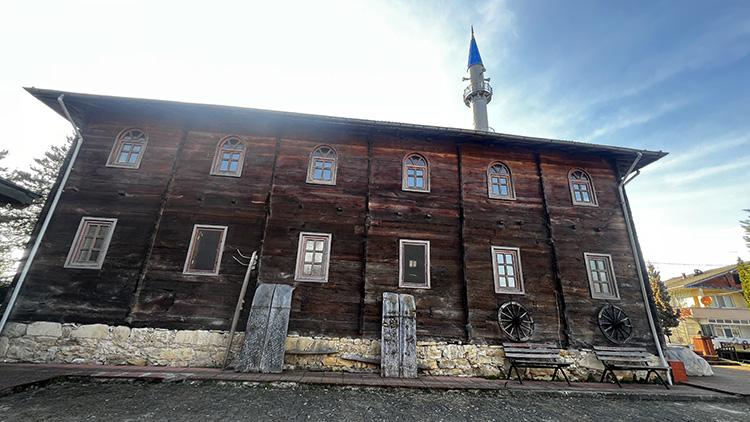
Akçahatipler Village Central Mosque is a traditional wooden mosque constructed using the çantı technique, located at the center of the eastern settlement of Akçahatipler Village within the boundaries of Çaycuma District in Zonguldak Province, near Bartın. Estimated to have been built in the first half of the 19th century, the structure is one of the rare examples of çantı mosques in the Western Black Sea region, notable for both its architectural planning and the skilled use of its timber-frame system.
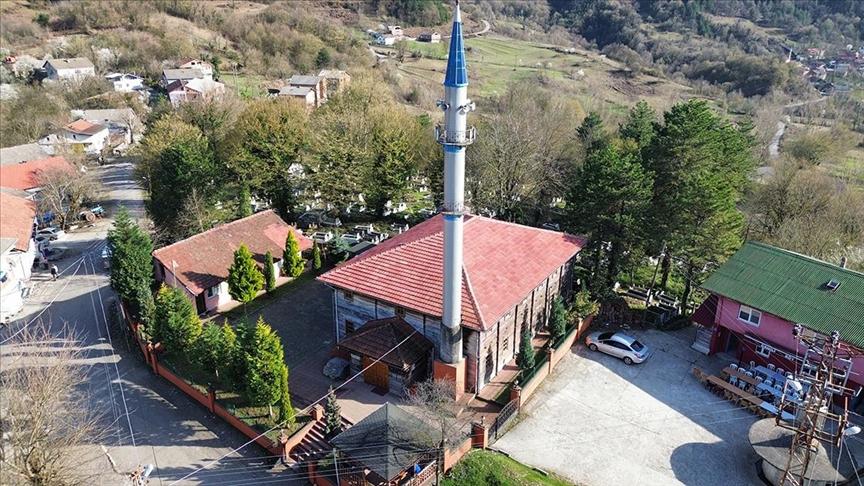
Akçahatipler Köyü Merkez Cami (AA)
The mosque does not have a direct foundation inscription. However, based on an inscription on the fountain immediately to its west, it is believed to have been constructed in AH 1260 (CE 1844/45). The oldest gravestone in the cemetery located to the south of the mosque is dated 1863. These data support the view that the structure was built in the middle of the 19th century. The building underwent a comprehensive restoration in 1959, during which a women’s gallery was added; between 2003 and 2010, interior lambri claddings were installed, joinery was renewed, and the surrounding area was landscaped.
The mosque has a rectangular plan oriented along the north-south axis, comprising a prayer hall and an upper gallery floor. The ground floor measures 11.7 × 15.8 meters. The gallery occupies a U-shaped space along the north, east, and west sides, with a total interior height of 5.20 meters. The entrance is centrally located on the north façade and is emphasized by a recessed and projecting mass. The mihrab, minbar, and pulpit are positioned on the qibla wall in accordance with the classical Ottoman mosque layout.
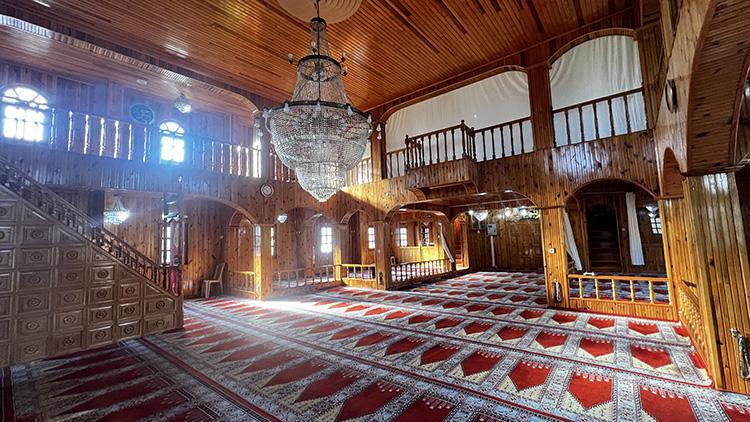
Akçahatipler Köyü Merkez Cami (AA)
The building’s facades are animated by symmetrical windows, and the traces of the wooden çantı system remain clearly visible from the exterior. All facades except the north feature paired window arrangements: six windows on the east and west sides and four on the south. The lower windows are rectangular while the upper ones are semicircular arched. The roof is a four-sloped gabled structure covered with Marseille-type tiles. Chestnut timber is used in the ground floor walls while oak is employed in the gallery. The structural skeleton is formed by wooden partitions joined without nails using the kurtboğazı joinery technique. The foundation is constructed of rubble stone, with stones observed to be laid in large blocks.
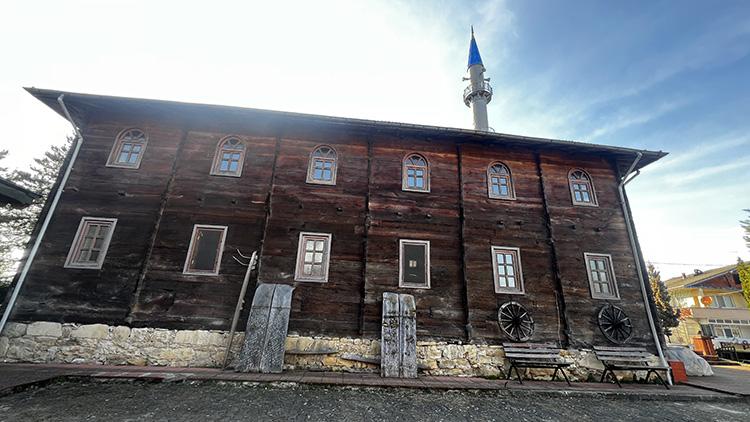
Akçahatipler Köyü Merkez Cami (AA)
Akçahatipler Village Central Mosque is a significant example among çantı-built mosques due to its dimensions, construction system, and siting. It was constructed in harmony with the traditional practice of locating mosques near cemeteries and has remained in continuous use through maintenance provided by the local community over time. However, some insensitive interventions during the 2000s resulted in the loss of original interior details. With its monumental scale, U-shaped gallery, and symmetrical façade arrangement, Akçahatipler Village Central Mosque represents the Western Black Sea tradition of çantı mosques and holds the potential, through future restoration projects, to more clearly preserve the architectural memory of this tradition.
Unnailed Mosque Has Been in Service for 200 Years (AA)
Akıllı, Ferdi. “Çivisiz cami 200 yıldır hizmet veriyor.” Anadolu Ajansı. Accessed May 14, 2025. https://www.aa.com.tr/tr/yasam/civisiz-cami-200-yildir-hizmet-veriyor/238255
Anadolu Ajansı. “Çivisiz cami 200 yıldır hizmet veriyor.” YouTube. Accessed May 14, 2025. https://www.youtube.com/watch?v=4f4-GsN5y7c
Mısırlı, Arif. “Zonguldak/Çaycuma’da Çantı Tekniğinde İnşa Edilmiş Bir Cami: Akçahatipler Köyü Cami.” *Türkiye Bilimler Akademisi Kültür Envanteri Dergisi (TÜBA-KED)*, no. 26 (2022): 55–70. Accessed May 14, 2025. https://dergipark.org.tr/tr/pub/tubaked/issue/72536/1035936
Sulucak, Murat. “Zonguldak'ta çantı tekniğiyle inşa edilen cami 2 asırdır ayakta duruyor.” Anadolu Ajansı. Accessed May 14, 2025. https://www.aa.com.tr/tr/kultur/zonguldakta-canti-teknigiyle-insa-edilen-cami-2-asirdir-ayakta-duruyor/3511752
Visit Zonguldak. "Akçahatipler Köyü Merkez Cami." *Visit Zonguldak*. Accessed May 14, 2025. https://www.visitzonguldak.com/place/akcahatipler-koyu-merkez-camisi.

No Discussion Added Yet
Start discussion for "Akçahatipler Village Central Mosque" article
History and Location
Architectural Features
Facades and Construction Materials
Conservation Status and Assessment