


This article was automatically translated from the original Turkish version.
+2 More
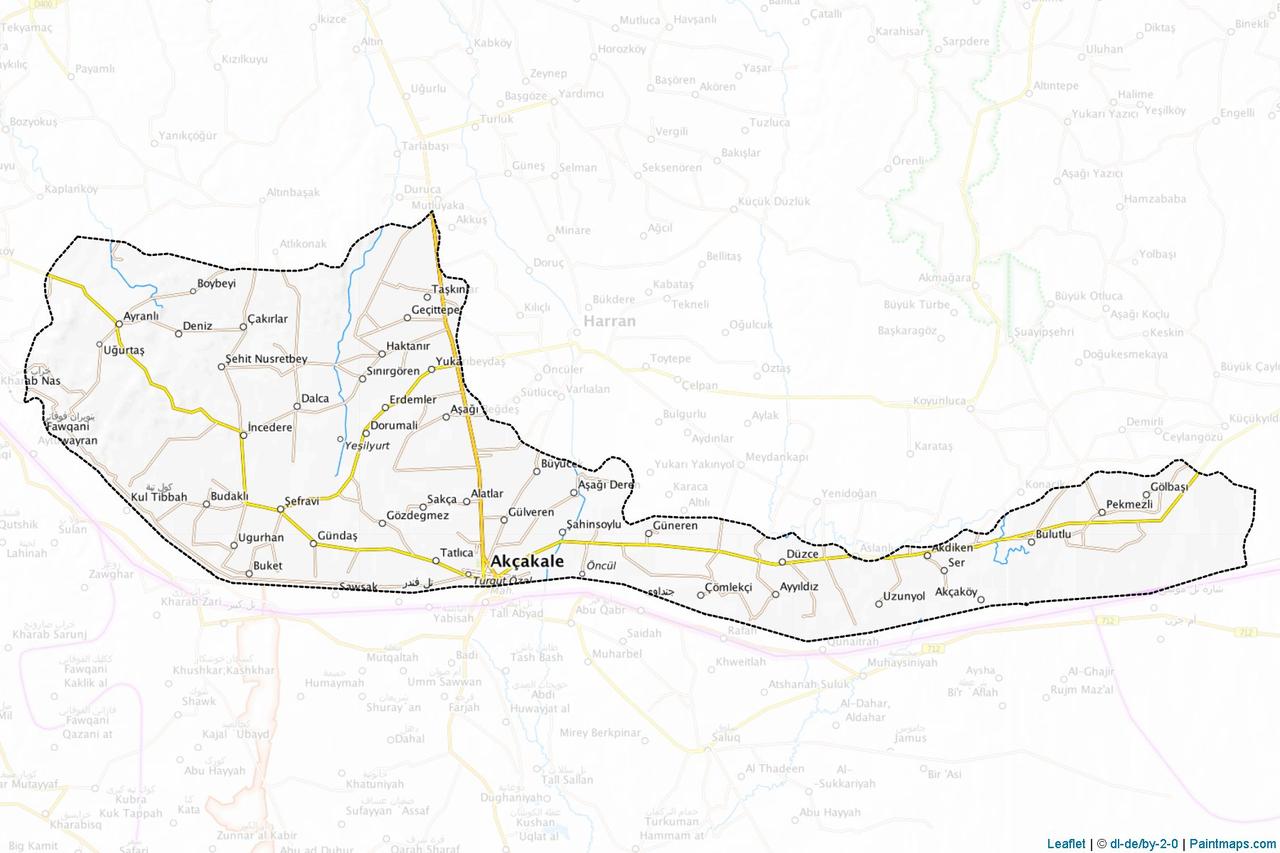
Akçakale (District)
Akçakale (District)
Location | Şanlıurfa Türkiye (at the zero point of the Syria border) | ||||||||
|---|---|---|---|---|---|---|---|---|---|
Area(s) | 1952 km² | ||||||||
Population | 129,262 (2024 TÜİK data) | ||||||||
Administrative Structure | 1 district, 73 villages | ||||||||
Borders | East: Ceylanpınar-Viranşehir, West: Suruç, North: Şanlıurfa-Harran, South: Syria | ||||||||
Akçakale is a well-established district of Türkiye’s Şanlıurfa province and occupies a strategic location on the Syrian border. Harran This settlement, situated on the fertile lands of the Harran Plain, place stands out for its historical richness and geographical characteristics. Agricultural activities and border trade form the foundation of the district’s economy. According to 2024 TÜİK data, Akçakale has a population of 129,262 and covers an area of 1,952 km² at an elevation of 385 metres above sea level.
Akçakale’s history extends back to the 5000s BCE and it is regarded as one of the oldest settlement sites in Şanlıurfa. Throughout history, the region has come under the control of various civilizations. This legacy began with the Sumerians and Hittites, continued with the incursions of Semitic communities around 2750 BCE, and then passed under Assyrian rule until 612 BCE. Subsequently, Akçakale fell under Persian and then Alexander the Great’s dominion. In 750 CE, the Arab conquest liberated the region from Byzantine influence. After the Battle of Manzikert in 1071, the district came under Turkish control and later acquired its current position along the Türkiye-Syria border established by the Treaty of Lausanne. In 1946, the district center was moved from Altınbaşak to Akçakale, and in 1987, Harran became a separate administrative unit.
One of the region’s notable historical features is Ayn-El Arus’Türkiye. This water spring is believed to be the place where Prophet Ibrahim married Sara during his migration from Harran to Damascus. This site, known as the “Wedding eye” or “Ayn Halil’ür-Rahman,” is partially located in Akçakale and partially in Syrian territory. Additionally, the ruins of Cudi Mountain and Cudi City provide important clues about the district’s past.
Akçakale is situated on the vast and flat terrain of the Harran Plain. The district covers an area of 1,952 km², stretching 85 km from east to west and 28 km from north to south. With an elevation of 385 metres above sea level, the region has no rugged land and its height does not exceed 1,000 metres. Surrounding areas include Ceylanpınar, Viranşehir, Suruç, Şanlıurfa, Harran, and Syria to the south. Although there is no major river or lake, the Cudi Creek and Cudi Mountain are prominent geographical features. Access to the district is easy throughout the year.
Akçakale exhibits continental climate characteristics. Summers are hot and dry while winters are mild and receive little precipitation. July and August temperatures can exceed 40°C, and nighttime temperatures often remain above 30°C during time. In winter, temperatures rarely drop below 0°C and snowfall is absent. The vegetation cover, despite the fertile soils of the Harran Plain, has steppe characteristics. Agriculture, supported by irrigation systems, revitalizes the region’s natural environment.
Akçakale has a rural structure comprising 1 township and 73 villages. Influenced over time by various civilizations, the district reflects this heritage as cultural richness. Ayn-El Arus like are central to the community’s social life due to their religious significance. Traditional lifestyles blend with modern elements, while agriculture and border trade form the backbone of daily life. Proximity to Syria is a significant factor shaping social dynamics.
The district’s economy is largely based on agriculture. The opportunities offered by the Harran Plain make farming the primary source of livelihood for the population. In addition, Akçakale Customs Gate serves as the center of trade with Syria. Known as the “Pasavan Gate,” this door became an official border crossing in 1974 and is located 52 km from Şanlıurfa. In the past, Akçakale Railway Station also contributed to the economy but closed in 2011 due to the internal war in Syria. This station, part of the Berlin-Baghdad Railway, was a vital hub for transportation and trade during the 20th century.
Akçakale does not attract significant tourism interest at present but possesses considerable potential. Ayn-El Arus, believed to be the site where Prophet Ibrahim and Prophet Sara married, draws attention in religious tourism as an oasis. Cudi Mountain and the ruins of Cudi City are key destinations for archaeology enthusiasts. These sites, easily accessible from Şanlıurfa, appeal to history lovers. Moreover, the historical structure of Akçakale Railway Station can be developed for industrial heritage tourism. Tourism activities are expected to grow as stability in the region improves.
According to 2024 TÜİK data, Akçakale’s population is 129,262. The district includes 1 township and 73 village. Proximity to the Syrian border enhances demographic diversity. The rich history spanning from the Sumerians to the Turks is reflected in the cultural fabric of the population. Agriculture- and trade-oriented lifestyles have led the majority of the population to concentrate in rural areas road.
Akçakale is one of Türkiye’s original regions, distinguished by its historical depth, strategic importance, and cultural heritage. While maintaining its economic value through its customs gate and agricultural production, it looks toward the future with hope in tourism, anchored by sites such as Ayn-El Arus and Cudi Mountain.
Akçakale Belediyesi. "Tarihçe." Accessed April 8, 2025. https://akcakale.bel.tr/icerik/tarihce.
Akçakale Kaymakamlığı. “Tarihçe.” Accessed April 8, 2025. http://www.akcakale.gov.tr/tarihce.
Akçakale Kaymakamlığı. “İlçe Tarihimiz.” Accessed April 8, 2025. http://www.akcakale.gov.tr/ilce-tarihimiz.
Şanlıurfa Büyükşehir Municipality. "Akçakale." Accessed April 8, 2025. https://www.sanliurfa.bel.tr/icerik/269/45/akcakale.

Akçakale (District)
Akçakale (District)
Location | Şanlıurfa Türkiye (at the zero point of the Syria border) | ||||||||
|---|---|---|---|---|---|---|---|---|---|
Area(s) | 1952 km² | ||||||||
Population | 129,262 (2024 TÜİK data) | ||||||||
Administrative Structure | 1 district, 73 villages | ||||||||
Borders | East: Ceylanpınar-Viranşehir, West: Suruç, North: Şanlıurfa-Harran, South: Syria | ||||||||
No Discussion Added Yet
Start discussion for "Akçakale (District)" article
History
Geographical Features
Climate and Natural Environment
Social and Cultural Life
Economy
Tourism Opportunities
Population Structure