

This article was automatically translated from the original Turkish version.
+2 More
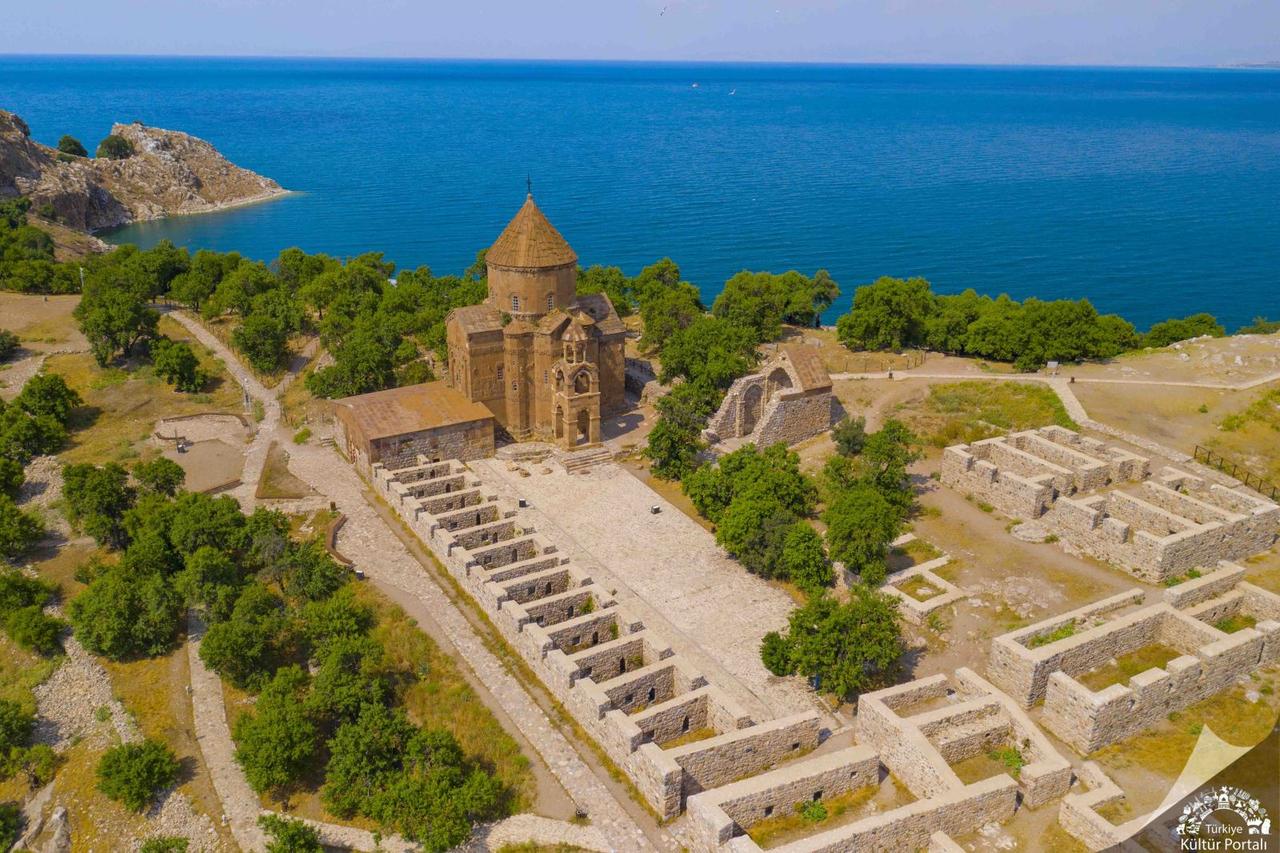
Akdamar Monumental Museum is a historic Armenian church located on Akdamar Island, the second largest island in Lake Van, near the district of Gevaş in Van, Türkiye. Also known as the Church of the Holy Cross, it was commissioned by King Gagik I Ardzruni of Vaspurakan between 915 and 921 and constructed by the architect Monk Manuel. This palace church reflects the cultural and architectural heritage of the Vaspurakan Kingdom, which ruled Van and its surroundings under the Abbasids from 908 to 1021. The structure was restored in 2007 and opened to the public as a monumental museum. With its architectural features, stone reliefs, and historical significance, it holds an important place in the history of world architecture.

Akdamar (Ahtamar) Monumental Museum
Church was built between 915 and 921 as part of a palace complex commissioned by King Gagik I Ardzruni. According to the work of Thomas Ardzruni, the palace, church, and fortifications were completed in just five years under the king’s direct supervision. In 908, the capital of the Vaspurakan Kingdom was moved to Akdamar Island, which was then equipped with palaces, a harbor, a town, and markets. The purpose of the church was to house a fragment of the Holy Cross, brought from Jerusalem to Van via Iran in the 7th century.
When the Vaspurakan Kingdom was annexed by Byzantine Emperor Basil II in 1021–1022, the last king, Senekerim, relocated with 40,000 Armenians to the regions around Sivas and Kayseri. With this event, the church lost its function as a palace church and was converted into a monastery. Expanded with additional structures in 1113, the complex served as the center of the Armenian Patriarchate until 1895. Civil settlement on the island ended in the 16th century, but the monastery continued to operate. Until the late 19th century, approximately 300 monks lived in the monastery, which was abandoned after the events of 1895 and 1915. By 1918, the island was completely deserted. During this period, monastery buildings were destroyed and the church and annexes fell into ruin.
Culture and Tourism Ministry initiated restoration work in 2005, completed in 2006. The church was opened to the public as a monumental museum in 2007. Scientific excavations in 2006 (covering an area of 3,435 m²) uncovered the courtyard, cell rooms, service section, cistern, and monastic school located south of the church.

Akdamar (Ahtamar) Church of the Holy Cross (Culture Portal)
The Akdamar Church has a square, corner-niche, four-leaf clover plan, known in Armenian architecture as the “Hripsime type.” The central space of this cross-domed structure is covered by a high drum-supported dome and an external conical roof. The height of the dome emphasizes verticality. The church, entered through doors on the west and south, is oriented along an east-west axis and sits on a rectangular base. The central dome is supported by arches resting on two free-standing piers to the west and the eastern apse wall. The eastern apse is pentagonal and surrounded by two side cells. The western arm of the cross is covered by a ribbed dome.
The structure was built using cut stone. Its exterior facades are adorned with richly figured stone reliefs. The western jamatun (added in 1763) is square in plan, divided into nine sections, and covered with intersecting vaults. Its entrance features a muqarnas portal and is arranged as a bell tower. The chapel on the northeast (1296–1336), the bell tower on the south (late 18th century), and other additions were constructed in later periods. The interior frescoes, largely damaged, depict scenes related to Jesus Christ. Influences of Central Asian Turkic art are also observable in the architectural plasticity.

Akdamar (Ahtamar) Church of the Holy Cross (Culture Portal)
The exterior walls of the church are distinguished by figural stone reliefs arranged in bands. Scenes from the Bible and the Torah are depicted, including Jonah being cast into the sea, the Virgin Mary and Jesus, Adam and Eve being expelled from Eden, David and Goliath, and Daniel in the lions’ den. Religious figures (apostles and prophets), Armenian nobility, court life, hunting scenes, animals (lions, rabbits, etc.), vegetal motifs (vine tendrils), and geometric patterns are also represented. On the western facade, a scene shows King Gagik presenting a model of the church; on the eastern facade, the Abbasid Caliph Muktafi is depicted with his head bowed and hands folded. The four tympana feature full-length depictions of the Evangelists.

Akdamar (Ahtamar) Church of the Holy Cross (Culture Portal)
The church derives its name from Akdamar Island. “Akdamar” (formerly Ahtamar) is explained by a local legend: A young man fell in love with Tamara, the daughter of a monk living on the island, and swam to the island every night. During a stormy night, he drowned, crying “Ah Tamara!” as he died. Tamara, overcome with grief, also lost her life. After this event, the island became known as Ahtamar, later evolving into Akdamar.

Akdamar (Ahtamar) Church of the Holy Cross (Culture Portal)
Accessible by a 20-minute boat ride from Gevaş, located 4 km from the shore of Lake Van, Akdamar Island and its church are visited annually by domestic and international tourists.
Also known as the Akdamar Monumental Museum, the church was added to UNESCO’s Tentative List of World Heritage Sites in 2015.

No Discussion Added Yet
Start discussion for "Akdamar (Ahtamar) Holy Cross Church" article
History
Architectural Features
Stone Reliefs and Decorations
Name of the Island and the Church
Current Status