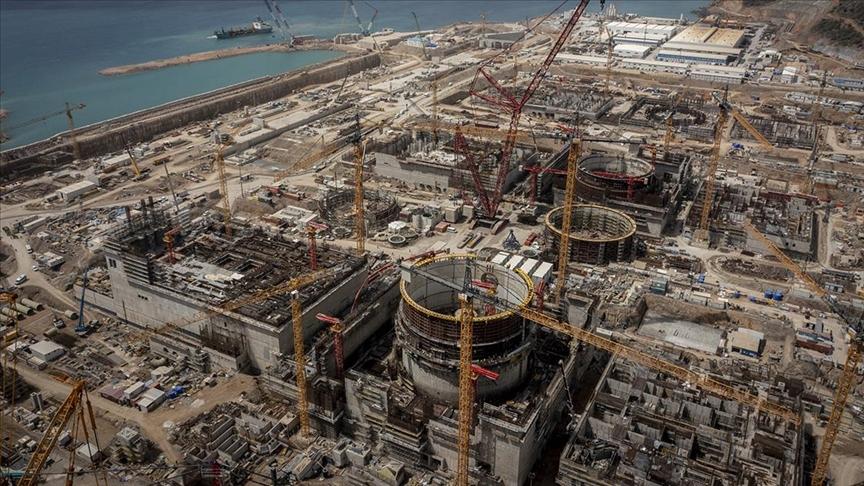
This article was automatically translated from the original Turkish version.
+1 More
Location | Gülnar - Mersin / Türkiye | ||||||||
|---|---|---|---|---|---|---|---|---|---|
Status | Under construction | ||||||||
Start | 3 April 2018 (first concrete for Unit 1) | ||||||||
Project Company | Akkuyu Nuclear JSC | ||||||||
Reactor Type | VVER-1200, Generation 3+ pressurized water reactor (PWR) | ||||||||
Number of Units | 4 | ||||||||
Unit Capacity | 1200 MW (each) | ||||||||
Total Installed Capacity | 4800 MW | ||||||||
Completion Target | All units are planned to be completed by the end of 2028 | ||||||||
Intergovernmental Agreement | 12 May 2010 | ||||||||
Reactor Lifetime | 60 years | ||||||||
Type(s) | Nuclear power plant | ||||||||
Project Model | Build-Own-Operate (BOO) | ||||||||
Akkuyu Nuclear Power Plant (Akkuyu NPP) is Türkiye’s first nuclear energy production facility. The project, located in Büyükeceli, Gülnar district of Mersin Province, consists of four VVER-1200 pressurized water reactors, each with a capacity of 1200 megawatts. Built under an intergovernmental agreement signed with the Russian Federation in 2010, the plant has been designed in compliance with international standards using multi-layered safety systems. Upon completion, it is expected to meet approximately 10% of Türkiye’s electricity demand.【1】

Placement of the Outer Containment Dome of Akkuyu Nuclear Power Plant (AKKUYU NUCLEAR JSC)
The historical background of the Akkuyu Nuclear Power Plant extends back to the 1960s. The idea of nuclear power generation in Türkiye was first introduced in 1965 through the work of the Atomic Energy Commission, and in 1974 the Akkuyu and Sinop sites were identified as candidate locations. A site license for Akkuyu was granted in 1976, but four subsequent project competitions held between 1977 and 2009 failed due to economic and political reasons.
The foundation of the current project was laid with the intergovernmental agreement signed between Türkiye and the Russian Federation on 12 May 2010. In the same year, Akkuyu Nuclear JSC was established, and in 2011 the site and its licensing rights were assigned to the company. In 2013, the updated site report was approved; in 2014 a positive Environmental Impact Assessment decision was issued; and in 2017 the Electricity Production License was granted by the Energy Market Regulatory Authority (EPDK).
Construction began on 2 April 2018 with the issuance of the construction license for Unit 1 and the pouring of the first concrete on 3 April. From 2019 to 2021, licenses and foundational works were carried out for Units 2, 3 and 4. In 2022 and 2023, the reactor pressure vessel, internal containment dome, and system installations for Unit 1 were completed, and an operating license was granted on 21 November 2023. The same year, the first fuel arrived at the site, followed by critical construction phases including the outer containment structure, coastal pump station, and turbine buildings. On 22 August 2025, the control assembly of the reactor vessel for Unit 4 was completed at the Atommash facility in Russia.
The project’s goal is to bring all four units online by the end of 2028, providing a total installed capacity of 4800 megawatts and meeting approximately 10% of Türkiye’s electricity demand.

President Recep Tayyip Erdoğan and Russian President Vladimir Putin at the Foundation Laying Ceremony, 3 April 2018 (President of Russia, kremlin.ru)
The Akkuyu Nuclear Power Plant is equipped with Russian-designed Generation 3+ VVER-1200 reactors. The plant comprises four power units, each with a capacity of 1200 MW, for a total installed capacity of 4800 MW. The VVER-1200 is described as one of Russia’s most advanced reactor designs, offering a 20% increase in electrical output compared to the earlier VVER-1000 models. The reactor’s design life is 60 years, with an expected extension of an additional 20 years.
The reactors operate on the principle of a controlled nuclear chain reaction. In the primary circuit, borated demineralized water circulates at a pressure of 16.2 MPa and is heated to 328.8 °C.【2】 The circulation of cooling water is maintained by four main circulation pumps, each passing approximately 87,460 cubic meters of primary circuit water per hour. Heat generated in the reactor is transferred via steam generators to the secondary circuit water, producing steam. This steam drives a turbine to generate mechanical energy, which is then converted into electrical energy by a generator. The semi-fast turbines used at the plant achieve an efficiency of up to 38%.【3】
Nuclear fuel consists of pellets made from low-enriched uranium. Approximately 350 fuel pellets are loaded into a zirconium alloy fuel rod. 312 fuel rods are assembled into a fuel assembly. The reactor core contains 163 fuel assemblies. Akkuyu NPP employs an 18-month fuel cycle. Spent nuclear fuel is stored in a cooling pool for at least nine years after removal from the reactor.
The plant’s safety infrastructure is based on a multi-layered system combining active and passive safety features. Passive safety systems can maintain safety functions for at least 72 hours without operator intervention, even during a complete power outage. The safety system includes an emergency core cooling system, emergency control system, hydraulic reservoirs, a containment isolation system, and a core catcher. In the event of a power failure, the reactor control and protection system’s control rods descend rapidly into the reactor core under gravity, stopping the nuclear reaction.
The core catcher is a key component of the passive safety system. This steel structure, weighing approximately 144 tons, is designed to safely contain molten core material and prevent its escape from the reactor building. The core catcher’s body is 6.14 meters high and 5.83 meters in diameter. Inside, a special material interacts with the molten core to reduce its thermal energy.

Akkuyu Nuclear Power Plant (AKKUYU NUCLEAR JSC)
The plant’s structures are designed to withstand extreme external events, including earthquakes up to magnitude 9, storms and hurricanes with wind speeds up to 60 m/s, daily rainfall up to 314 mm, tsunamis and waves up to 10 meters in height.
The Akkuyu Nuclear Power Plant is planned with four power units, each with a capacity of 1200 MW, for a total installed capacity of 4800 MW. The plant is located on a 11 km² site in Büyükeceli, Gülnar district of Mersin Province. After all four units are operational, the plant is expected to generate approximately 35 billion kilowatt-hours of electricity annually, equivalent to 40,000 million kWh, supplying power to more than 12 million consumers.【4】
The plant’s infrastructure includes auxiliary systems such as cooling machine buildings, coastal pump stations, and compressor facilities, which provide the technical water supply, climate control, and compressed air support required for reactor operation. Engineering solutions during construction have relied on heavy equipment including prestressed steel cables, high-strength concrete, polar cranes, and main gantry cranes. Active and passive safety systems are used in tandem, with passive systems capable of maintaining functionality for at least 72 hours without operator intervention during a total power loss.
The passive safety systems used at the plant can maintain safety functions for at least 72 hours without operator intervention, even during a total power outage. The reactor control and protection system’s rods rapidly descend into the reactor core under gravity to halt the nuclear reaction in the event of a power failure. The plant’s safety approach is stated to comply with requirements set by the International Atomic Energy Agency, the International Nuclear Safety Advisory Group, and EUR.【5】
The project facilitates the exchange of expertise and technology, fostering close cooperation between the two countries and developing constructive partnerships. During construction, significant local employment was generated, with approximately 25,000 people working on-site at any given time, peaking at 30,000 during the most intensive phases.【6】 The plant is recognized as a project with significant economic and social impact in the region and features a special framework for human resource development.
AKKUYU NUCLEAR ROSATOM. "AKKUYU NGS’NIN 3’ÜNCÜ GÜÇ ÜNITESI’NE AIT TÜRBIN BINASI’NDA DUVAR BETONLAMA ÇALIŞMALARI TAMAMLANDI." Accessed September 24, 2025. https://akkuyu.com/tr/news/akkuyu-ngs-nin-3-nc-g-nitesi-ne-ait-t-rbin-binas-nda-duvar-betonlama-al-malar-tamamland
AKKUYU NUCLEAR ROSATOM. "AKKUYU NPP UNIT 1 COOLING WATER PUMP STATION: ELECTRIC MOTORS OF THE TECHNICAL WATER SUPPLY SYSTEM PUMPS ARE SWITCHED ON." Accessed September 24, 2025. https://akkuyu.com/tr/news/akkuyu-ngs-1-g-nitesi-nin-k-y-pompa-istasyonunda-teknik-su-besleme-sistemi-pompalar-n-n-elektrik-mot
AKKUYU NUCLEAR ROSATOM. “Akkuyu NGS’nin 4. Güç Ünitesi’nde reaktör şaftının kritik yapısal bileşeni monte edildi”. Accessed April 1, 2026. https://akkuyu.com/tr/news/akkuyu-ngs-nin-4-g-nitesi-nde-reakt-r-aft-n-n-kritik-yap-sal-bile-eni-monte-edildi
AKKUYU NUCLEAR ROSATOM. “Akkuyu NGS’nin ikinci güç ünitesinde kutup vinci kuruldu”. Accessed April 1, 2026. https://akkuyu.com/tr/news/akkuyu-ngs-nin-ikinci-g-nitesinde-kutup-vinci-kuruldu
AKKUYU NÜKLEER ROSATOM. "AKKUYU NÜKLEER GÜÇ SANTRALİ’NİN 1’İNCİ ÜNİTESİNDE DIŞ KORUMA KABUĞUNUN KUBBESİ TASARIM KONUMUNA YERLEŞTİRİLDİ". Accessed September 24, 2025. https://akkuyu.com/tr/news/akkuyu-n-kleer-g-santral-n-n-1-nc-n-tes-nde-di-koruma-kabu-unun-kubbes-tasarim-konumuna-yerle-t-r-ld
AKKUYU NÜKLEER ROSATOM. "Gerçekler." Accessed April 1, 2026. https://akkuyu.com/tr/facts.
AKKUYU NÜKLEER ROSATOM. "Güvenlik." Accessed September 24, 2025. https://akkuyu.com/tr/safety.
AKKUYU NÜKLEER ROSATOM. "NGS nasıl çalışır?". Accessed September 24, 2025. https://akkuyu.com/tr/how-it-works
AKKUYU NÜKLEER ROSATOM. "Proje hakkında." Accessed September 24, 2025. https://akkuyu.com/tr/about/info
AKKUYU NÜKLEER ROSATOM. "Projenin Tarihçesi." Accessed September 24, 2025. https://akkuyu.com/tr/about/history
AKKUYU NÜKLEER ROSATOM. "ROSATOM, AKKUYU NÜKLEER GÜÇ SANTRALI'NIN DÖRDÜNCÜ GÜÇ ÜNITESI’NE AIT REAKTÖRÜN KONTROL MONTAJINA BAŞLADI". Accessed September 24, 2025. https://akkuyu.com/tr/news/rosatom-akkuyu-n-kleer-g-santrali-nin-d-rd-nc-g-nitesi-ne-ait-reakt-r-n-kontrol-montaj-na-ba-lad
AKKUYU NÜKLEER ROSATOM. "Çevre." Accessed April 1, 2026. https://akkuyu.com/tr/ecology.
AKKUYU NÜKLEER ROSATOM. "Şirket." Accessed September 24, 2025. https://akkuyu.com/tr/company/info
Anadolu Ajansı. "Akkuyu Nükleer Güç Santrali, nükleer yakıt için gün sayıyor." Accessed September 24, 2025. https://www.aa.com.tr/tr/ekonomi/akkuyu-nukleer-guc-santrali-nukleer-yakit-icin-gun-sayiyor/2880721.
President of Russia. “Akkuyu Nuclear Power Plant ground-breaking ceremony.” Accessed September 24, 2025. http://en.kremlin.ru/events/president/news/57190.
T.C. Ministry of Energy and Natural Resources. “Akkuyu Nükleer Güç Santrali Projesi.” Accessed September 24, 2025. https://enerji.gov.tr/neupgm-akkuyu-nukleer-guc-santrali-projesi.
[1]
T.C. Enerji ve Tabii Kaynaklar Bakanlığı, “Akkuyu Nükleer Güç Santrali Projesi”, Enerji.gov.tr, Last access: 24 September 2025, https://enerji.gov.tr/neupgm-akkuyu-nukleer-guc-santrali-projesi
[2]
AKKUYU NUCLEAR ROSATOM, “How does the NPP work?”, akkuyu.com, Last access: 24 September 2025, https://akkuyu.com/tr/how-it-works
[3]
AKKUYU NUCLEAR ROSATOM, “How does the NPP work?”, akkuyu.com, Last access: 24 September 2025, https://akkuyu.com/tr/how-it-works
[4]
AKKUYU NUCLEAR ROSATOM, “Facts”, akkuyu.com, Last access: 1 April 2026, https://akkuyu.com/tr/facts
[5]
AKKUYU NUCLEAR ROSATOM, “About the Project”, akkuyu.com, Last access: 24 September 2025, https://akkuyu.com/tr/about/info
[6]
AKKUYU NUCLEAR ROSATOM, “About the Project”, akkuyu.com, Last access: 24 September 2025, https://akkuyu.com/tr/about/info


Location | Gülnar - Mersin / Türkiye | ||||||||
|---|---|---|---|---|---|---|---|---|---|
Status | Under construction | ||||||||
Start | 3 April 2018 (first concrete for Unit 1) | ||||||||
Project Company | Akkuyu Nuclear JSC | ||||||||
Reactor Type | VVER-1200, Generation 3+ pressurized water reactor (PWR) | ||||||||
Number of Units | 4 | ||||||||
Unit Capacity | 1200 MW (each) | ||||||||
Total Installed Capacity | 4800 MW | ||||||||
Completion Target | All units are planned to be completed by the end of 2028 | ||||||||
Intergovernmental Agreement | 12 May 2010 | ||||||||
Reactor Lifetime | 60 years | ||||||||
Type(s) | Nuclear power plant | ||||||||
Project Model | Build-Own-Operate (BOO) | ||||||||
No Discussion Added Yet
Start discussion for "Akkuyu Nuclear Power Plant" article
Historical Background
Reactor Characteristics
Technical Specifications
Project Chronology
Safety and Social Dimensions