
This article was automatically translated from the original Turkish version.
+1 More
Registration Number | 891 | ||||||||
|---|---|---|---|---|---|---|---|---|---|
Registration Date | 16.09.2021 | ||||||||
Application Number | C2020/200 | ||||||||
Application Date | 17.07.2020 | ||||||||
Name of the Geographical Indication | Aksaray Köpük Helva | ||||||||
Product / Product Group(s) | Bakery and Confectionery Products Desserts Dough Products | ||||||||
Type of Geographical Indication | Mahreç Mark | ||||||||
Applicant/Registrant(s) | Aksaray Municipality | ||||||||
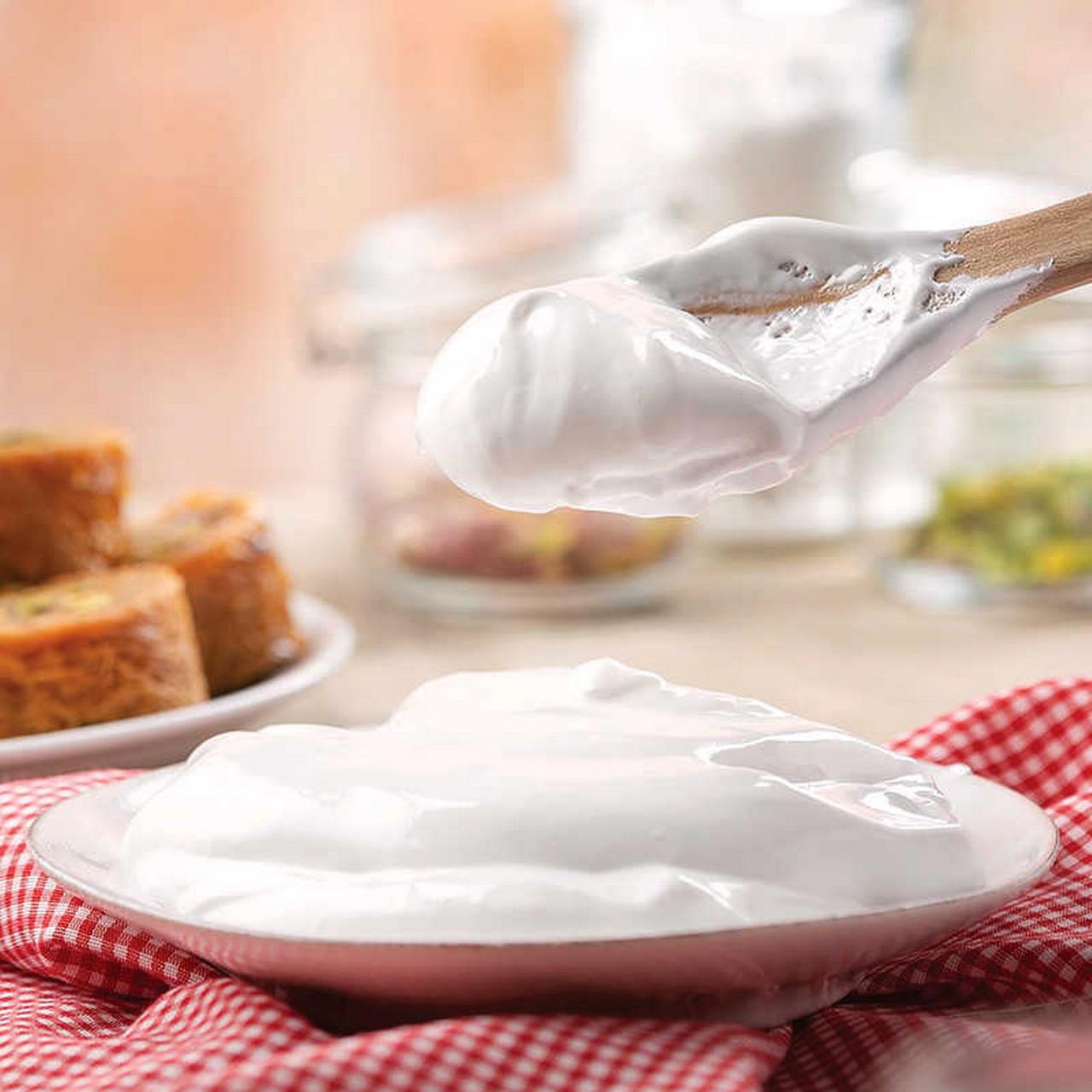
Aksaray Köpük Helva is a traditional sweet prepared using çöven herb (Gypsophila perfoliata L.), white sugar, corn syrup, and water. In production, çöven water is obtained by boiling the plant several times. The helva has a white color, a glossy and smooth surface, and a homogeneous, semi-fluid texture. Due to this consistency, it is also locally referred to as “bulama”.

Aksaray Köpük Helva (Aksaray Municipality)
Aksaray Köpük Helva is visually distinguished by its glossy smooth surface and white color. The syrup of the product must have a Brix value between 70 and 80; this measurement determines the texture and sweetness balance of the helva. Commonly consumed during the month of Ramadan, this helva carries a geographical indication tied to its origin.
The production of Aksaray Köpük Helva consists of three stages: preparation of çöven water, boiling of the syrup, and formation of the helva.
Approximately 80 grams of çöven herb is boiled each time with one liter of water. After boiling, the resulting extract is filtered and separated. This process is repeated three times. The collected çöven water is then boiled down until it reaches a volume of 200 milliliters, achieving the desired consistency for helva production.
White sugar, water, and citric acid are boiled together to produce a syrup. In a separate container, corn syrup is mixed with water and boiled. The çöven water is added to the sugar solution once it reaches the required temperature. The mixture is then cooled after reaching a specific temperature. The Brix level of the syrup must be between 70 and 80.
The prepared çöven water and syrup are combined in specified proportions and continuously stirred until the helva reaches the desired consistency. The resulting product can be stored at room temperature in appropriate packaging.

Aksaray Köpük Helva (Aksaray Municipality)
Aksaray Köpük Helva bears the designation “Aksaray Köpük Helva” and its official geographical indication emblem either on the product itself or its packaging. When this is not feasible on the product or packaging, the designation and emblem must be visibly displayed at the production facility. This practice confirms that the product is officially registered as a geographical indication and originates from Aksaray.
Aksaray Köpük Helva is a sweet with a history dating back to antiquity and has been produced in the region for many years. Traditionally, it is widely consumed during Ramadan. Its reputation and historical associations create a strong link with Aksaray Province and necessitate its production within the defined geographical boundaries.
The production of Aksaray Köpük Helva is monitored under the coordination of Aksaray Municipality. The monitoring team consists of experts from the municipality, the Provincial Directorate of Agriculture and Forestry, and the Provincial Directorate of Culture and Tourism. Regular inspections are conducted annually or as needed in response to complaints or requirements. During inspections, the suitability of the çöven water and syrup, the Brix value, the production method, the physical properties of the product, and the use of the geographical indication emblem are examined. The geographical indication of the product has been registered by Aksaray Municipality under Law No. 6769 on Industrial Property, and the municipality ensures the protection of these rights.
Aksaray Belediyesi. (2021, October 8). Aksaray’s Foam Halva Has Been Registered. Accessed August 22, 2025. https://aksaray.bel.tr/HaberDetay.aspx?icerikId=2034&AKSARAY%E2%80%99IN-KOPUK-HELVASI-TESCILLENDI
Turk Patent and Trademark Office. (2021, September 16). Aksaray Köpük Helva – Geographical Indications Portal. Accessed August 22, 2025: https://ci.turkpatent.gov.tr/cografi-isaretler/detay/2343
Turk Patent and Trademark Office. (2021, September 16). No: 891 – Certification Mark – Aksaray Köpük Helva. Accessed August 22, 2025: https://ci.turkpatent.gov.tr/Files/GeographicalSigns/2969351e-32a2-4768-8c20-0e1eaf55ecea.pdf

Registration Number | 891 | ||||||||
|---|---|---|---|---|---|---|---|---|---|
Registration Date | 16.09.2021 | ||||||||
Application Number | C2020/200 | ||||||||
Application Date | 17.07.2020 | ||||||||
Name of the Geographical Indication | Aksaray Köpük Helva | ||||||||
Product / Product Group(s) | Bakery and Confectionery Products Desserts Dough Products | ||||||||
Type of Geographical Indication | Mahreç Mark | ||||||||
Applicant/Registrant(s) | Aksaray Municipality | ||||||||
Distinguishing Characteristics
Ingredients
Production Method
Preparation of çöven water
Preparation of the syrup
Formation of the helva
Usage Method
Historical Background and Consumption
Monitoring and Registration