


This article was automatically translated from the original Turkish version.
+2 More
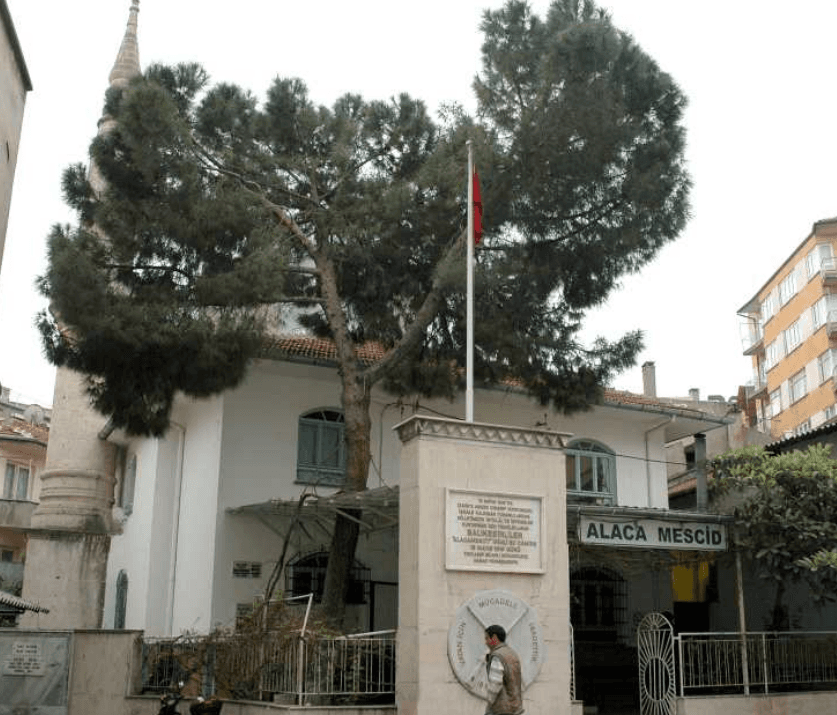
Alaca Mescit Camii (Balıkesir)
Name(s) | Alaca Mescit Camii | ||||||||
|---|---|---|---|---|---|---|---|---|---|
Other Name(s) | Alaca Mescit | ||||||||
Location | Karesi Türkiye Balıkesir | ||||||||
Last Restoration | 1911 | ||||||||
Founder(s) | Unknown | ||||||||
Architectural Style(s) | Ottoman Architecture – Neighborhood Mosque Type | ||||||||
Material(s) | Stone Wood | ||||||||
Usage Status | Active – Open for Worship | ||||||||
Registration Status | Registered Cultural Heritage (Ministry of Culture and Tourism of the Republic of Türkiye) | ||||||||
Notable Feature | Decision-Making Center in the Emergence of the Kuvayımilliye (1919) | ||||||||
Historical Significance | The Mosque Where the First Civil Resistance Meetings Were Held After the Occupation of İzmir | ||||||||
Related Events | Establishment of the Rejection of Annexation Commission, Alaca Mescit Meetings | ||||||||
Affiliated Institution | Ministry of Culture and Tourism of the Republic of Türkiye | ||||||||
Alaca Mescit, located within the boundaries of the central district of Balıkesir Province, is a significant Ottoman-era mosque notable for both its architectural features and historical role. Since its original inscription has not survived to the present day, the exact construction date and founder remain unknown. However, based on its architectural characteristics, it is regarded as one of the simpler examples of classical Ottoman neighborhood mosques. The mosque underwent a comprehensive restoration in 1911.
Alaca Mescit was constructed in a small-scale, neighborhood mosque form. Its plan is a near-square rectangle with a minimalist decorative approach. With its plain wall masonry and single minaret, it exhibits architectural similarities to other classical mosques in the region. The structure acquired its current appearance following the 1911 restoration.
Alaca Mescit rose to historical prominence not primarily for its architectural presence but for the pivotal role it played during the National Struggle years. Following the Greek occupation of İzmir on 15 May 1919, a mawlid ceremony held at Alaca Mescit on 18 May 1919 transformed into a public meeting in which the people of Balıkesir resolved to take action against the occupation.
After the mawlid, a gathering of civilians and intellectuals adopted the principle of “de facto rejection of annexation” and decided to establish the “Rejection of Annexation Committee.” This decision marked the first concrete step of resistance in Balıkesir; subsequent “Alaca Mescit Meetings” led to the resolution to engage in direct armed struggle against the occupations.
This civil mobilization formed the foundation for the Balıkesir Congresses and the organization of the Kuvayımilliye movement, establishing Balıkesir as one of the pioneering cities of the independence struggle across Anatolia.
The volunteers who gathered at Alaca Mescit were organized under the leadership of prominent figures of the era, including Mayor Keçecizâde Mehmet Emin Efendi, Karesi Deputy Mehmet Vehbi Bey, Hasan Basri Çantay Hoca, and Yırcalızâde Şükrü Efendi. Patriotic citizens from all parts of the city formed a structure known as the “41 Flag Men,” effectively initiating the city’s defense.
This movement is recorded in history as one of the first national resistance initiatives in Turkey based on popular will. The statement by Leblebici Raşit Efendi, voiced during the meetings—“The power to drive the enemy back lies at the tip of the barrel”—proved decisive in the decision to adopt armed resistance.
Alaca Mescit is not merely a place of worship but a symbol of the independent spirit shaped by popular will. The people who gathered after the mawlid made a unified decision to resist the occupations with a heightened national consciousness, transforming the mosque into one of the sacred sites of the National Struggle.
The resistance initiated here was grounded in the understanding that “it is the duty of every Muslim,” and the conviction that freedom could be preserved only through struggle became deeply rooted among the populace.
The resistance movement that began at Alaca Mescit laid the foundation for the first serious civil organization in Balıkesir and eventually evolved into the Balıkesir Congresses. For 14 months, Balıkesir fought Greek forces on four fronts and became one of the strongest centers of the Kuvayımilliye in Anatolia.
The people of Balıkesir entered the defense of the homeland without receiving direct orders from any external authority, emerging as pioneers of the independence struggle, encompassing both rural and urban populations.
Today, Alaca Mescit is not only a historical monument but also an educational space where awareness of cultural heritage is actively sustained. It is visited as part of initiatives such as the “Treasure Hunt in Historical Sites” program organized by the Balıkesir Science and Art Center, instilling a sense of national history in younger generations.
These activities demonstrate that Alaca Mescit continues to hold significance not merely as a relic of the past but as a living carrier of social identity and cultural heritage in the present day.
Aliağaoğlu, Alpaslan, and Yücel Yiğit. “Balıkesir’de Şehirsel Toponimi: Cadde Adları.” *Doğu Coğrafya Dergisi*, no. 30. https://dergipark.org.tr/en/pub/ataunidcd/issue/2458/31330
Balibey, Arda. Havran’a Bağlı (Çamdibi, Büyükdere ve Temaşalık) Köyleri Mezar Taşları. Master's thesis,Balıkesir Üniversitesi, 2024.
Balıkesir İl Directorate of Culture and Tourism. "Kuva-yi Milliye’de Alaca Mescit." Accessed April 25, 2025. https://balikesir.ktb.gov.tr/TR-65834/kuva-yi-milliye39de-alaca-mescit.html.
Günendi, Refik. Cumhuriyet’in İlanının İlk YıllarındaBalıkesir Üniversitesi. Master's thesis, Balıkesir University, 2019.
Karakuş, Ufuk. Milli Mücadele’de Edremit. Master's thesis,Balıkesir Üniversitesi, 2009.
Metin, Özcan. *Balıkesir’de Tasavvuf Kültürü: Uşşâkıyye Örneği*. Master's thesis,Balıkesir Üniversitesi, 2022.
Sarıtekin, Tekin. *Balıkesir Üniversitesi Mahallesi Kazım Özalp ve Ulus Sokakları Geleneksel Konutlarının Belgelenmesi ve Koruma Önerileri Geliştirilmesi*. Master's thesis, Balıkesir University, 2023. https://dspace.balikesir.edu.tr/xmlui/handle/20.500.12462/13110
Yıldız, Mahir. *61. Fırka Komutanı Kazım Özalp’in Balıkesir’deki Faaliyetleri (15 Mayıs 1919–30 Haziran 1920)*. Master's thesis,Balıkesir Üniversitesi, 2009. https://dspace.balikesir.edu.tr/xmlui/handle/20.500.12462/2026
Çakı, Fahri. "Aidiyet ve Mekân Olarak Sokaklar: Balıkesir Örnek Olayı Çerçevesinde Bir Tipoloji Önerisi." Çekmece İZÜ Sosyal Bilimler Dergisi 5, no. 10–11 (2017): 25–54.
İnci, İbrahim. "Milli Mücadele Yıllarında İzmir-Balıkesir Ekseninde Oluşan Kongre Siyasal İktidarlarının Milli Egemenliğe Dayalı Demokratik Yapıları." MCBÜ Sosyal Bilimler Dergisi 15, no. 1 (2017): 450–460.

Alaca Mescit Camii (Balıkesir)
Name(s) | Alaca Mescit Camii | ||||||||
|---|---|---|---|---|---|---|---|---|---|
Other Name(s) | Alaca Mescit | ||||||||
Location | Karesi Türkiye Balıkesir | ||||||||
Last Restoration | 1911 | ||||||||
Founder(s) | Unknown | ||||||||
Architectural Style(s) | Ottoman Architecture – Neighborhood Mosque Type | ||||||||
Material(s) | Stone Wood | ||||||||
Usage Status | Active – Open for Worship | ||||||||
Registration Status | Registered Cultural Heritage (Ministry of Culture and Tourism of the Republic of Türkiye) | ||||||||
Notable Feature | Decision-Making Center in the Emergence of the Kuvayımilliye (1919) | ||||||||
Historical Significance | The Mosque Where the First Civil Resistance Meetings Were Held After the Occupation of İzmir | ||||||||
Related Events | Establishment of the Rejection of Annexation Commission, Alaca Mescit Meetings | ||||||||
Affiliated Institution | Ministry of Culture and Tourism of the Republic of Türkiye | ||||||||
No Discussion Added Yet
Start discussion for "Alaca Mescit Camii (Balıkesir)" article
Architectural Features
Historical Role and the National Struggle
The 41 Flag Men and Pioneers of Resistance
Symbol of the National Spirit
Balıkesir and the Kuvayımilliye
Preservation of Cultural Heritage and Its Role in Education