


This article was automatically translated from the original Turkish version.
+1 More
Location | Serik Türkiye Antalya | ||||||||
|---|---|---|---|---|---|---|---|---|---|
River It Crosses | Köprüpazar Çayı | ||||||||
Year of Construction | 1239–1240 | ||||||||
Length(s) | Approximately 225 Metres | ||||||||
Number of Arches | 7 | ||||||||
Construction Technique | Devşirme Roma Blokları, Selçuklu Taş İşçiliği | ||||||||
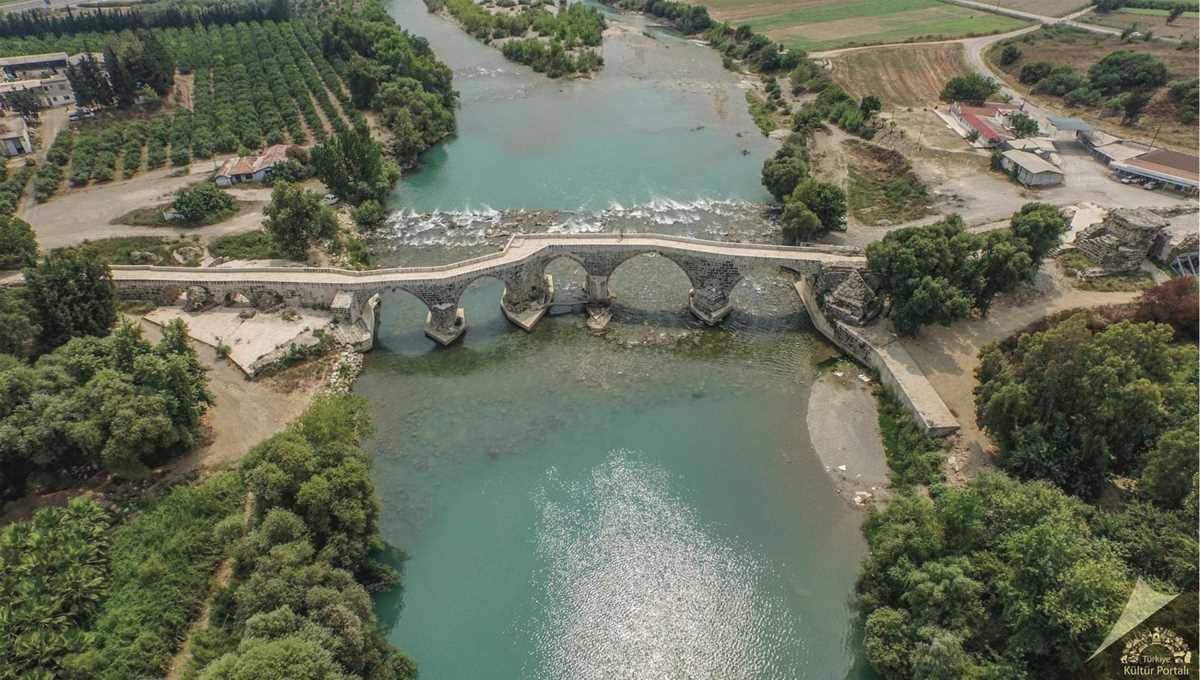
Alaeddin Keykubad Bridge is a 13th-century Anatolian Seljuk bridge located within the boundaries of the Serik district of Antalya, approximately 2 kilometers south of the ancient city of Aspendos, spanning the Köprüpazar Stream (ancient Eurymedon River). In literature, it is also known as the “Köprüpazar Bridge,” “Köprü Çayı Bridge,” and “Belkıs Bridge.” Due to the incorporation of structural elements from both the Roman and Seljuk periods, it exhibits a multi-layered historical character.
The bridge is strategically situated south of Aspendos, one of Pamphylia’s major port cities, over the Eurymedon River. This region has been a critical transit and communication route throughout history due to its position at the intersection of east-west and north-south land and water routes since antiquity. The bridge, as in antiquity, remained a fundamental component of the region’s logistical infrastructure during the Seljuk period.
Evidence from surviving foundations and architectural traces indicates that a Roman-era bridge once stood on the same site. It is believed that this bridge was destroyed by a natural disaster during the Byzantine period. However, some of its piers and foundations remained intact. The Seljuk bridge was constructed directly upon these surviving Roman piers, thereby integrating the earlier engineering heritage into the new structure.
The bridge’s foundation inscription is located on the parapet of the first arch’s northwestern pier. Although the inscription has suffered damage over time, epigraphic analysis of its remaining fragments has established that the bridge was built during the reign of Sultan II. Ghiyath al-Din Kaykhusraw, between 1239 and 1240. The inscription refers to the sultan using traditional Islamic titles and emphasizes that the structure was erected as part of his commitment to justice and public works.
The bridge is approximately 225 meters long and consists of seven arches. The spans and heights of the arches vary, reflecting adaptation to the existing topography and the preservation of the earlier Roman piers. The structure was built along a curved alignment, a design choice favored in 13th-century Seljuk bridge architecture for both aesthetic and structural advantages.
In terms of materials, the bridge incorporates reused Roman blocks alongside new stonework. Masonry walls combine finely cut stones with roughly hewn blocks. In particular, the eastern piers show a dominant use of ancient reused stone elements.

Alaeddin Keykubad Bridge (AA)
The structure has maintained its function over time and has undergone various repairs in different periods. In 2009, a comprehensive restoration project carried out by the Ministry of Culture and Tourism strengthened the bridge’s structural integrity while ensuring interventions remained consistent with its original materials and design. Today, the bridge is open to both vehicular and pedestrian traffic and is protected as a cultural heritage asset.

Aerial View of Alaeddin Keykubad Bridge (AA)
The Alaeddin Keykubad Bridge is valuable not only as an example of Anatolian Seljuk architecture but also as a tangible embodiment of engineering knowledge transmitted from Roman to Seljuk times. Its construction atop the remains of the ancient Roman bridge serves as a model for the reuse and continuity of cultural heritage.
The Alaeddin Keykubad Bridge was constructed within the framework of the political and public works policies of Sultan II. Ghiyath al-Din Kaykhusraw and represents structures that symbolized Seljuk state authority. Other Seljuk bridges were similarly commissioned by the state or local emirs and typically located along strategic routes.
The bridge is modest in decoration, identifying itself solely through its foundation inscription. This is common among Seljuk bridges; some feature more elaborate ornamentation and additional inscriptions.
Its location near Aspendos ensured the continuity of historic trade and military routes, making it significant for commerce and military mobility. This aligns with the common function of all Seljuk bridges.
Alaeddin Keykubad Bridge is not merely an architectural monument but a convergence point of historical processes, cultural interactions, and state policies. By reusing Roman infrastructure and reflecting Seljuk engineering traditions, it stands as one of the key examples documenting the continuity and transformation of bridge architecture in Anatolia.
Bilici, Kenan. “Aspendos Antik Kenti Güneyindeki Selçuklu Dönemi Köprüsü Üzerine Bazı Gözlemler.” *Adalya* 5 (2001–2002): 1–15. Accessed June 20, 2025. https://akmedmedia.ku.edu.tr/Adalya/Adalya_2001_2002/10._Kenan_Bilici.pdf
Güçlü, Muhammet. "XX. Yüzyılın Başlarında Teke (Antalya) Sancağı’nda Dağılan Bir Pazar: Köprü Pazarı." *Selçuk Üniversitesi Selçuklu Araştırmaları Dergisi* 10 (2019): 79–106. Accessed June 20, 2025. https://dergipark.org.tr/tr/download/article-file/763437
“Tarihin En Görkemli Tanığı Alaeddin Keykubad Köprüsü.” Anadolu Ajansı. Accessed June 20, 2025. https://www.aa.com.tr/tr/kultur-sanat/tarihin-en-gorkemli-tanigi-alaeddin-keykubad-koprusu/1368984
“Tarihin Tanıkları Köprüler.” *Kültür Portalı*, T.C. Kültür ve Turizm Bakanlığı. Accessed June 20, 2025. https://www.kulturportali.gov.tr/portal/tarihin-taniklari-kopruler

Location | Serik Türkiye Antalya | ||||||||
|---|---|---|---|---|---|---|---|---|---|
River It Crosses | Köprüpazar Çayı | ||||||||
Year of Construction | 1239–1240 | ||||||||
Length(s) | Approximately 225 Metres | ||||||||
Number of Arches | 7 | ||||||||
Construction Technique | Devşirme Roma Blokları, Selçuklu Taş İşçiliği | ||||||||
No Discussion Added Yet
Start discussion for "Alaeddin Keykubad Bridge" article
History
Roman Infrastructure and the Earlier Bridge
Seljuk Construction
Architectural Plan and Construction Techniques
Conservation Status and Restoration Process
Historical Continuity and Significance
Comparison with Other Seljuk Bridges
Historical Context
Decoration and Inscriptions
Transportation and Strategic Function