

This article was automatically translated from the original Turkish version.
+2 More
Location | Antalya / Türkiye | ||||||||
|---|---|---|---|---|---|---|---|---|---|
Period(s) | 117–138 CE Roman Empire | ||||||||
Function(s) | Monumental city gate | ||||||||
Width | 4.15 m | ||||||||
Height(s) | 6.18 m | ||||||||
Architectural Feature(s) | structure with four piers and eight columns (columns carry the architrave) ceiling covered with coffered blocks Barrel-vaulted triple-arched passage | ||||||||
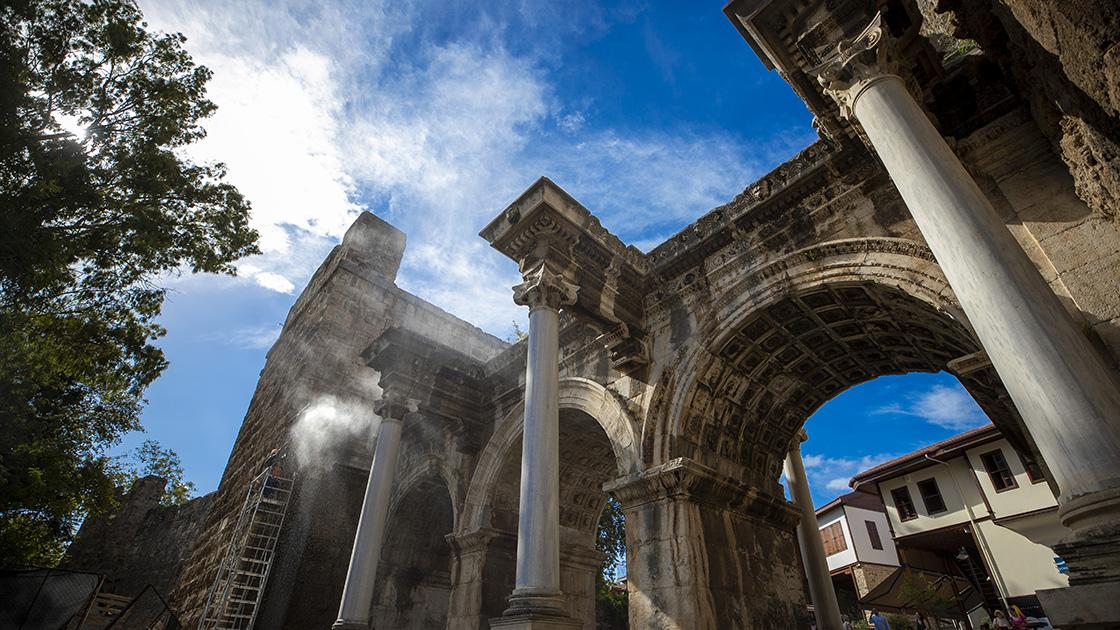
The Hadrianus Gate is a monumental entrance structure built in commemoration of the visit of the Roman Emperor Hadrian (r. 117–138 CE) to Attaleia (Antalya). Located in the historic center of present-day Antalya, within the ancient city wall system, this structure holds significance both for its architectural features and its historical context. Known locally as “Üçkapılar,” the gate is distinguished by elements characteristic of Roman architecture and has survived to the present day thanks to various restoration and conservation efforts throughout its history.

Hadrianus Gate (AA)
The Hadrianus Gate is a triple-arched travertine structure situated between two towers, largely preserving its original form. All three openings are of equal size and are covered by barrel vaults composed of coffered blocks. These blocks are raised on pedestals and rest on four piers, with the central vault being narrower than the side ones. On both facades of the gate, at the level of the piers and 1.05 meters in front of them, stand eight columns. These columns support architraves—the horizontal beams directly above the columns.
The structure is 4.15 meters wide and 6.18 meters high. The architrave above the openings and between the arches is decorated with egg-and-dart, bead-and-reel, acanthus, and tooth motifs. The bronze-lettered inscription dedicated to Hadrianus, once located above the gate, no longer survives; however, some of its letters are exhibited at the Ashmolean Museum in Oxford.

Hadrianus Gate (AA)
Although its architectural style suggests a later phase, the gate is believed to have been constructed before the 120s CE, in connection with Hadrianus’s eastern campaign (121–125 CE). While reminiscent of monumental arches in Rome, the gate also served as a city gate due to its position within the city wall system and its role in controlling access to the urban center.
On either side of the gate stand two rectangular towers. The southern tower, based on its craftsmanship, is dated to the Roman Imperial period. Over time, its upper section suffered damage and was repaired using rubble stone and brick, with battlements added. The northern tower was rebuilt during the reign of the Seljuk Sultan Alaaddin Keykubad, as indicated by an inscription dated 617 AH (1220 CE).
The Hadrianus Gate has been renovated and repaired multiple times throughout its history. After a collapse occurred during excavations at its front in 1882, temporary columns were installed for support. The gate acquired its current appearance following a comprehensive restoration carried out in 1958.
AKMED. "Hadrianus Takı (Hadrian Kapısı, Üçkapılar, Çiçekli Kapı)." Koç Üniversitesi Suna & İnan Kıraç Akdeniz Medeniyetleri Araştırma Merkezi. Accessed June 28, 2025. https://akmed.ku.edu.tr/inventory/hadrianus-taki/
Anadolu Ajansı. "Antalya’nın Simgelerinden Hadrianus Kapısı’nın Desenleri Daha Görünür Olacak." Accessed June 28, 2025. https://www.aa.com.tr/tr/kultur/antalyanin-simgelerinden-hadrianus-kapisinin-desenleri-daha-gorunur-olacak/2697917

Location | Antalya / Türkiye | ||||||||
|---|---|---|---|---|---|---|---|---|---|
Period(s) | 117–138 CE Roman Empire | ||||||||
Function(s) | Monumental city gate | ||||||||
Width | 4.15 m | ||||||||
Height(s) | 6.18 m | ||||||||
Architectural Feature(s) | structure with four piers and eight columns (columns carry the architrave) ceiling covered with coffered blocks Barrel-vaulted triple-arched passage | ||||||||
Architectural Features
Dating and Function
Restoration and Conservation Efforts