

This article was automatically translated from the original Turkish version.
+2 More
Length(s) | Approximately 116 m (south long side) | ||||||||
|---|---|---|---|---|---|---|---|---|---|
Plan | Pseudodipteros | ||||||||
Period(s) | Roman Imperial Period (1st–2nd century AD) | ||||||||
Location | Kyzikos Ancient City (Balıkesir) | ||||||||
Column Layout | 8 × 15 | ||||||||
Arrangement | Corinth | ||||||||
Related Emperor | Hadrian | ||||||||
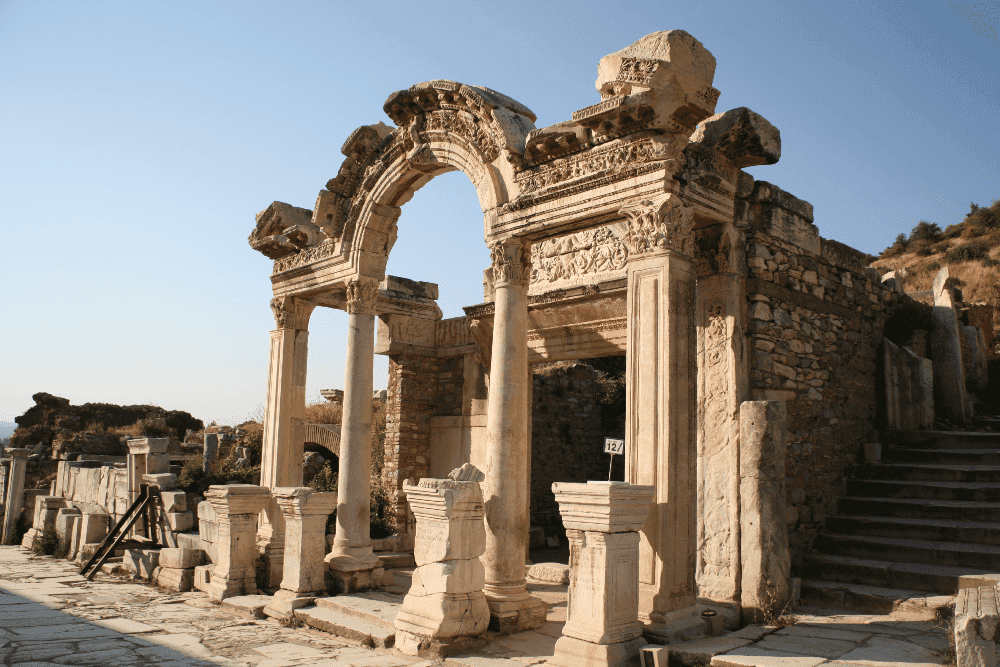
Temple of Hadrian is a monumental temple from the Roman Imperial period located within the ancient city of Cyzicus, within the boundaries of the Erdek district of Balıkesir Province. Constructed in the Corinthian order, it is one of the most notable architectural monuments of the city.

Excavation work at the Temple of Hadrian (AA)
Construction of the temple likely began in the first century CE. According to ancient sources, the building could not be completed quickly due to financial difficulties, but work resumed after an earthquake in 123 CE, following financial support provided by Emperor Hadrian during his visit to the city. This imperial patronage accelerated the completion of the temple.
It is stated that the structure was originally dedicated to Zeus but was also dedicated to Hadrian due to his support. Another earthquake during the Antonine period caused further damage, prompting additional restoration efforts.
After a major earthquake in the mid-sixth century, the structure was largely destroyed. As Cyzicus lost its importance during the Eastern Roman period, the temple was abandoned. During the Middle Ages and afterward, the building materials were systematically quarried for lime production, leading to significant damage to the remains.
The Temple of Hadrian was built atop a series of seven east-west oriented galleries. The pseudodipteral structure, designed in the Corinthian order, originally featured 8 × 15 columns. Ancient authors note that the temple had three stories and served as a landmark for sailors due to its imposing size.
There are differing opinions regarding the dimensions of the stylobate, but excavation data indicate that the southern long side at the eutyntheria level measures approximately 116 meters. The naos of the temple rests upon vaulted galleries. Ventilation openings and the galleries are among the key architectural elements of the temple’s substructure.【1】
Numerous architectural fragments belonging to Corinthian capitals have been recovered during excavations. However, due to the site’s prolonged use as a lime kiln, most of the decorative elements were found in small, fragmented pieces.
Travelers who visited Cyzicus in the 15th century recorded that columns of the temple still stood despite the conditions of the time. The accounts of Cyriacus of Ancona provide particularly valuable information on the temple’s condition in the late Middle Ages. It is noted that during his first visit, many columns remained upright, but by his second visit, significant destruction had occurred.【2】

Excavation work at the Temple of Hadrian (AA)
The first systematic excavations at Cyzicus were conducted between 1989 and 1997, and a second phase of excavations resumed in 2006. Work has focused particularly on the temple area.
Medieval burials, pithoi, and amphorae have been uncovered during excavations. Additionally, lime kilns dating to the Middle Ages and the Republican period have been identified around the temple. These findings demonstrate that the structure was used for centuries as a source of building materials.
The vaulted galleries supporting the temple, ventilation openings, and substructure system have been more thoroughly documented through excavation. While there is scholarly disagreement regarding the number of columns, some researchers accept that there were eight columns on the eastern facade.
Today, the temple’s remains lie largely buried beneath soil and rubble, appearing as an elevated ridge oriented east-west. Excavation and documentation efforts are ongoing, with continued research focused on architectural decorations and structural elements.
Anadolu Ajansı. "Hadrian Tapınağı Kazısında Arkeologlar Parçaları Birleştirerek Geçmişe Işık Tutuyor." Accessed February 22, 2026. https://www.aa.com.tr/tr/kultur-sanat/hadrian-tapinagi-kazisinda-arkeologlar-parcalari-birlestirerek-gecmise-isik-tutuyor/1960556
Erdem, Ayşe. “Kyzikos’ta Ele Geçen Geç Roma Amphoraları Üzerine İlk İzlenimler.” Anatolian Archaeology 2 (September 2023): 94–116. Accessed February 22, 2026. https://dergipark.org.tr/en/download/article-file/3283448
Koçhan, Nurettin, and Ahmet Tercanlıoğlu. “15. Yüzyıl Seyyahlarının Yazmalarında Kyzikos Hadrian Tapınağı.” Route Educational and Social Science Journal 4, no. 8 (2017): 205–217. Accessed February 22, 2026. https://www.ressjournal.com/Makaleler/2029670942_16%20Nurettin%20KO%C3%87HAN.pdf
Koçhan, Nurettin, and Korkmaz Meral. “Kyzikos’ta Yapılan Kazı ve Sondajlarla İlgili Bir Değerlendirme.” Atatürk Üniversitesi Güzel Sanatlar Enstitüsü Dergisi 35 (2015): 60–77. Accessed February 22, 2026. https://dergipark.org.tr/en/download/article-file/711870
Koçhan, Nurettin. “Kyzikos 1989 Kazısı, Hadrian Tapınağı Mimari Bezemeleri.” Accessed February 22, 2026. https://dergipark.org.tr/en/download/article-file/2158662
Selçuk Belediyesi. "Hadrian Tapınağı." Accessed February 22, 2026. https://www.selcuk.bel.tr/hadrian-tapinagi
[1]
Nurettin Koçhan and Korkmaz Meral, “Kyzikos’ta Yapılan Kazı ve Sondajlarla İlgili Bir Değerlendirme,” Atatürk Üniversitesi Güzel Sanatlar Enstitüsü Dergisi 35 (2015): 62–63; also see Nurettin Koçhan, “Kyzikos 1989 Kazısı, Hadrian Tapınağı Mimari Bezemeleri,” 120–121. Access date: 22 Şubar 2026. https://dergipark.org.tr/en/download/article-file/711870
[2]
Nurettin Koçhan and Ahmet Tercanlıoğlu, “15. Yüzyıl Seyyahlarının Yazmalarında Kyzikos Hadrian Tapınağı,” Route Educational and Social Science Journal 4, no. 8 (2017): 208–210. Access date: 22 February 2026. https://dergipark.org.tr/en/download/article-file/711870


Length(s) | Approximately 116 m (south long side) | ||||||||
|---|---|---|---|---|---|---|---|---|---|
Plan | Pseudodipteros | ||||||||
Period(s) | Roman Imperial Period (1st–2nd century AD) | ||||||||
Location | Kyzikos Ancient City (Balıkesir) | ||||||||
Column Layout | 8 × 15 | ||||||||
Arrangement | Corinth | ||||||||
Related Emperor | Hadrian | ||||||||
History
Architectural Features
Travelers’ Accounts
Excavation Work
Current Condition