

This article was automatically translated from the original Turkish version.
+2 More
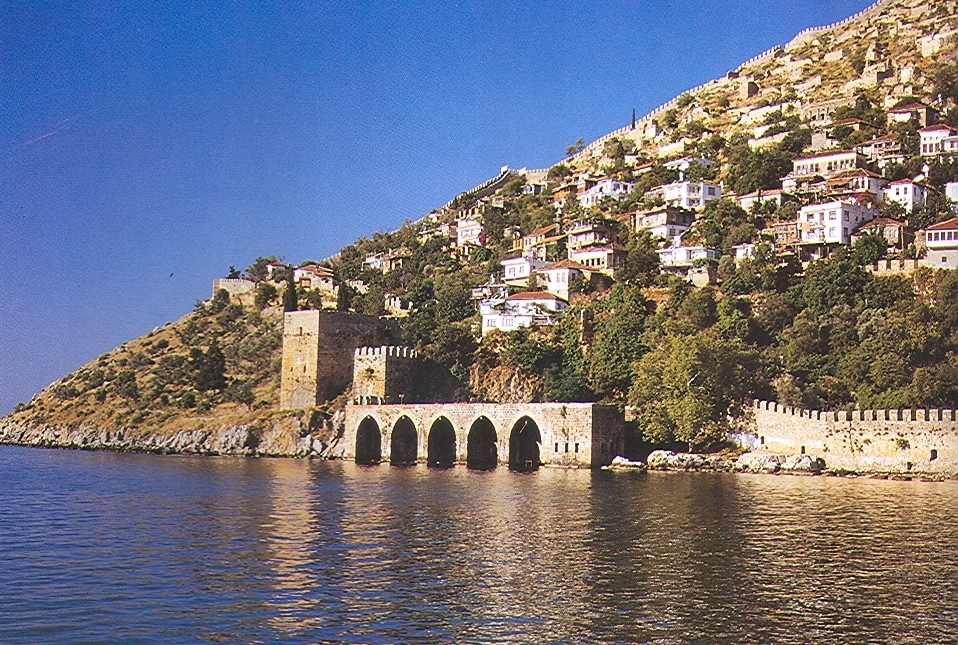
Alanya Shipyard, Antalya’s Alanya district, is an important historical structure located within the fortress and harbor fabric, associated with Seljuk maritime activities. Its position facing the Mediterranean Sea, five-bay layout, and original architectural arrangement make it a prime example of pre-Ottoman naval infrastructure serving both military and shipbuilding and maintenance functions. It is noted as the first shipyard built by the Seljuks on the Mediterranean and the only surviving Seljuk shipyard in the world.【1】

Alanya Tersanesi (Alanya Belediyesi)
The Alanya Shipyard is situated where the defensive wall system of Alanya Castle meets the sea, facing the old harbor. Access to the structure is via a narrow, round-arched entrance gate from the former harbor to the northwest. Approximately four meters above this gate, a five-line relief inscription praises I. Alaaddin Keykubad as “sultan of the land and the two seas”; between two emblems on the inscription, the sultan’s coat of arms is visible.
To the right of the entrance gate is a small mosque arranged as a projecting chamber; to the left is a five-windowed chancery used by shipyard officials for administrative purposes. The shipyard, with its direct contact with the sea and its layout following the natural rock formation, forms an integral part of a unified naval and military complex that includes the harbor, towers, and fortification walls.
The shipyard was constructed in 1228 by the Anatolian Seljuk sultan I. Alaaddin Keykubad. The same sultan also commissioned the Sinop Shipyard on the Black Sea coast, a fact that led to him being titled “sultan of the two seas”; the Alanya Shipyard is one of the tangible manifestations of this title in the Mediterranean.【2】
During the Seljuk period, Alanya became one of the principal centers for naval operations and maritime trade. The shipyard was planned as a permanent facility for the construction, maintenance, and winter berthing of warships. It functioned as an infrastructure unit supporting Seljuk naval power in the Mediterranean through engineering, storage, and equipment preparation processes.

Alanya Tersanesi Mimari Yapı (Alanya Belediyesi)
The Alanya Shipyard is a structure composed of five barrel-vaulted bays aligned parallel to the coast. The shipyard measures approximately 57 meters in length and 40 meters in depth. Each bay is about 7.70 meters wide; their lengths vary between 43 meters and 32 meters.
Walls are constructed of cut stone, while arches and vaults are built of brick. The openings in the vaults serve functional purposes: they allow daylight into the interior and facilitate the escape of smoke, providing natural ventilation and illumination. On the landward side of the bays, where seawater does not fully penetrate, the floor consists partly of gravel and partly of natural rock surface. On the landward side of the third bay, a freshwater well is located, representing a crucial element in meeting the water needs of shipbuilding and repair activities.
The structure was built at different levels to maximize the use of natural daylight, with a design that minimized rock excavation. Adjacent to the shipyard, a storage chamber carved into the rock receives light through an opening in the ceiling, forming a secure enclosed storage area that enhances its functionality.
Among the decorative elements of the shipyard, the Zülfikar frescoes in the mosque chamber to the right of the entrance gate are particularly notable. During conservation and restoration work carried out as part of the Maritime and Ship Museum project, two opposing frescoes depicting Zülfikar were uncovered on the walls of this mosque. The Zülfikar motif is emphasized through wall paintings within the mosque interior, thereby positioning the shipyard not only as a testament to Seljuk maritime heritage but also as a structure imbued with symbolic and faith-based significance.
Throughout its period of construction and use, the Alanya Shipyard served for the construction, maintenance, and winter berthing of both warships and merchant vessels. It is noted that the shipyard was not merely a facility for shipbuilding or seasonal mooring; it also included ironworks for repairs, production of sails and ship fittings, and administrative and storage areas, making it a permanent shipyard. Permanent shipyards are said to have served two primary purposes: enabling the construction of large vessels during winter and providing shelter for inactive ships.
Alanya’s geographical position, its strategic importance in the Mediterranean, and the integrated planning of the shipyard with towers and defensive structures within a walled harbor area demonstrate that the site was designed as a secure naval base for both military and commercial purposes.【3】 Thus, during the Seljuk period, the shipyard fulfilled a central role in supporting both maritime trade and naval operations.
Today, the Alanya Shipyard has been restored and preserved as a protected cultural heritage site, and it now functions as a museum. Through collaborative efforts by the Alanya Municipality, the Ministry of Culture and Tourism, and the Alanya Museum, the “Maritime and Ship Museum” project has been implemented within the structure.
The Alanya Shipyard Maritime and Ship Museum displays various artifacts from the medieval period, including cranes and trebuchets, battering ram-like siege equipment, tools used in boat construction, and pazar kayığı boats used for transport during the Ottoman period. Additionally, replicas illustrating the construction stages of a “çekevele”-type vessel from the Ottoman era have been incorporated into the museum’s exhibits.
Through this arrangement, the Alanya Shipyard serves as a museum space that presents the Seljuk maritime heritage alongside the structure’s original architectural fabric, transforming into a cultural site that concretely embodies both Alanya’s historical identity and the maritime history of the Mediterranean.
[1]
360 Araştırma Grubu, “ALANYA TERSANESİ DENİZCİLİK VE GEMİCİLİK MÜZESİ,” 360 Derece, Erişim 16 Ocak 2026, https://360derece.info/alanya-tersanesi/
[2]
Alanya Belediyesi, “Tersane,” alanya.bel.tr, Erişim 16 Ocak 2026, https://www.alanya.bel.tr/S/427/Tersane
[3]
Alanya Belediyesi, “Tersane,” alanya.bel.tr, Erişim 16 Ocak 2026, https://www.alanya.bel.tr/S/427/Tersane

Location and General Features
Historical Context
Architectural and Structural Features
Zülfikar Frescoes and Decorative Program
Use and Function
Current Status